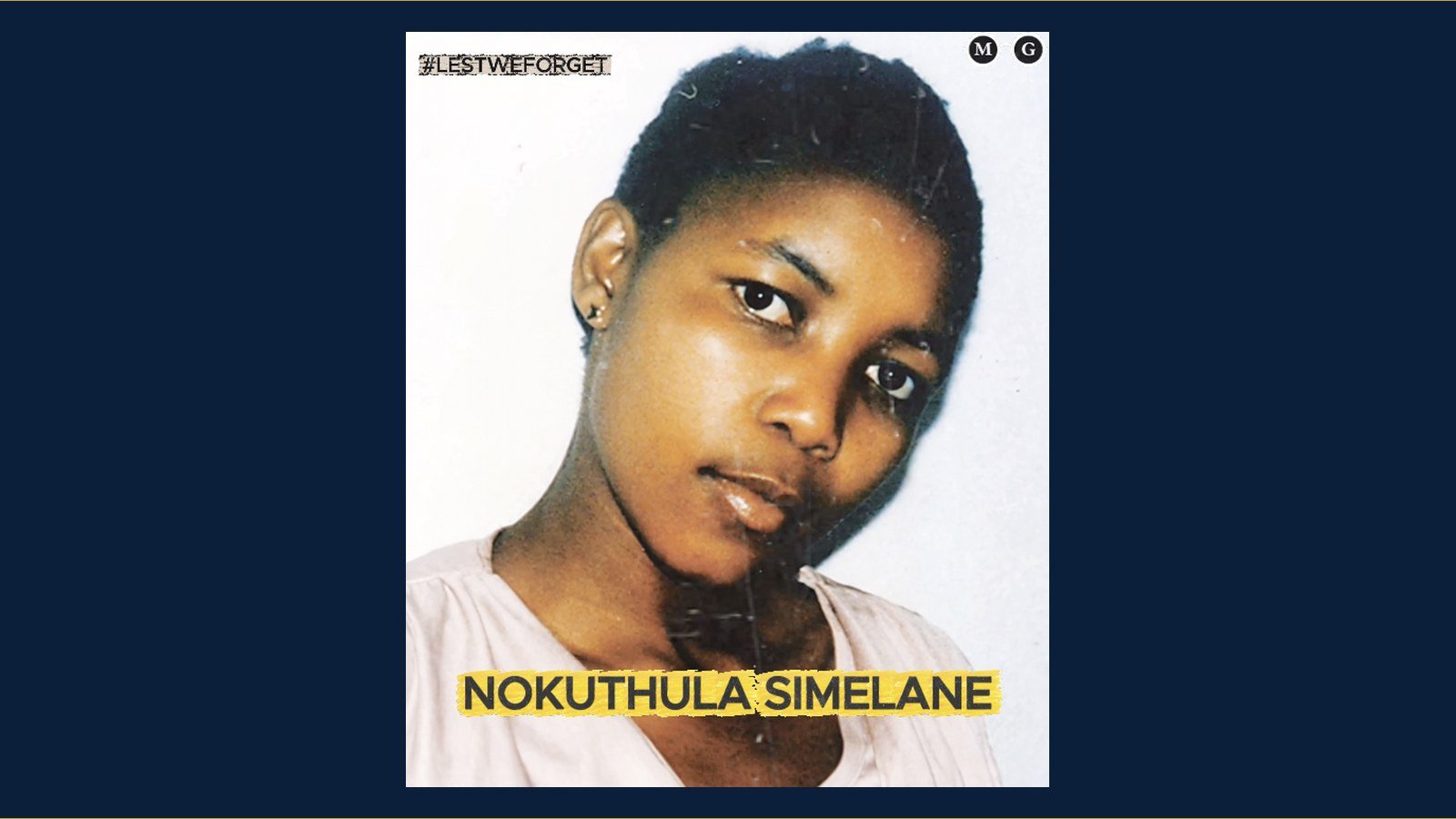
Nokuthula Simelane, photographed before her abduction in September 1983. Image: Simelane family / Office of Dr Malusi Gigaba
“Nokuthula Simelane 2026 | Lest We Forget” – published on Dr Malusi Gigaba’s channel, 6 September 2026. The song is Senzeni Na, sung by the University of Pretoria Camerata. Video: Office of Dr Malusi Gigaba
Heritage Month opened on Tuesday. The theme the government has set for it this year asks South Africa to reimagine our heritage institutions for a new era, and it means the museums and archives where a nation keeps what it knows about itself.
So consider what this country has kept of Nokuthula Simelane.
Yesterday would have been her birthday.
We say "would have been" and we say it carefully. The written records give her birth year as 1960. The family’s date is 5 September 1959, which makes this weekend her sixty-seventh birthday, and which would make her twenty-four when they took her rather than the twenty-three the record has always carried. Forty-three years on, this country cannot say with certainty how old Nokuthula Simelane was on the day it lost her.
That is where we should begin, because it tells you what kind of case this is. Not a mystery. An absence, and a long official comfort with the absence. And it puts a question to a month about heritage institutions: what is an archive worth if the country keeping it cannot say how old a woman was, or where she is buried?
President Ramaphosa said on Thursday: "We will not rest until she can be laid to rest and until those responsible are held to account." He said the family "deserves to know the specific place where their daughter lies". Those are the right words, and we do not doubt them. We would ask a different question of them.
What has to happen on a Monday morning, in an office, on a docket, for a sentence like that to become true?
Because the difficulty in this case has never been that the country did not know. It is that the country knew, and stopped anyway. And every time it started again, this family had to make it.
The first-born
She was the first-born child of Mathew and Ernestina Simelane, and she grew up near Bethal, in what is now Mpumalanga Province.
By September 1983 she had just completed a degree in administration at the University of Swaziland. She had not yet graduated. The gown was still ahead of her – and the reason she gave for the trip that killed her was that she was going to buy clothes for the ceremony.
Her other work was that she carried things across a border. She had joined uMkhonto weSizwe the year before and served as a courier for one of its units within the Transvaal Urban Machinery, moving between Swaziland and South Africa. She was not a commander. She drafted no strategy and commanded no unit, which describes almost everyone who actually made the liberation of this country happen.
There is a detail in her commander’s evidence to the Truth and Reconciliation Commission that should be read slowly. Of Nokuthula, he testified:
"She was specifically never given any information concerning the membership of the unit or in regard to operational issues such as the location of arms caches or targets for attack."
Hold that against what came next. They took her, and they held her, and they tortured her for weeks, to extract information that her own organisation had deliberately withheld from her. She could not have bought her way out with the truth. There was no truth in her to buy it with.
What was done
On or about 10 September 1983 she went to the basement of the Carlton Centre in Johannesburg to meet a man she believed was a comrade. He was Norman Mkhonza, an askari – a captured MK member turned by the police. Members of the Security Branch attached to the intelligence unit at Soweto were waiting.
They took her to the Custodum Flats in Norwood, Johannesburg, where the Security Police kept an operational office in the cleaner’s quarters, and held her about a week. Then they moved her to a secluded farm in the district of Northam and kept her there for four or five weeks.
The Amnesty Committee’s own finding on what happened at that farm needs no paraphrase:
"Due to the prolonged and sustained assaults, Ms Simelane’s physical condition deteriorated to the extent that she was hardly recognisable and could barely walk."
The last anyone saw of her, on the record, she was lying in the boot of a car with her hands and feet cuffed.
Two stories, and what the Commission did with them
At the amnesty hearings in Johannesburg in May 1999, the men told two irreconcilable stories.
Coetzee, Pretorius and Mong said she had broken after a week, agreed to work as an agent, been registered as an occasional source, and been driven back to Swaziland – where she simply failed to keep her appointments and was never heard of again. Two of their own colleagues, Veyi and Selamolela, said the opposite: that the torture never stopped, that she never cooperated, that by the end she was barely recognisable.
The Amnesty Committee believed the second group. It found their evidence basically truthful and the first group’s evasive and inherently improbable.
On 23 May 2001 it ruled, and it ruled differently on each count. On the abduction, every applicant was granted amnesty except Veyi, who had taken no part in that. On the torture it divided them: Veyi and Selamolela were granted amnesty, and Coetzee, Pretorius and Mong were refused it, on the ground that they had "failed to make a full disclosure of all relevant facts".
And here is the part that has sat in the open for twenty-five years.
The applications covered her abduction, her detention and her torture. They did not cover her death. No man in that room ever asked to be forgiven for killing Nokuthula Simelane. And the Committee, having no application before it on the point, wrote this:
"It is not necessary for the purpose of this matter to make a definitive finding on the eventual fate of Ms Simelane."
Read that again. The body established to tell this country the truth about its disappeared recorded, in the matter of a woman last seen cuffed in the boot of a policeman’s car, that determining her fate was not necessary.
Amnesty was the whole bargain of the transition: tell the truth about what you did, and the law will let you go. On her killing, that bargain was never struck – which means it was never available to anyone as a defence. The door was open in 2001. A court had to say so again in 2008. It is open this morning.
This is not a story about a country that could not find a legal route to justice. The route was found, mapped and left standing. Somebody chose not to walk down it.
The second disappearance
Here is where the argument becomes uncomfortable, and here is where it becomes ours.
A docket existed. In 2003 the National Prosecuting Authority set up its Priority Crimes Litigation Unit and this was among the cases it took. The Daily Maverick, reporting the evidence of the investigator Andrew Leask to the current judicial commission, records that the case against Coetzee and Pretorius had been fully prepared for trial before the process was abruptly halted.
Fully prepared. Then nothing.
Advocate Silas Ramaite SC, a senior prosecutor at the time, has testified that the then Minister of Justice, Brigitte Mabandla, telephoned him in 2004 to tell him not to proceed with the TRC prosecutions, and that a moratorium was placed on them while an outside structure was assembled to handle the cases. He testified that he was surprised and unhappy at the involvement of the executive. Under cross-examination he accepted that no written instruction was ever produced – in his words, "the letter never appeared". The commission has also heard evidence that the then National Commissioner of Police, Jackie Selebi, accused the prosecuting authority of targeting ANC leaders, withdrew detectives from TRC investigations, and had around four hundred TRC dockets transferred to the Scorpions.
All of that is testimony before a sitting judicial commission. It is not findings, it must be read as testimony, and Ms Mabandla has not answered it publicly. She has been summonsed to give evidence and is entitled to be heard before anyone concludes anything about her. Justice Khampepe and her colleagues will make the findings, and they must be allowed to make them without anyone writing their report for them.
But the shape of the thing is not in dispute, because the families lived inside it. Nokuthula Simelane was disappeared once by a state that regarded her as an enemy. She was disappeared a second time from a working docket, under the state she had fought to bring into being. The first disappearance we understand. The second one this country has never been made to explain.
Three times to court
The family did not wait quietly. In 2007 they went to court, together with the widows of the Cradock Four, to challenge a prosecution policy the authorities had adopted in December 2005 – a policy that allowed a prosecutor to decline cases like this one even where the evidence was strong. On 12 December 2008 the High Court in Pretoria agreed with the families, and declared those provisions inconsistent with the Constitution, unlawful and invalid. The first applicant named in that judgment is the second name on this article.
So the obstacle was removed, and it was removed by a family in a courtroom rather than by the state that built it. Seven more years then passed, and no charges came.
In 2015 the family launched an application in the Gauteng High Court to compel the National Director of Public Prosecutions simply to take a decision. The NDPP and the Minister of Justice gave notice that they intended to oppose it.
Charges were announced in February 2016 – fifteen years after the amnesty refusal, thirty-three years after she was taken, and only after a family had gone to court to force a decision that should never have needed forcing. Four men were charged with her murder, the one thing no amnesty had ever covered. In August 2019 she was declared presumed dead, and a death certificate now exists for a woman whose body has never been found.
That sentence should be read twice, and I – Dr Malusi Gigaba – cannot read it the way another reader can. A death certificate is a Home Affairs document, issued by a department I once led. In the ordinary run of things it is the last administrative act a state performs for a citizen: it records a death so that an estate can be settled and a family can begin again.
Here the state issued that document without her body, and without anyone ever having been convicted of causing the death it records. It was able to close her file. It has never been able to find her.
Those of us who have served in the state know what a document can do and what it cannot. It can settle a status. It cannot stand in for a grave.
Since 2022 the trial has been held short of its start by proceedings about whether one of the accused is fit to stand trial at all. Two of the four men charged have died. Neither was tried. On Thursday the President put the position in seven words: "the nation still awaits the outcome".
And the inquiry now sitting was not offered either. It was extracted.
On 20 January 2025 twenty-five survivors and families of victims went to the Pretoria High Court and asked it to declare that the President’s refusal to appoint a commission of inquiry was unconstitutional, and to order him to appoint one. Settlement negotiations followed. On 29 May 2025 the President established the commission now sitting in Johannesburg under retired Justice Sisi Khampepe, with retired Judge President Frans Kgomo and Advocate Andrea Gabriel SC, to establish whether the investigation and prosecution of TRC cases were deliberately obstructed. It began hearing evidence in February 2026. Its report is now due in December, after two extensions.
Three times now. In 2007 to strike down a policy that let prosecutors walk away. In 2015 to force a decision on charges. In 2025 to get the inquiry itself. Every step this country has taken towards the truth about Nokuthula Simelane, her family has had to sue for.
Why a commission is not a prosecution
That commission is necessary, it is welcome, and we support its work without reservation.
We also want to say plainly what it is not. A commission of inquiry is an instrument for establishing what happened. It is not an instrument for prosecuting anybody, and it has one dangerous property that every South African should now recognise on sight: while it sits, everything else can be called premature. We have watched that property used before, in other matters, by people with no intention of doing anything at the end of it.
Wole Soyinka wrote that the man dies in all who keep silent in the face of tyranny. The harder lesson of the last twenty-two years is that he can also die in those who speak – at length, in committee, for years – while the file gathers dust in a drawer three floors down.
So the test of this commission will not be the quality of its report. Our reports are usually excellent. The test is whether a single prosecution moves because of it.
A word from Sis Thembisile Simelane, Minister of Human Settlements
There is a part of this that I – Dr Malusi Gigaba – cannot write, and should not try to. Sis Thembisile Simelane, Minister of Human Settlements, is Nokuthula’s sister and a co-author of this article. In February she was the first witness the Khampepe Commission called. She takes it from here.
I gave evidence on behalf of my own family and of twenty-five other families. I said then what I will say here.
"We feel betrayed, I feel betrayed; the State has betrayed us. I had hoped that the new system would at least give me the truth, which is what the TRC promised us – nothing else, just the truth. That’s what I can say on behalf of these families. It’s been a lonely journey."
I was asked whether any senior official of the police or the prosecuting authority had ever apologised to my family. My answer was: "Not once, Chair, not once. And in some instances, I will ask them directly, do you realise the harm you have caused?"
I have spent most of my adult life inside the institutions of this democracy. Being inside them has not made the answer come any faster.
And because people assume that a family in our position wants punishment above everything, let me repeat what I have said before. "What is of interest for me and my family is to get her remains or to get the truth, so we could arrive at closure." That is the whole of it. We want to bury my sister.
What we are actually asking for
Nothing in this piece rests on our authority, and it should not. It rests on documents.
The amnesty decision of May 2001 is public. The evidence being given under oath in Johannesburg is public. The President’s words on Thursday are published on the Presidency’s own website. The death certificate exists; the grave has never been found. Every claim we have made here can be checked this afternoon by anyone with a phone and access to the internet, which is the only kind of claim worth making about a case this old.
We are asking for three things, and each of them can be done by somebody whose name is known.
Find her. The evidence pointing to a burial near Rustenburg has been on the record since 1999, when one of the applicants told the amnesty hearings that a colleague had said Coetzee and Pretorius shot her and buried her there. Coetzee denied it. The President repeated the same account on Thursday. The NPA’s Missing Persons Task Team has traced and recovered the remains of other activists from unmarked and pauper graves. It has not recovered hers.
This is not a counsel of despair, and the comparison that proves it is not ours. When Argentina came out of its dictatorship it built a forensic anthropology team, developed under the American scientist Clyde Snow, and set it to work on its own disappeared. Four decades on that team is still working, and other countries have called it in to do the same thing.
South Africa did not have to invent any of it. We have the unit. By 2018 the Missing Persons Task Team had recovered the remains of 138 people murdered by apartheid forces. That is one hundred and thirty-eight families who now know something this one does not.
What separates them from the Simelanes is not science. It is whether anybody decided her file was worth the resource. That is not a matter for a commission. It is a matter for a budget line and an instruction.
Finish the trial. Ten years have passed since the charges were brought. Every year of delay is a year in which an accused may die at home and a mother may die without a grave to visit. Two of the four are already gone. Delay in a case this old is not a neutral procedural fact. Delay is the outcome.
Say who stopped it, and why. Not as a report in language nobody reads. As names, and as consequences. A democratic state that cannot bring itself to say which of its own officials let the killers of a young courier grow old has not finished the transition. It has only stopped talking about it.
The unfinished business
There is a version of Heritage Month that we perform each September in beadwork and choral music, and there is a version that asks what a nation owes the people who made it possible. Reimagining our heritage institutions could start there.
The President quoted Faulkner on Thursday – that the past is never dead, that it is not even past. He is right, and the proof is not in a library. It is in a file.
A young woman crossed a border for us, over and over, carrying messages she was not allowed to understand, until the apartheid police caught her. No one has told her family where she is buried. Her mother is alive and waiting. Four men were charged with her murder in 2016. Two have since died. The trial has still not begun. Her family has been to court three times to get even this far. And the thing standing between this family and an ordinary courtroom is not the apartheid state, which fell thirty-two years ago, but the paperwork, the caution and the calendar of the state that replaced it.
Nokuthula Simelane was not lost. She was taken, and then she was mislaid. The second of those is ours.
“The future is not an accident.”
Dr Malusi Gigaba is a Scholar-Statesman, an ANC NEC Member, a former Cabinet Minister of the Republic of South Africa, a Member of Parliament, and a member of both the Joint Standing Committee on Defence and the Portfolio Committee on Trade, Industry and Competition.
Minister Thembisile Simelane is the Minister of Human Settlements of the Republic of South Africa and a Member of Parliament. She is the sister of Nokuthula Simelane and writes here in her personal capacity.