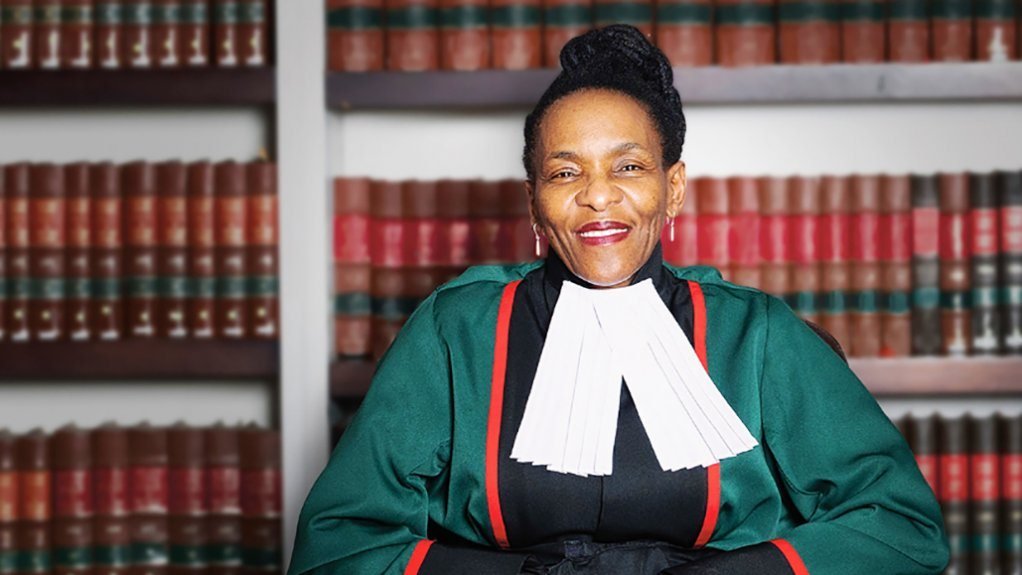
Mandisa Maya, Chief Justice of the Republic of South Africa since 1 September 2024 — the twenty-sixth and most recent of the firsts counted here. Source: Polity.co.za
I distrust anniversaries, not the events they mark, but the comfort we have learned to take in marking them.
Seventy years ago this Sunday, twenty thousand women walked on the Union Buildings and left a petition against the pass laws at a locked door. We commemorate that walk every year, and we are right to. But there is a habit in the way we mark this particular day that I think deserves examining, and a seventieth anniversary seems the correct place to examine it.
1956 was a special year. In April, at a special conference in Orlando, the ANC finally adopted and ratified the Freedom Charter, which had first been adopted by the Congress of the People at Kliptown the previous year. In August, South African women marched on the Union Buildings, the very citadel of oppression, to confront the monster of white supremacy. J.G. Strijdom, the apartheid Prime Minister, ran away from the militant, fire-breathing women and did not receive their petition, in order to avoid the protest. In December, 156 of the most eminent leaders of the South African people (women and men, young and old, black and white) were charged with high treason, beginning the Treason Trial that ended in March 1961 with the final acquittal of all the defendants.
What a milestone of a year for the liberation movement, and what a blow of a year for the apartheid regime. Two years later the cowardly Strijdom, who had evaded the women's march, would be dead.
Today, we celebrate firsts. The first woman to qualify. The first to be admitted. The first to summit, to preside, to command. We recite them as achievements, and they are. But a "first" is not, in the end, a fact about a woman. It is a fact about a country.
Consider what the sentence actually contains. When we say Charlotte Maxeke was the first Black South African woman to hold a university degree, we are not saying that no Black South African woman before her was capable of one. We are saying that none was permitted one. The date is not a measure of her arrival. It is a measure of how long the door had been held shut, and of the women on the other side of it, whose names we do not have because nothing they did was ever written down.
So: twenty-six women, for 2026. Not a hall of fame. A reckoning with an archive.
A word first about how they were chosen, because the choosing is part of the argument.
I have deliberately not reached for the names you are expecting. Several of the most celebrated African women of the past century are absent here, and their absence is not an oversight: the women who are easiest to name are the ones the record already serves. They do not need me. I have gone instead for the ones you would have to go looking for: a poet nobody could date, a painter who worked by paraffin lamp, three harbour pilots, a queen her enemies turned into a monster. This is deliberate. There are many unsung heroines of this struggle, and many of their remains lie strewn across the length and breadth of South Africa, celebrated only by their families and their communities.
And I have tried to hold to three rules. Where a celebrated claim turned out to be wrong, I say so rather than quietly leaving it out. Where two women's claims collide, I show the collision instead of choosing the tidier one. And where I could not settle a date, I print the disagreement rather than the version that reads better.
A list of firsts assembled any other way is a press release. This is meant to be something else.
What the record kept, and what it threw away
Begin at the beginning, in 1652, with a girl the Dutch called Eva.
Her name was Krotoa. She was Khoikhoi, and she was taken into Jan van Riebeeck's household as a child. She learned Dutch and Portuguese alongside her own language and became the Company's interpreter and negotiator, moving between two peoples who each thought she belonged to the other. Her uncle Autshumato had interpreted for the Dutch before her, having learned English in Java; she is the first woman the record shows doing it. She was baptised into the Dutch Reformed Church. In 1664 she married the surgeon Pieter van Meerhof. After his death she was banished to Robben Island, and she died there in 1674, aged about thirty, her children taken from her.
Krotoa is among the most fought-over figures in our history. She has been read as a collaborator and as a victim, as a diplomat of genuine skill and as a woman with no good options. I do not intend to settle that in a newspaper column, and anyone who tells you it is settled is selling something.
But I would ask you to notice where the argument actually comes from.
Every document we have about Krotoa was written by Dutch colonists: the Company's officers, its administrators, its church. They used and dehumanised her in life and denigrated her in death. They would never allow her to live a life of dignity. Yet she lives, because we refuse, and should refuse, to let her have died in vain.
Nothing in her own hand survives, and nothing in her own language; no written Khoikhoi record of that century survives at all. She is among the best-documented indigenous people of the seventeenth-century Cape, and all of it is in the voice, the vocabulary and the interest of the people she was translating for.
Her words are in there. That is the part that should trouble us most. The journals quote her, but every sentence attributed to Krotoa reaches us as a Dutch scribe's rendering, set down by the party on the other side of the negotiation she was conducting. So when we argue today about whether she betrayed her people or served them, we are arguing from the coloniser's record, in the coloniser's terms, over the coloniser's translation of a woman whose profession was translation.
The controversy is not a distraction from the problem of the archive. It is the problem of the archive, arriving in the present tense.
One honest qualification, because it is a separate matter and it deserves to be named separately. Part of the argument about Krotoa is not about the seventeenth century at all. It is about what later generations did with her, the attempt to install her as a founding mother of a people, a twentieth-century construction rather than a Dutch one, and one that many Khoisan South Africans reject and are entitled to reject. Those who object are not disputing the record. They are disputing who is permitted to claim her now. That is a live political question, and it is not mine to close.
And there is a second thing the record gives us, which cuts the other way and is, I think, the more interesting reading.
They wrote about her constantly. A trading company does not fill its daybooks with people who are incidental to it. The sheer volume of Dutch attention to this one woman is evidence in itself, not of what she was, but of how much was passing through her hands. You do not record someone at that length unless a great deal depends on her.
Note the limit, because it is the same limit as before. Volume proves that she was central. It cannot tell us whether that centrality was agency or instrumentality: whether she was shaping events or being used to shape them. Which is, of course, precisely the argument that has never been settled. The record is unreliable as testimony and entirely reliable as a measure of attention, and we have spent three hundred years mistaking the one for the other.
What is beyond dispute is the name. The Dutch wrote her down as Eva. Krotoa reaches us almost by accident.
Hold that, because it is the shape of everything that follows. The problem with our archive is not only that it went silent. It is that when it spoke, it spoke as the coloniser, and we have spent three centuries reading its terms as though they were neutral.
If Krotoa shows us an archive written by the people who used her, Queen Manthatisi shows us one written by the people who feared her.
From about 1813 she ruled the Batlokwa in the name of her young son Sekonyela, and commanded his armies through the upheaval this country calls the Difaqane. Her own people called her Mosadinyana, the little woman.
Her enemies called her something else. The accounts that reached the colonial record described a giantess with a single eye in the middle of her forehead, who sent swarms of bees ahead of her armies. Officials could not manage her name and set it down as "Mantatee," then attached that word to marauding bands she had nothing to do with. Historians suspect that some of the wilder material was encouraged by her own side: terror being cheaper than war, and a rumour costing nothing to deploy.
So there are two records of Manthatisi and neither of them is hers. One renamed her. The other turned her into a monster. What survives both is the detail nobody had any reason to invent: the commander who held a people together through that tumultuous but courageous decade was known, at home, as the little woman.
We cannot even agree on when she lived. Her birth is given as 1784 in some accounts and 1781 in others; her death as 1847, or as 1836. She led armies, and the record cannot place her within a decade.
Now move forward two hundred and fifty years from Krotoa, to a woman whose dates we cannot fix at all. Nontsizi Mgqwetho published more than a hundred poems in Umteteli wa Bantu between 1920 and 1929, the only woman of her generation to take up the role of the imbongi in print and produce a substantial body of Xhosa verse. She described her own body in her poems. A poem from 1924 implies she had been arrested. And we do not know when she was born, or when she died, or what she did before 1920 or after 1929. She was recovered eight decades later by a scholar reading newspaper microfilm.
That is not an accident of time. It is a filing decision, and a state that files this way is not being careless. It is being consistent.
Before her, Emma Sandile, born around 1842, a chief's daughter educated at Zonnebloem, who produced what scholars regard as the earliest known writing in English by a Xhosa woman, and who then petitioned a colonial land commission and won property registered in her own name. A Black woman argued a land case against the colonial state in the 1880s and won it. Most South Africans have never heard her name.
Cecilia Makiwane passed the Cape Colonial Medical Council examination in December 1907 and was registered in January 1908: the first Black woman in South Africa registered by the state as a professional nurse. She was dead at thirty-nine.
And Nokutela Dube, who co-founded the Ohlange Institute, the first school in this country established by Black South Africans, and who, on the evidence we have, had a hand in founding the newspaper Ilanga lase Natal, died in 1917 at forty-four and was buried in Johannesburg in a grave with no marker of her own, in a section of the cemetery designated CK. Christian Kaffir. She lay there for close to a century until a Malian-American professor went looking for her. She was a founder of institutions and a maker of enduring legacies. Not even CK could erase that.
I would ask you to sit with that section of ground for a moment, because it is the argument of this entire piece compressed into two characters. The state did not merely exclude these women from institutions. It declined to record that they had existed. And record-keeping is not a clerical function. It is a function of government. What a state writes down is what a state considers real, and what it leaves out, it has decided is not.
The eleven-year gap
On 21 June 1947, Mary Malahlela-Xakana took the Hippocratic oath at Wits, the first Black woman to qualify as a medical doctor at a South African university, and the first Black woman to graduate from that university. She was born in 1916 to a father who was cast out by his own people for refusing to let his twin children, her younger brother and sister, be killed at birth. She was the daughter of an outcast before she was a first. She collapsed and died on 8 May 1981, doing unpaid work at a rural clinic.
Hold on to those five words — at a South African university, because they are carrying the argument.
Eleven years before her, in 1936, a South African woman named Kesaveloo Goonam opened a medical practice in Grey Street, Durban. She had qualified at Edinburgh. She had qualified at Edinburgh because there was no institution in the country of her birth that would train her. She was Indian, and the door was shut here too, by a different clause of the same law. She was imprisoned seventeen times.
So the honest formulation is not that one woman came first and another came second. It is that this country did not train a Black woman as a doctor until 1947, and had been exporting the problem for at least eleven years before that: sending its daughters to Scotland rather than admitting them at home. Malahlela's first is not a story about her being early. It is a story about how late the institutions were, and about how dehumanisingly white supremacy treated women.
Black women were dehumanised as black people, and dehumanised again as black women.
A note on precision, because it decides the sentence. I have not tried in this piece to settle who counts as Black: that argument has its own long history and it is not mine to close. What I have done instead is state each woman's claim in the narrowest terms the record will bear, and name her specifically where the claim depends on it. A first that cannot survive its own definition is not a first. It is a slogan.
Not every first is an arrival. Some are refusals.
Katie Makanya, born 1873, toured England with the African Jubilee Choir and sang for Queen Victoria. She was offered a career in Europe as an opera singer. She turned it down and came home, and spent her working life as the indispensable colleague of a Durban doctor — initially refusing even to work for him, because of how white doctors had treated her people, and agreeing only once she was satisfied that he could be taught.
I want to argue that her refusal belongs in this list as fully as any qualification. We have a bad habit of measuring African women by the European institutions that admitted them. Makanya was offered admission and said no. That is not a lesser story. It may be the harder one.
In 1961, a year after Sharpeville, Gladys Mgudlandlu, her Xhosa name, Nomfanekiso, means "a picture of a person": held a solo exhibition in the offices of the Liberal Party in Cape Town. Hers is usually called the first solo exhibition by a Black South African woman artist. I print that with a caution: the surveyed record of Black South African women artists effectively begins around 1940, and earlier exhibitors, Valerie Desmore among them, surface as soon as you look. The claim may well be true. It has not been established. She painted her entire career by paraffin lamp. She refused to be called an Impressionist or an Expressionist and called herself a dreamer imaginist. Her birth year is given variously as 1917, 1923 and 1925, which tells you everything about how carefully she was documented.
And in 1967, Desiree Finca was admitted as the first Black African woman attorney in South Africa. A Free State magistrate once refused to let her appear in his court until she produced the name of a white attorney who would vouch that she was genuinely qualified. She was also a trained soprano. I cannot tell you the date of her birth. Nobody can.
Now set that against a second date. Irene Geffen was admitted as this country's first woman advocate in 1923. Constance Mary Hall became its first woman attorney in 1926. Both were white.
So the profession opened to women in the 1920s, and then stayed shut to Black African women until 1967. Forty-one years, between one opening and the other, in the same profession and the same country.
That is not a lag. A lag is what happens when a thing is difficult. This was a door that was opened, and then held closed against a particular set of hands for another forty-one years.
Africa's firsts were often the world's firsts. Nobody teaches this, least of all us.
Now widen the frame, because the same pattern runs across the continent and the omissions there are, if anything, worse.
In 1959, Josephine Namboze became the first woman to qualify as a medical doctor at Makerere. She is often called the first woman doctor in East Africa. That wider claim does not survive contact with the record, women had qualified in Khartoum in 1952, and the narrower one does. She used to ride to lectures on a borrowed bicycle whose brakes had failed; she would steer deliberately into a tree to stop. When word reached her village that she had passed her finals, her people lined both sides of the road home with banana trees, papyrus and red bougainvillaea.
In Ghana, Annie Jiagge had already gone further than any woman before her. Appointed a magistrate in 1953, she was the first woman to hold judicial office in the country; in 1961 she became the first woman on Ghana's High Court. At the London School of Economics she had been one of four women in her class and the only African, and colleagues had suggested she try dressmaking instead. In 1967, as elected rapporteur of the UN Commission on the Status of Women, she drafted, reportedly overnight, the text that the General Assembly adopted as the Declaration on the Elimination of Discrimination Against Women. That declaration of 1967 is the direct precursor of the 1979 convention the world now knows as CEDAW.
Read that again. A Ghanaian judge sits upstream of the world's principal treaty on the rights of women, and almost nobody on this continent knows her name.
In 1969, Angie Brooks of Liberia was elected President of the United Nations General Assembly, a divorced mother of two who had been unable to afford tuition, wrote directly to President Tubman, and was sent to Shaw University in North Carolina, where she refused to ride segregated buses and drove everywhere instead. She fostered dozens of Liberian children. She remains, fifty-seven years later, the only African woman ever to have held that office.
Three years after her, in 1972, Jeanne Martin Cissé of Guinea became the first woman to preside over the United Nations Security Council. She had begun as one of Guinea's first women teachers, in Kankan, in 1944.
And in 1975, Elisabeth Domitien of the Central African Republic became the first woman to serve as prime minister of any African country. She was a farmer and a businesswoman before she was anything else. Jean-Bédel Bokassa, the army officer who had taken the country in a coup nine years earlier and governed it as president ever since: dismissed her in 1976 and dissolved her cabinet. She had publicly opposed his intention to crown himself emperor. Whether that opposition is why he removed her is not something the record settles; the sequence is all we have. He crowned himself on 4 December 1977, in a ceremony modelled on Napoleon's.
The ones who fought, and the ones who played
Mekatilili wa Menza led the Giriama rising against British authority on the Kenyan coast in 1913 and 1914 (against hut tax, trade controls and forced labour recruitment) as an elderly woman. Tradition has her confronting the administrator Arthur Champion at a recruitment meeting with a hen and her chicks, telling him: this is what you will get if you try to take one of our sons, a scene the historian who collected the Giriama testimony in 1970 does not place her at. I keep it, because the telling is itself part of the record. I flag it, because that is not the same thing as the record. She was arrested in October 1913 and deported to Kisii. Giriama oral tradition holds that she walked home. A colonial officer conceded in writing that the Giriama feared the kiraho, the oath — more than they feared the government.
Deolinda Rodrigues sat on the MPLA's central committee in the 1960s and was a co-founder of the Organisation of Angolan Women. She hosted a radio programme, A Voz de Angola Combatente. She was captured by a rival movement and executed in her twenties. Angola marks its Day of the Angolan Woman every year on 2 March, not the date she died, but the date she was taken.
Emahoy Tsegué-Maryam Guèbrou was born in Addis Ababa on 12 December 1923. After Mussolini's invasion of Ethiopia in 1935 she and her family were interned in Italian prison camps; three members of her family were killed. She was offered a place at the Royal Academy of Music in London, and Haile Selassie's government blocked her from travelling. She refused food for close to a fortnight and was hospitalised. She entered a monastery at nineteen and did not return to the piano until her thirties.
She recorded more than a hundred pieces. The world found her in 2006, when she was eighty-two, through a volume of the Éthiopiques series. She was still practising in a convent in Jerusalem in her nineties, and died there on 26 March 2023, at ninety-nine.
Her elder sister, Senedu Gebru (1916–2009), was in 1957 the first woman elected to the Ethiopian parliament, and is remembered for telling that chamber that though she stood there alone and her ideas were dismissed, a day would come when there would be too many women in the room to defeat. The wording that reaches us varies with the telling. The sense does not.
Still counting
Which brings me to the part of this argument that I find hardest to write comfortably.
In 1984, Nawal El Moutawakel of Morocco became the first African woman to win Olympic gold. Eight years later, in Barcelona in 1992, Derartu Tulu of Ethiopia won the ten thousand metres and became the first Black African woman to do so. Eight years and one adjective apart. At the finish line Tulu waited for the silver medallist (Elana Meyer, a white South African, at South Africa's first Games after readmission) and the two of them ran a lap of honour together, hand in hand.
In 1990, Unity Dow sued the government of Botswana over a citizenship law that barred women married to foreigners from passing citizenship to their children. She won, and the Court of Appeal upheld it. Eight years later she took her seat as the first woman judge of Botswana's High Court. She had said of law school that the language of the law is male and the culture of the law is male, and that she had earned the right to be there.
By 2011, in Durban, Precious Dube, Bongiwe Mbambo and Pinky Zungu had qualified as marine pilots on an open licence: meaning no vessel afloat is too large for them to bring into port. Their achievement was on the parliamentary record by 4 August 2011. Mbambo has described a foreign captain photographing her on his own bridge while she piloted his ship.
In July 2014, at a private hospital in Lagos, Dr Ameyo Stella Adadevoh examined a Liberian-American official who had collapsed at the airport, diagnosed Ebola, and refused to let him leave. The pressure to discharge him included, by her family's account, the Liberian ambassador accusing the hospital of kidnapping the man. She did not move. Nigeria, the most populous country on this continent, with the outbreak's point of entry in a city of twenty million, was declared free of the virus that October, while Guinea, Liberia and Sierra Leone were still burying people. She caught it from him. She died on 19 August 2014.
She is not a first. She is the answer to the question of what the firsts are for.
In 2017, Senamile Masango — who began university at sixteen, was the only woman on the African-led team that ran an experiment on the isotope selenium-70 at CERN's ISOLDE facility. She took her master's in nuclear physics cum laude. She died last year, at thirty-seven.
In May 2019, Saray Khumalo became the first Black African woman to reach the summit of Everest, on her fourth attempt. Her three failures are the more instructive record: in 2014 she was on the mountain the morning the Khumbu icefall collapsed and killed sixteen Nepali guides; in 2015 the Nepal earthquake; in 2017 the weather. She went back three times. She did it as a corporate executive and a mother of two, raising money for libraries.
In the same year, Marie Korsaga of Burkina Faso became the first woman from Burkina Faso to hold a doctorate in astronomy. She had wanted it as a child and enrolled in civil engineering instead, because astronomy barely existed as a career where she lived.
In January 2022, Salima Mukansanga of Rwanda became the first woman to referee a match at the men's Africa Cup of Nations, leading an all-woman officiating team. She holds a degree in nursing and midwifery. She had wanted to play basketball for Rwanda, was told she was too young for the under-seventeen squad, and took up refereeing instead.
And on 1 September 2024, Mandisa Maya became the first woman Chief Justice of the Republic of South Africa. Among her judgments is one that receives almost no attention and should receive a great deal: she wrote a judgment in isiXhosa: the first judgment of a South African superior court on record written in that language. In thirty years of constitutional democracy, in a country with eleven official languages, that had to wait until 2020.
The rebuke
Count the most recent of them again. The harbour pilots at Durban, 2011. Masango at CERN, 2017. Khumalo on Everest and Korsaga's doctorate, both in 2019. Mukansanga with the whistle, 2022. Maya taking the oath as Chief Justice, 2024.
These are not historical firsts. Not one of them is out of living memory, and none of them is out of working memory. They happened while most of us reading this were already adults with jobs.
Thomas Sankara said this more sharply than I can. In the Political Orientation Speech he delivered in Ouagadougou on 2 October 1983, he refused the sentimental framing outright: "It is no act of charity or flight of humanitarianism to talk of women's emancipation. It is a fundamental necessity for the triumph of the revolution."
He was speaking about a revolution and I am writing about a list, but the principle survives the transfer. Naming these women is not a kindness we are extending to them. It is not generosity, and it is not a gesture. It is the minimum accuracy a country owes its own record.
And this is the thing I want to say plainly on a day designed for celebration. A first is not a trophy. It is a rebuke. Every one of these dates marks the last possible moment at which a door was still shut. When a woman becomes the first to do something in 2024, the honest reading is not that we have arrived. It is that until 2024 we had not, and that we cannot guarantee the door will not be shut again. What we can guarantee is that women will keep kicking them down.
So the measure of this day is not how many firsts we can recite. Any country can assemble a list. The measure is how many we are still producing, because a nation that is still generating firsts seventy years after twenty thousand women walked on the Union Buildings is a nation that has been slow, and should say so.
Those twenty thousand women were not petitioning for recognition. They were petitioning for the repeal of a specific law. They were practical. They wanted the pass abolished, not admired. I would suggest we honour them in the same register: not by naming women, but by asking which doors are shut right now, and who is being kept on the other side of them, and whether in thirty years someone will write an article marvelling that it took us until 2056.
The twenty-six women in this piece did not need our admiration. Most of them died without it. Several died without so much as a recorded birthday. What they needed was a country that wrote things down, opened its institutions, and did not require a woman to be exceptional in order to be ordinary. It took ordinary women to be extraordinary, and every day in this country the examples abound.
There are many more who made history, achieved extraordinary things, kicked doors down, and whose achievements were never written anywhere. In every family and every community there are people who know. In our communities we must record them ourselves, the dead and the living, and keep the memory alive. The final epitaph on a woman's gravestone should be engraved by those who loved and admired her, not by her fearful enemies.
That is still the work. It has no anniversary.
“The future is not an accident.”
Dr Malusi Gigaba is a Scholar-Statesman, an ANC NEC Member, a former Cabinet Minister of the Republic of South Africa, a Member of Parliament, and a member of both the Joint Standing Committee on Defence and the Portfolio Committee on Trade, Industry and Competition.
The Record
A note on where these women can be found, and where they cannot. Some are a click away. Several exist in a single out-of-print volume, and one or two in almost nothing at all. That distribution is the argument of this piece, set out in full.
-
01
Krotoa
Interpreter and negotiator for the Dutch East India Company at the Cape, c.1652–1674: the first woman the record shows in that role. No institutional source makes the wider superlative.
Julia Wells, “Eva’s Men: Gender and Power in the Establishment of the Cape of Good Hope, 1652–74”, Journal of African History 39 (1998); the journals of Jan van Riebeeck.
-
02
Queen Manthatisi
Ruled the Batlokwa from c.1813 in the name of her son Sekonyela and commanded his armies through the Difaqane.
Encyclopaedia Africana, which gives her praise-name as Mosadinyana (Little Woman); Difaqane historiography. Birth and death dates disputed across sources.
-
03
Emma Sandile
Earliest known writing in English by a Xhosa woman; won property registered in her own name in the 1880s.
Janet Hodgson, Black Womanism in South Africa: Princess Emma Sandile, HSRC Press, 2021.
-
04
Charlotte Maxeke
First Black South African woman known to have earned a university degree, Wilberforce University, Ohio.
Wilberforce University. Graduation year unsettled: Wilberforce, Payne Theological Seminary and ASC Leiden give 1903; the Western Cape Provincial Parliament and The Conversation give 1901. Birth year is given variously as 1871, 1872 and 1874.
-
05
Cecilia Makiwane
First Black woman in South Africa registered by the state as a professional nurse, January 1908.
South African History Online — examined 19 December 1907, registered 7 January 1908.
-
06
Nontsizi Mgqwetho
More than a hundred poems in Umteteli wa Bantu, 1920–1929. Dates of birth and death unknown.
Jeff Opland (ed.), The Nation’s Bounty: The Xhosa Poetry of Nontsizi Mgqwetho, Wits University Press, 2007.
-
07
Mary Malahlela-Xakana
First Black woman to qualify as a medical doctor at a South African university, Wits, 21 June 1947. Earlier South African women qualified abroad, so the narrower formulation is the defensible one.
University of the Witwatersrand, the degree-granting institution, which also records her collapse at the Witkoppen clinic on 8 May 1981.
-
08
Gladys Mgudlandlu
Solo exhibition, Cape Town, 1961, usually described as the first by a Black South African woman artist. Not established: earlier exhibitors surface on inspection.
Museum of Modern Art, post — confirms the 1961 exhibition at the Liberal Party offices in Cape Town, not the “first” superlative.
-
09
Desiree Finca
First Black African woman admitted as an attorney in South Africa, 1967.
Law Society of South Africa rolls of attorneys; De Rebus archive. Date of birth unrecorded.
-
10
Precious Dube, Bongiwe Mbambo and Pinky Zungu
Qualified as marine pilots on an open licence, Durban. On the parliamentary record by 4 August 2011.
National Council of Provinces, Hansard, 4 August 2011; Transnet National Ports Authority.
-
11
Senamile Masango
Only woman on the African-led team that ran an experiment on selenium-70 at CERN’s ISOLDE facility, 2017.
CERN obituary, home.cern/news/obituary/experiments/senamile-masango-1987-2025.
-
12
Saray Khumalo
First Black African woman to reach the summit of Mount Everest, May 2019, on her fourth attempt.
TimesLIVE, 19 May 2019 — summit 17 May, fourth attempt. No Seven Summits claim is made.
-
13
Mandisa Maya
First woman Chief Justice of the Republic of South Africa, 1 September 2024.
The Presidency of the Republic of South Africa. isiXhosa judgment: AfriForum NPC v Chairperson of the Council of UNISA [2020] ZASCA 79.
-
14
Mekatilili wa Menza
Led the Giriama rising against British authority on the Kenyan coast, 1913–14.
Cynthia Brantley, The Giriama and Colonial Resistance in Kenya, 1800–1920, University of California Press, 1981.
-
15
Josephine Namboze
First woman to qualify as a medical doctor at Makerere, 1959. The wider “first in East Africa” claim fails: women qualified at Khartoum in 1952.
Makerere University centenary archive — cited for the Makerere claim and the 20 February 1959 graduation only. That page’s headline repeats the wider East Africa claim, which is false.
-
16
Annie Jiagge
First woman to hold judicial office in Ghana — magistrate, 1953; first woman on Ghana’s High Court, 1961. Drafted the Declaration adopted by the General Assembly on 7 November 1967, the precursor to CEDAW.
Judicial dates: GhanaWeb, corroborated by Gale, Women in World History. Declaration: Verfassungsblog, whose 1959 judgeship date we do not follow.
-
17
Ameyo Stella Adadevoh
Diagnosed Nigeria’s Ebola index case in July 2014 and refused to discharge him. Died 19 August 2014.
BBC News, October 2014, for the ambassador pressure, attributed there to Dr Benjamin Ohiaeri. Death of 19 August 2014: The Guardian Nigeria.
-
18
Deolinda Rodrigues
Sat on the MPLA central committee in the 1960s; captured 2 March 1967, the date Angola marks as its Day of the Angolan Woman. Executed 1968.
Angolan state commemorative record; her prison diary, published posthumously.
-
19
Emahoy Tsegué-Maryam Guèbrou
Ethiopian pianist and nun, 1923–2023; offered a place at the Royal Academy of Music and not permitted to travel, a refusal she attributed to the imperial court. Found by the world at eighty-two.
The Washington Post obituary, 1 April 2023 — Royal Academy offer, the travel block by Selassie’s government, born 12 December 1923, died 26 March 2023 aged 99.
-
20
Angie Brooks
Elected President of the United Nations General Assembly, 24th Session, 1969.
United Nations Photo, 16 September 1969: the twenty-fourth session “electing Miss Angie E. Brooks of Liberia as its President.” The standing “only” is carried by Global Studies Quarterly (Oxford University Press).
-
21
Jeanne Martin Cissé
First woman to preside over the United Nations Security Council, 1972.
UN News: “In 1972, Jeanne Martin Cissé (Guinea) became the first female president of the Security Council.”
-
22
Elisabeth Domitien
First woman to serve as prime minister of any African country, Central African Republic, 1975.
Gale, Women in World History — “Africa’s 1st female prime minister.” Britannica’s narrower “sub-Saharan” wording is contradicted by its own roster, which records no North African woman head of government before 2021.
-
23
Unity Dow
Sued the Botswana government over its citizenship law and won; first woman judge of its High Court.
Attorney-General v Unity Dow, Botswana Court of Appeal: reported judgment.
-
24
Derartu Tulu
First Black African woman to win an Olympic gold medal, 10,000m, Barcelona 1992.
Olympedia: “In 1992, Derartu Tulu became the first black African woman to win an Olympic gold.”
-
25
Marie Korsaga
First Burkinabè woman to obtain a doctorate in astronomy; PhD, University of Cape Town, 2019.
African Astronomical Society — national claim only. The West Africa regional claim that dominates coverage is not made here.
-
26
Salima Mukansanga
First woman to referee a match at the men’s Africa Cup of Nations, January 2022.
Confederation of African Football. On the all-woman crew, CAF’s statement as reported by Africanews: “It is the first time that an all-female team will referee a match of the CAN.”