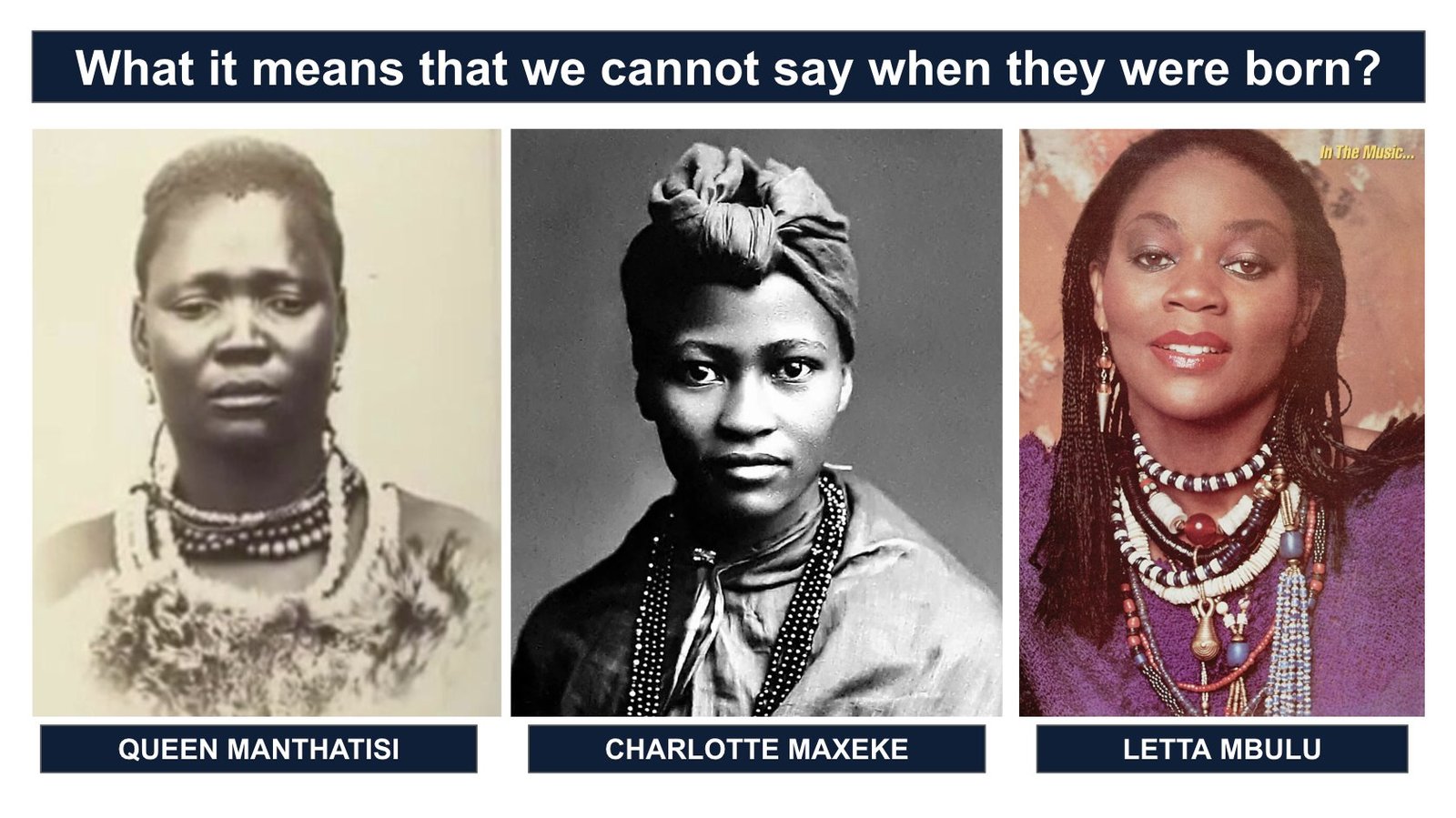
Queen Manthatisi, Charlotte Maxeke and Letta Mbulu. The register is the least discussed of Africa’s lost libraries, and the one that decides whether a person can prove they were born.
On Wednesday, Caiphus Semenya turned eighty-seven.
He was born in Alexandra on 19 August 1939. The date is settled. It appears the same way wherever you look for it, and it is anchored where such things ought to be anchored: in the record of the Republic, which honoured him. I had intended to mark the week by writing about a marriage.
It is a marriage worth writing about. On 2 December 2009 the Presidency announced that year's national orders, and in a single sentence conferred the Order of Ikhamanga in Silver on two people at once: Letta Mbulu and Caiphus Semenya, "for their excellent contribution to the field of music and struggle against apartheid". One grade. One list. One sentence. Two people entered into the national record as a single contribution.
That was the article. Two young people who met in the orbit of King Kong, left this country in 1964 because it had made itself uninhabitable to them, built a life and a body of work in Los Angeles, raised children in a house where the languages of home were spoken at the door, and began coming home in 1991, when it was possible to come home. A partnership of equals, which is rarer than a partnership that lasts.
I did not write that article. I could not get past the second paragraph.
The birthday I could not confirm
I had planned to publish on Letta Mbulu's birthday.
South African History Online records her as born on 23 August 1942 in Soweto. Two other sources say the same, which felt like corroboration until I opened them. One of them cites South African History Online. The other is a directory entry added by a member of the public in December 2025. The archive's own record carries no footnotes, no bibliography, no source of any kind. It was made in 2011 and last touched in 2020.
Three sources are one source, if two of them are quoting the third.
Set against it is a different date, 24 September, which most people encounter on Wikipedia and dismiss for that reason. But it is not Wikipedia's date. Follow the footnote and it leads to a printed reference work: The Guinness Encyclopedia of Popular Music, edited by Colin Larkin, published in London in 1992, nineteen years before our own archive made its entry.
And there is a third kind of evidence, which I have come to think is the most telling of all. On Monday 24 September 2018, the City of Johannesburg unveiled a plaque at her family home in Orlando West, and Letta Mbulu celebrated a birthday. It was Heritage Day, and the reporting of the time was careful to say that the two things coincided.
So: the best-supported record of when a South African woman was born is a book published in London by the publishing arm of a brewing company. Our own archive gives a different day, a different month, and offers nothing to check it against. Somewhere in there is a woman, alive, eighty-three or eighty-four, who knows perfectly well when she was born and has never been asked in a way that made it into a register.
I want to be precise about what I am not saying. I am not saying anyone lied. I am not saying the archive is careless; I have relied on it for years and will go on relying on it. I am saying that the thing did not get written down properly at the time, and that everything since has been reconstruction.
Now hold that, and let me take you somewhere older.
"A Malian ethnologist"
There is a line everybody knows. When an old man dies, a library burns.
You will find it printed on conference programmes and quoted in eulogies and reproduced on the walls of institutions, and almost every time you find it, it will be labelled an African proverb.
It is not a proverb. And this is the part I did not know until this week: it is not quite a quotation either.
On 1 December 1960, at the eleventh session of the UNESCO General Conference in Paris, Amadou Hampâté Bâ rose to speak for the delegation of Mali. What he said, in UNESCO's own record of it, was that he considered the death of each of these traditionalists to be the burning of an unexploited cultural fund.
An unexploited cultural fund. A heavier phrase, and a more awkward one, and far more precise than the sentence the world decided to keep. He was not reaching for an image. He was making an administrative point about a resource nobody had catalogued.
What we quote is a compression, made later, by other hands. It reaches print in 1962, in a book about Côte d'Ivoire:
"Chaque vieillard qui meurt, c'est une bibliothèque qui brûle."
Every old man who dies is a library burning. It is credited there to "un ethnologue malien, Amadou Hampâté Bâ." A Malian ethnologist.
Read that again. Even at the moment of first citation he had to be explained. Not the writer, not the historian, not the novelist, not the diplomat who would sit on UNESCO's Executive Board from 1962 to 1970. A Malian ethnologist, placed and categorised for readers assumed not to know him.
So the words were smoothed, and then the name came off them. Two losses, sixty-six years, and what survives is an anonymous proverb warning us about the danger of things not being written down.
I know of no cleaner demonstration of the problem, and I did not have to go looking for it. It was sitting inside the quotation.
A story is what a people tells. A register is what a state keeps.
Hampâté Bâ was talking about stories. The elder who dies takes with him the genealogies, the medicine, the law, the names of things. That loss is real and it is largely irreversible, and every serious African intellectual project of the last seventy years has been in some way a response to it.
But there is a second library, and we discuss it far less, because it is administrative rather than cultural and administration does not move anyone to poetry.
A story is what a people tells about itself. A register is what a state keeps about a person: born on this day, to these parents, in this place. Stories are kept by memory and are gloriously elastic. Registers are kept by clerks and are only ever as good as the clerk, the form, the office, the ink, and the political decision about whose birth is worth the paper.
In this part of Africa the two arrived in the wrong order, and we should be honest about that rather than flinch from it. Our languages were reduced to writing, systematically, by missionaries in the nineteenth century, by ear, in a borrowed alphabet, so that scripture could be put into them. John Bennie began on isiXhosa in 1823 and described his own project, in words the Lovedale Press's historian preserved, as "reducing to form and rule this language which hitherto floated in the wind." Robert Moffat did the same for Setswana and had a complete Bible in it by 1857, the first in any language of southern Africa. But an alphabet is not an archive, and a mission is not an administration. There was a Bible in Setswana in 1857. There was no dependable way of recording the birth of a Motswana child for another hundred years.
Both libraries burned here. Only one of them is mourned. And it is the unmourned one that decides whether a person can prove they exist: the register, the ledger, the index card.
So when Letta Mbulu's birthday would not hold, I wanted to know whether I had found an oddity or a pattern. And I set myself a rule before I began looking, because this is the second-last Sunday of Women's Month and I did not want to arrive at a convenient answer: I would start with the women, and I would go back as far as our records go.
I expected to find a problem of distance. Every country's record thins as you move away from the present. That is ordinary, it is true of Europe too, and it would let us off.
It is not what I found.
Mother of Nthatisi
I wrote about Queen Manthatisi two Sundays ago, and I am about to write about her again. That requires an explanation, and the explanation is the argument.
That piece was concerned with how she was described: renamed by officials who could not manage her name, turned by her enemies into a one-eyed giantess who sent swarms of bees ahead of her armies. It was about the archive as testimony: what the record says about a person, and in whose voice it says it.
This is a narrower and a colder question. Not what the record says about her. Whether it can say when she lived.
Those are different failures, and only one of them is famous. A record can be eloquent and false, and we know how to argue with that; we have been arguing with it for a century. A record can also simply be blank, and there is nothing to argue with at all. Queen Manthatisi suffers both, which is why she has earned her place in both pieces. The second failure is the one nobody notices, because it does not look like a distortion. It looks like an absence, and absences do not announce themselves.
So. She became regent of the Batlokwa during the minority of her son Sekonyela, and led them through the upheaval this country calls the Difaqane. The sources differ on the year, which by now will not surprise you. How many people moved with the Batlokwa at their height is put in the tens of thousands, though those figures reach us through the same colonial reporting that gave her the extra eye and the bees, and I would not lean on them.
Now try to write down when she was born.
One reference work gives about 1784. Another gives 1781. On her death, one gives 1836; another gives 1847; a third declines to give a year at all. Eleven years of disagreement about when the leader of a nation died. And a widely used African-history resource, listing its sources for her life, cites a personal blog.
Try, then, to write down her name. "Mmanthatisi" is not a name she was given at birth. It is a teknonym: the Sotho-Tswana convention by which a woman takes Mma-, mother, and then her firstborn's name. She is filed, in other words, under her daughter Nthatisi. What she was called before that daughter arrived survives in one heritage volume and very nearly nowhere else.
So the record holds a head of state under her child's name, cannot agree on the decade of her death, and reaches for a blog to steady itself.
There is one more thing, and I want to state it carefully, because it is not an accusation.
We know what happened at Dithakong, the battle of 1823 that decided so much, because several men wrote it down. Robert Moffat left a journal and letters. John Melvill, the government agent at Griqua Town, was there and wrote a narrative. So did George Thompson, a Cape Town merchant, and T.L. Hodgson, a Methodist missionary. The South African Commercial Advertiser carried it on 7 January 1824.
Five accounts. We are fortunate to have them, and I would not have this read as an attack on men who left a record where there might have been none.
But read the list again. Not one of those five was Tlokwa, or Tlhaping, or Griqua.
Thousands of people were at Dithakong. Thousands could have recounted that day in detail for the rest of their lives, and did, to their children, who told their children. Not one of them had a press, an office, or a clerk. And Moffat was among the men holding the pen: the same Robert Moffat who was at that moment reducing Setswana to form and rule, and who would put the Bible into it by 1857. He wrote the battle down. He fixed the spelling of the language. He decided which sounds mattered.
What was missing at Dithakong was never the knowledge, and never the capacity. What was missing was the institution that would have taken it down from the people who were in it, kept it, and let us find it two hundred years later.
That is not a story that burned. That is a register that was never opened.
The woman whose birth year belongs to her sister
Now come forward a century, to a woman the entire country claims.
Charlotte Manye, whom we know as Charlotte Maxeke, took a degree at Wilberforce University in Ohio, and is the first Black South African woman known to have earned one. She founded the Bantu Women's League in 1918. Every branch of the ANC Women's League that has met since traces its line back through her. There is a hospital in Johannesburg carrying her name.
She is the fourth of the twenty-six women in that Women's Day piece. Beneath her entry, in the source note, sits a single line: her birth year is given variously as 1871, 1872 and 1874.
Two Sundays ago I let that line stand where it was, as a caveat. It is not a caveat. It is the story.
The year most often printed, 1871, has no documentary confirmation. Her biographer, Zubeida Jaffer, went looking for the record, with the interest of a sitting Minister of Home Affairs behind her, and no records were found.
And here is the detail that has stayed with me all week. Jaffer settled on 1871 for a reason she states plainly: the other two years conflict with the birth of Charlotte's younger sister Katie in 1873.
She does not have a birth year. She has a birth year that fails to contradict somebody else's. Our own Western Cape Provincial Parliament, meanwhile, publishes 1874.
Nor is it only the birth. The year of the degree, the very achievement the claim rests on, is unsettled too. The Payne Theological Seminary's guide to Wilberforce's history gives 1903, and so does the African Studies Centre at Leiden. The Western Cape Provincial Parliament and The Conversation give 1901. And when Jaffer wrote to Wilberforce itself, the university sent her a photograph taken on the day, dated 1901. We honour her as the first Black South African woman to hold a university degree, and we cannot say in which year she was handed it.
The journalist Zubeida Jaffer put the question to the country in the Mail & Guardian ten years ago under a headline I have not been able to shake: Why is Charlotte Maxeke's life such a blurry memory for SA? A decade later I have no better answer than the one this article is giving.
And hold this against it. Charlotte Maxeke lived and worked and died inside a state that was perfectly capable of writing things down. It wrote down where she was permitted to live. It wrote down what she was permitted to own. Within a few decades of her death it would build a national register classifying every person in this country by race, an administrative undertaking of extraordinary thoroughness, and it would issue documents that had to be carried on the body and produced on demand.
The pen was never the problem.
And I would like to be able to tell you that this is what distance does. That a woman born in 1871, or a queen born in the 1780s, is simply too far back for any country's paperwork to reach, and that the failure ends somewhere behind us.
I cannot. The woman whose birthday I set out to mark was born in Soweto in the nineteen-forties, within living memory, in a city with hospitals and clerks and filing cabinets and a municipality that knew exactly which streets she was permitted to live on. We are no more certain about Letta Mbulu than we are about Manthatisi.
Two hundred years, and the failure has not changed its shape.
Twenty thousand women, and four names
We are in August, and this month we commemorated seventy years since the women's march on the Union Buildings.
Approximately twenty thousand women went up that hill on 9 August 1956. Twenty thousand. Coordinated across four organisations and several languages, under a state that had made such an assembly all but impossible, without telephones, in a country designed to keep them apart.
Ask any South African to name them. You will get four: Lilian Ngoyi, Helen Joseph, Rahima Moosa, Sophia Williams-De Bruyn.
Four, out of twenty thousand. And the other nineteen thousand nine hundred and ninety-six are not lost because their courage was smaller. They are lost because nobody wrote their names down, and because the state they marched against had no intention of doing so, and because we have not since gone looking with anything like the seriousness the debt requires.
One of the four is with us. Two weeks ago Sophia Williams-De Bruyn stood at the Union Buildings, on the seventieth anniversary of the day she climbed them as a teenager, and told the women in front of her: "Stand up, use your voice and fight for your future just like we fought against apartheid and together let us finish the march."
She is there. She can be asked anything.
Our national archive records her birth as: born 1938. A year. No day, no month. The last living leader of the most commemorated act of women's political organisation in this country's history, and we cannot tell you her birthday.
What it means that we cannot say
A missing birthday is only worth an article if it means something. So let me answer that plainly, and in two parts.
It means, first, that this is not one woman.
Every month this platform compiles a calendar of the anniversaries that fall in it, and every month a date will not settle. Two reputable references give different days. A year turns out to rest on nothing at all. A figure of real consequence has no establishable birthday and the calendar must say so on its face, as it does for Kateb Yacine, the Algerian novelist, born on either the second or the sixth of August, and for Jomo Kenyatta, first Prime Minister and first President of Kenya, whose birth year has never been established.
When this Library first drew up its roll of African luminaries to commemorate, an early list of twenty-two names produced nine that could not be dated without a hunt. Richard Maponya. Irvin Khoza. Jomo Sono. Kippie Moeketsi. Pat Matshikiza. Bessie Head. Sam Motsuenyane. Lillian Dube. Letta Mbulu.
A property developer who built the shopping centre that changed Soweto. A man who has run this country's biggest football club for a generation. South Africa's most popular and best ever Number 10, who made the jersey number famous and was awarded with its retirement after his playing days were done, though Orlando Pirates release it again for continental football, and whether they should is argued over still. One of the finest saxophonists we ever produced. A novelist read in universities on four continents.
I would not have that ratio taken for a finding. It was one early list and it has since been overtaken, in the wrong direction. This month alone has added to it. Queen Manthatisi and Charlotte Maxeke are in this article precisely because their dates would not hold. Sindiwe Magona's birthday is disputed and she is alive to be asked. John Kani's is disputed and he is alive to be asked. Sophia Williams-De Bruyn's is a year with no day inside it.
And in the Women's Day piece two Sundays ago, the source note beneath Nontsizi Mgqwetho, who published more than a hundred poems in Umteteli wa Bantu between 1920 and 1929, reads in full: dates of birth and death unknown.
More than a hundred poems, in a national newspaper, dated to the year. And we cannot say when the poet was born, or when she died.
I did not go looking for this argument. It arrived every month, in the ordinary course of trying to say when people were born and died.
If that is what the register holds for them, I invite you to ask what it holds for your grandmother.
Which is what it means, second — and this is the part that matters more than any of the names I have set down here.
That question is not a rhetorical flourish. We can answer it, because Statistics South Africa counts this.
A birth is "late registered" when it is recorded after March of the year following the birth: that is, when someone comes to an office some time later and reports, from memory, that a child was born. In 2024, 75,925 births were registered late: 8.8 per cent of the 863,858 registered that year. Roughly one in twelve.
In 2005, the figure was 42.5 per cent.
Read that again, because it is the whole argument. Two decades ago, more than four in every ten birth registrations processed in this country were of births that had already happened, recorded after the fact, from somebody's recollection of a day that had passed.
The luminaries are not the exception. They are the part of this we can see. Charlotte Maxeke had a degree, a founded organisation, a national profile and eventually a hospital, and the state still could not produce the day she was born. Letta Mbulu has a national order conferred by the President of the Republic, and we cannot fix her birthday. These are the best-documented lives we have. If the register failed them, the question of what it held for a woman with no degree, no organisation and no hospital answers itself, and the numbers say it plainly.
And now we can say why, which is the whole point of having come this far.
Not because writing was foreign to us. We took the alphabet we were handed and built a literature with it inside a single generation. Not because the state could not count. It counted us with great precision the moment counting served it: where we could walk, where we could sleep, what we could own, which of four boxes we belonged in. Passes, classifications, labour bureaux, tax rolls: all recorded, all filed, all retrievable decades later by anyone who wanted them.
The day a child arrived was simply not the kind of fact this country had decided to keep about us.
A register holds what a state has resolved is worth remembering. Ours was built to hold control, and it let go of life.
There is something else in those numbers, and I will not pretend otherwise, because a country that only ever indicts itself learns nothing.
Forty-two and a half per cent to eight point eight per cent, in nineteen years. That is not a small thing. That is a state that could not reliably record when its people were born learning to record almost all of them, on time, in a single generation. It was done by clerks and systems and mobile units and an enormous amount of unglamorous administrative work that nobody will ever write a poem about. It is one of the least celebrated achievements in our public life.
I raise it because it settles the question this article has been circling. Is the register a fate or a choice? It is a choice. We have the proof in our own statistics. The gaps where our grandmothers should be are not evidence of what Africans are; they are evidence of what was decided about us, and of what has since been undecided by people doing careful work.
So let me end where a piece like this should end — not in lament, but in the only place a lament is any use.
A person the register never held cannot prove that they were born. Without that proof there is no identity document. Without an identity document there is no school place, no clinic file, no bank account, no grant, no passport, no inheritance, no lawful burial — and no vote.
That last one is not an abstraction this month. To register as a voter, the Electoral Commission requires a green barcoded identity document, a smart identity card, or a temporary identity certificate. Nothing else will do, and nothing else should. The voters' roll for the municipal elections closed at midnight on 7 August, two days before we gathered to commemorate the women who walked on the Union Buildings, and it will not open again for this election. On 4 November, seventy-three days from today, South Africans will choose their municipal councils. Every citizen who still cannot prove when they were born will sit outside that choice.
Not because anyone turned them away at a door. Because a piece of paperwork was never completed, in most cases long before they were old enough to know it had not been.
That is what a register is. Not bureaucracy. The paperwork of belonging.
We cannot re-open Queen Manthatisi's. We cannot recover the names of nineteen thousand women on a hill in 1956, and I do not think we should pretend otherwise; some of that library has burned and the smoke has cleared and there is nothing standing.
But Sophia Williams-De Bruyn is eighty-eight and was at the Union Buildings two weeks ago. Letta Mbulu is alive in Johannesburg. Sindiwe Magona is alive, and our records cannot agree on her birthday either. John Kani turns eighty-three next Sunday, or he does not, because the sources disagree about that too, and he is alive to be asked.
Hampâté Bâ's warning has been quoted at us for sixty-six years as though it described something that had already happened. It does not. It describes something happening now. Abdullah Ibrahim died in June, ten weeks ago, and Sathima Bea Benjamin, his wife and his equal, honoured with the same order five years before he was, died on the twentieth of August, thirteen years ago this week. That library is burning in our own time, in front of us, and some of it can still be put out by picking up a telephone and asking an old woman a simple question while she is still here to answer it.
We built a country before we built the record of it. That was the order the century forced on us, and I do not think our parents could have done it differently. But the record is not optional and it is not decoration. It is the difference between a people who are remembered and a people who are merely referred to.
We know how to fix this. We have been fixing it. Let us finish.
“The future is not an accident.”
Dr Malusi Gigaba is a Scholar-Statesman, an ANC NEC Member, a former Cabinet Minister of the Republic of South Africa, a Member of Parliament, and a member of both the Joint Standing Committee on Defence and the Portfolio Committee on Trade, Industry and Competition.