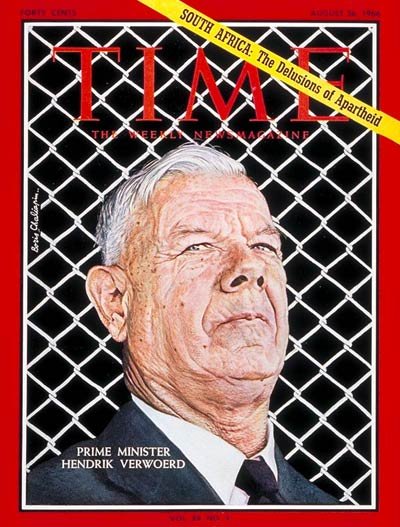
TIME magazine cover, 26 August 1966: “South Africa: The Delusions of Apartheid”.Portrait: Boris Chaliapin
Hendrik Verwoerd was born 125 years ago this month. This is not a piece about the man's life or his death. It is about what he believed, what he wrote into the law of this country, what he did to its classrooms, and how much of it the generations after him have inherited.
Hendrik Frensch Verwoerd was born in Amsterdam on 8 September 1901, one hundred and twenty-five years ago this month. I have chosen to write about him on a Sunday that marks nothing in his life, because nothing here is offered as commemoration. Yet there is an irony in the calendar that I cannot leave alone. September is Heritage Month, and on the 24th we will celebrate what we are meant to hold in common as South Africans. The man who did more than any other to make a common heritage impossible was born in this month. And as Thabo Mbeki, then Deputy President, reminded us in his "I am an African" address of 8 May 1996, all who fought on this soil, those who fought "to redress a wrong" and those who fought "to defend the indefensible", are in his words "my people", and so part of the heritage that defines who we are. That heritage reminds us not only where we come from, but that we are the offspring of warrior women and men who refused to tolerate oppression and dehumanisation, who rose in courage to fight injustice and raised the flag of justice in its stead.
As such, we must never stop reminding ourselves of the injustices of the past, the struggles we fought against them, the heroes of our just war and the high priests and prophets of injustice, so that we never repeat the errors and follies of the past.
My interest in Verwoerd is in something harder to see than a man: a design. He did not invent apartheid, but he gave it its most complete shape, and he wrote that shape into statutes, into school syllabuses and into the map of the country. Most of those statutes are gone. The question I want to ask is why so much of the design is still with us.
To answer it we have to take him seriously, which means reading what he actually believed, what he actually enacted, and what became of it.
How the beliefs were formed, and when they hardened
Verwoerd's power came two years after the change of guard. The National Party won the 1948 election, and he was appointed a senator; in 1950 he became Minister of Native Affairs. By the time he took that office, the beliefs he would write into law were fully formed. To understand the design, we have to understand where those beliefs came from, and when they set.
He came to politics from the university, where he taught psychology and then sociology at Stellenbosch. What matters is not the scholarship itself but what he turned it towards. The question that absorbed him in the early 1930s was white Afrikaner poverty. When the Dutch Reformed Churches convened a national congress on the poor white problem in Kimberley from 2 to 5 October 1934, he was, as the church historian Robert Vosloo records, one of the heads of its commissions. Roberta Balstad Miller, writing in the Journal of Southern African Studies in 1993, found that he "played a central role in the campaign against white Afrikaner poverty in the 1930s". The instinct formed there is the key to everything that followed: that the state exists to lift one people, and that a people is lifted by being organised, planned for and kept together.
What he believed about everyone else is where the scholarship is more unsettling than the caricature. Miller described the Verwoerd of those years as "neither a strident Afrikaner nationalist nor a doctrinaire white supremacist". The historian Christoph Marx, who disputes parts of Miller's account, found that "the racist component in the sense of denying an African ability to develop owing to biological factors is not clearly discernible" in his work. Verwoerd's system did not rest, in its own public language, on a claim that Africans were biologically lesser. It rested on something that sounded more respectable. The scholar J.J. Venter names it: "a stringent application of the principle of one people ('volk'), one state; conceiving of a people in organic terms". Each people, in this view, is a living organism with its own place, its own destiny and its own boundaries. Venter adds that the National Party's thinking about ethnicity had "a definite, though hidden, racial basis".
What we learn from all this is that no historical figure enjoys a single description across historians, scholars or periods. One thing is certain, however: Verwoerd was deeply instrumental in both the organisation and the ideology of white supremacy, and particularly of Afrikaner nationalism, one of its most potent and fanatical elements. What the record does show is the company he kept. Dan O'Meara counts him among "the famous four doctors", with Nico Diederichs, Piet Meyer and Albert Hertzog, men newly returned from study in Europe who, with the Calvinist academics of Potchefstroom, "led the post-fusion ideological redefinition" of Afrikaner nationalism. The Broederbond, of which Verwoerd was a member, concentrated on three tasks: reworking nationalist ideology, organising Afrikaner workers into separate trade unions, and promoting Afrikaner business. The Potchefstroom thinkers built a rigidly Calvinist worldview on Kuyper's doctrine of sovereignty in each sphere; Verwoerd, as editor of Die Transvaler after 1937, propagated what O'Meara calls "a modified form of the 'Fichtean' view". Reaching into church, school, culture and politics, these currents served a white, and above all Afrikaner, capitalist project.
The years between the university and office are where that belief hardened. In the mid-1930s, as Stanley Uys recorded in Africa South in 1959, he "accompanied five fellow-professors on a deputation to the Hertzog-Smuts Government to protest against the admission into South Africa of Jewish refugees from Hitler's Germany". In 1937 he was appointed editor of Die Transvaler, the new Nationalist daily in Johannesburg, and it was then, in Britannica's words, that he "became prominent in politics". When he sued The Star for libel in 1943, Mr Justice Millin found against him in the Transvaal Supreme Court. In the words Uys reported: "He did support Nazi propaganda, he did make his paper a tool of the Nazis in South Africa, and he knew it." Time magazine carried the same finding in 1958.
So the man who became Minister of Native Affairs in 1950 brought three things with him: a conviction that each "volk" must be kept whole and separate, a social scientist's confidence that people can be classified and planned for, and a decade of practice in the politics of exclusion. He did not need to invent the principles of apartheid; Venter's judgement is that he "found the basic principles of apartheid ready-made". What he brought was the method. Learning does not make a person just. It makes a person effective.
The offices, and the words he chose
He held two offices that mattered: Minister of Native Affairs from 1950, and Prime Minister from September 1958 until 1966. In both, he explained himself at length. His collected speeches, edited by A.N. Pelzer and published in 1966 as Verwoerd Speaks, let him do so in his own words, and they are more damning than any paraphrase.
On 5 December 1950, shortly after taking his first office, he addressed the Natives Representative Council. Mixed development, he told the councillors, would lead to "the most terrific clash of interests imaginable". His remedy was that "both adopt a development divorced from each other. That is all that the word apartheid means."
On 10 April 1961, as Prime Minister, he told the House of Assembly where that development was meant to end. "The Bantu will be able to develop into separate Bantu states. That is not what we would have liked to see. It is a form of fragmentation which we would not have liked if we were able to avoid it. In the light of the pressure being exerted on South Africa there is, however, no doubt that eventually this will have to be done, thereby buying for the White man his freedom and the right to retain domination in what is his country, settled for him by his forefathers."
Read those two statements side by side and the design is plain. The language is "development", "separate states", "their own community". The purpose, stated by the man himself, is "the right to retain domination". Self-determination was the vocabulary. Domination was the grammar.
Hendrik Verwoerd speaking in Bloemfontein in 1960, telling his audience that the white man would remain “the guardian of the black man”. Published on Dr Malusi Gigaba’s channel. Footage as credited in the clip: Kamikaze Thunderbird. Video: Office of Dr Malusi Gigaba
I should be careful with the title he is usually given. Venter calls "the architect of apartheid" "an exaggeration", for the reason already given. The scholar Deborah Posel's The Making of Apartheid, 1948–1961 is described as debunking the orthodoxy that presented apartheid "as the product of a single 'grand plan'"; her study of influx control found a policy that arose from conflict and compromise. Both are right that there was no single blueprint. But one strand of the system bears Verwoerd's signature more clearly than any other: the decision to divide the African majority not only from white South Africa, but from itself, people by people, and to tie each people to a place. That is what the Dictionary of South African English calls grand apartheid: "the removal of Black people from 'White' areas and the creation of separate ethnic 'homelands'". Of that, if of anything, he was the architect.
The statute book, and what became of it
A design only becomes real when it is written into law. These are the principal statutes of his two offices, with what became of each. Their commencement and repeal are taken from the Truth and Reconciliation Commission's chronology of apartheid legislation unless another source is named.
As Minister of Native Affairs:
- The Bantu Authorities Act, No. 68 of 1951, which provided for tribal, regional and territorial authorities in the reserves and abolished the Natives Representative Council he had addressed a few months earlier. It outlived apartheid. The TRC's chronology lists it both as repealed in 1984 and as still in force in 1996. The later record settles it: Parliament repealed it by the Black Authorities Act Repeal Act, No. 13 of 2010, which came into force on 3 December 2010.
- The Natives (Abolition of Passes and Co-ordination of Documents) Act, No. 67 of 1952, which, under the title of abolishing passes, provided "for the issue of reference books to natives": the document the country came to know as the dompas. On 21 March 1960, by which time Verwoerd was Prime Minister, police at Sharpeville opened fire on people who had gathered at the call of the Pan Africanist Congress to protest against the pass laws. The police counted 69 dead and 180 injured. The historians Nancy Clark and William Worger have since shown, from autopsy and medical records, that at least 91 died and 281 were injured. The Act was repealed by the Identification Act of 1986.
- The Bantu Education Act, No. 47 of 1953, in force from 1 January 1954, which transferred "the administration and control of native education" from the provinces to the Union government. Replaced by the Education and Training Act of 1979, in the aftermath of Soweto's 16 June 1976.
- The Natives Resettlement Act, No. 19 of 1954, which empowered the government to remove Africans from any area in and around the magisterial district of Johannesburg. Less than a year later the removals from Sophiatown began. It was not the only community to go, though this Act reached only Johannesburg. In Vereeniging, the town council had established Sharpeville in the 1930s to empty the crowded Top Location; in the 1950s, the historians Nancy Clark and William Worger write, Top Location was razed "to make space for white people's businesses and homes". The Act was repealed in 1984.
As Prime Minister:
- The Promotion of Bantu Self-Government Act, No. 46 of 1959, which provided "for the gradual development of self-governing Bantu national units" and repealed the Representation of Natives Act of 1936, taking away the three white representatives that Cape African voters had elected to the House of Assembly on a separate roll. It remained law until the interim Constitution came into force on 27 April 1994.
- The Extension of University Education Act, No. 45 of 1959, which provided for separate university colleges for students who were not white and made it a criminal offence for a student who was not white to register at a hitherto open university without the Minister's written consent. From it came the University Colleges of the North at Turfloop, of Zululand at Ngoye, of the Western Cape and of Durban, each for a designated group. In the same year Fort Hare was confined by law to Xhosa-speaking students. Their mostly rural sites, the quality of the education and the lack of academic freedom earned them the name "bush colleges". The Act was repealed by the Tertiary Education Act of 1988.
- The Unlawful Organisations Act, No. 34 of 1960, in force from 7 April 1960, under which the African National Congress and the Pan Africanist Congress were banned. The Act was repealed by the Internal Security Act of 1982; the ban itself was lifted only in 1990.
- The Transkei Constitution Act, No. 48 of 1963, which gave the Transkei a measure of "self-government" within the Republic. It too remained law until 27 April 1994.
Three lessons sit in that list. The first is that most of this edifice fell before 1994, not because its authors repented but because it stopped working: the passes, the removals and the banning laws were repealed or rewritten by a state under siege, often only to be replaced by something that did the same work under a new name. The second lesson is harder. The laws that built the homelands survived until the first morning of democracy, and the law that built the tribal authorities survived sixteen years beyond it. The Minister who moved its repeal in 2010, Gugile Nkwinti, told the National Assembly that "the institutional legacy of the Black Authorities Act is a colossal social experiment that a single legislative Act cannot wipe away". He was right. Repealing a statute is the easy part.
The third lesson is harder still, because it concerns the most difficult part of national liberation: social emancipation. The laws administered under Verwoerd, as Minister and as Prime Minister, were, as I read them, ultimately meant to codify primitive accumulation and make it permanent in South Africa. They were, in effect, about the cheap exploitation of the black majority, and its preparation as cheaply exploitable and expendable labour in the service of white capital accumulation. Ending legislated racism would prove far easier than ending its social consequences, difficult, painful and protracted though that was. Social emancipation is a far more arduous task than political liberation.
The classroom as a weapon: from 1953 to 16 June 1976
Of everything Verwoerd built, the school was the most deliberate. He did not hide what it was for.
In September 1953, moving the second reading of the Bantu Education Bill in the House of Assembly, he asked: "What is the use of teaching a Bantu child mathematics, when it cannot use it in practice? That is quite absurd." Education, he went on, "must train and teach people in accordance with their opportunities in life, according to the sphere in which they live". In the same speech he warned that "racial relations cannot improve" if African education produced "people who are trained for professions not open to them". These words are recorded in Hansard, volume 83, and were reproduced the following year by M.C. O'Dowd in a 1954 survey published by the National Union of South African Students.
Then came the passage that tells us what the Bill was. "Their education should not clash with Government policy," Verwoerd said, and he anticipated the objection before it was made: "I suppose Honourable Members will at once say that we want to give ideological education." A member, Mr Lawrence, interjected: "That is indoctrination." Verwoerd did not deny it. He replied that any African child "being taught to expect that he will live his adult life under a policy of equal rights" was "making a big mistake", and that such a person "should be reared in that idea from the start".
Reared in that idea from the start. There is the weapon, named by the man who forged it.
Nelson Mandela understood it. From the dock at Rivonia on 20 April 1964, he told the court that during the 1953 debate the man who was by then Prime Minister had said: "When I have control of Native education I will reform it so that Natives will be taught from childhood to realize that equality with Europeans is not for them." President Mandela's wording follows a press report of the debate rather than the Hansard text, but the Hansard record carries the same idea in Verwoerd's own words.
The following year Verwoerd set out the design in full. On 7 June 1954 he read a prepared statement to the Senate, later published by his department as Bantu Education: Policy for the Immediate Future. "The Bantu must be guided to serve his own community in all respects," he said. "There is no place for him in the European community above the level of certain forms of labour. Within his own community, however, all doors are open." The passage is often misdated to 1953, and it is usually quoted without its last sentence. The historian Hermann Giliomee has objected to that omission, and on that narrow point he is right. But the last sentence does not soften the second. It completes it: opportunity, but only at an address the state would choose. The same statement declared that "more institutions for advanced education in urban areas are not desired", and that they would be established "as far as possible in the Native reserves".
Giliomee has argued that Bantu Education was a "part reform" as well as a destructive intervention, and the record he assembles deserves an answer rather than a dismissal. Enrolment grew, from 800 000 African pupils in 1953, by his count, to 2 750 000 in 1970. Mathematics, he points out, "continued to be a school subject". But the same scholar supplies the figures that settle the argument. The gap between white and black spending per pupil, he writes, "widened from 7 to 1 in 1953 to 18 to 1 in 1969". And "from 1958 to 1965 a total of only 431 black matriculants passed mathematics". A system does not need to ban a subject to make it unattainable. It only needs to starve the classroom in which it is taught. I wrote in July that the system required black labour to be kept "uneducated as much as possible", while a few obtained "education sufficient enough to ensure the reproduction of cheap labour". Those 431 were the measure of that sufficiency. It is also why, for us, academic achievement is never a neutral act. It is a political rebuke.
Nor did Giliomee's argument go unanswered. When he first made it, in September 2012, Martin Prew, director of the Centre for Education Policy Development, replied that it was "tantamount to blaming the victims for the situation that they found themselves in". Giliomee, in his rejoinder, protested that he was being presented "as an apologist for Bantu education". The charge has not gone away. In 2016, Emeritus Professor Tim Crowe wrote that Giliomee presented "a highly personalized, arguably apologist, perspective" on Verwoerd himself.
That is the context in which 1976 must be read. In 1974 the Bantu Education Department made Afrikaans compulsory, alongside English, as a medium of instruction in black schools. On 11 June 1976 the Deputy Minister responsible for Bantu Education, Andries Treurnicht, rejected the applications of five Soweto schools to depart from that policy. Five days later, on 16 June, police opened fire on thousands of pupils marching against it. Hector Pieterson, aged 12, was one of the first casualties.
The state's own inquiry, the Cillié Commission, counted 575 dead between June 1976 and February 1977. Its figures were disputed by various sources as too low. Yet even that commission, reporting in 1980, found that while Afrikaans instruction was "the immediate cause of the unrest", "the causes of the unrest were to be sought in some of the cornerstones of the apartheid policy", as Pat Tucker reported. Among those cornerstones was the Act Verwoerd moved in 1953.
The children of 1976 were the first generation raised wholly inside his design. They were meant to be reared in the idea of their own inferiority from the start. Instead they walked out of the classroom and changed the course of the country. The Bantu Education Act did not survive them. It was replaced in 1979. Its purpose failed. Its effects did not.
Mandela's lifelong friend and comrade, OR Tambo, made plain what he understood the role of education to be, during the struggle and after it, in the ANC's 8 January statement of 1987, which he delivered as its President. The crisis in the schools, he said, was "a national issue requiring the united action of the students, teachers and parents", and he set out "the guidelines that must instruct our behaviour over such questions and the people's courts and the education crisis". He urged them all to "proceed from the position that our task is to win a revolution".
In the midst of a popular uprising, when it would have been easy for any populist leader to urge the students to keep boycotting their schools, he appealed instead to their revolutionary resolve to "fight the enemy for the right to be at our respective institutions of learning, within which we should build and organise our democratic structures and within which we should introduce the system of people's education which is a decisive element in the future of our country and people". Then he came to the point:
"To return to school must therefore be seen as a revolutionary act which puts us in a better position further to advance the struggle for a people's education in a society in which we, the people, shall govern."
He appealed to their revolutionary consciousness, and reminded them that education was vital to a free society, one "in which we, the people, shall govern".
The language was never the crime
Here I want to draw a careful line, because this argument is easily carried too far, and because it bears on a live debate.
Teaching children in their home language was not Verwoerd's idea, and it is not his legacy. It is sound educational practice, and a democratic government is right to pursue it. The Department of Basic Education set out to introduce mother tongue-based bilingual education for mathematics and for Natural Science and Technology from Grade 4, starting in 2025 and planned to reach the end of primary school by 2028.
What made Bantu Education a crime was not the language of the classroom. It was the fence around it. Verwoerd used language as an address. He turned it into another instrument of domination. A child's home language told the state which authority she answered to, which college she might one day attend and which "national unit" she would be sent back to serve. The tongue was made into a border.
The difference is everything. A language that opens the way to learning is liberation. A language that assigns you to a territory is administration. Any proposal, in any decade and from any direction, that begins to sort people into institutions by ethnic origin, however kindly it is phrased, is walking back towards the second.
The citizens he meant to unmake
Verwoerd told Parliament in 1961 that the homelands would one day become "separate Bantu states". His successors carried the logic to its end. The Bantu Homelands Citizenship Act of 1970 made every black South African a citizen of a homeland. Then came the four "independent" states, known by their initials as the TBVC: Transkei, declared independent on 26 October 1976; Bophuthatswana in 1977; Venda in 1979; and Ciskei, under the Status of Ciskei Act, in 1981. On the day Transkei was declared independent, the United Nations General Assembly called on all governments "to deny any form of recognition to the so-called independent Transkei", as the Security Council recalled that December. As each territory was declared, its designated citizens ceased to be citizens of South Africa.
The logic reached one of its furthest points in this very month, forty-seven years ago. On 13 September 1979, under the Status of Venda Act, Venda became the third homeland to be declared an "independent" state. Like Transkei, which, as John Dugard noted, no state other than South Africa recognised, Venda was not recognised by the rest of the world. Those assigned to it as citizens ceased, in Pretoria's law, to be South Africans. It happened thirteen years after Verwoerd's death, under another prime minister. But it was the destination he had named from the floor of the House of Assembly in 1961: "separate Bantu states".
Dr Connie Mulder, then Minister of Bantu Administration and Development, told Parliament on 7 February 1978 what the policy meant: "if our policy is taken to its full logical conclusion as far as the black people are concerned, there will be not one black man with South African citizenship." The international lawyer John Dugard, writing in 1980, called it "the compulsory denationalization of some seven million persons connected with Transkei, Bophuthatswana, and Venda". The Promotion of Bantu Self-Government Act and the Transkei Constitution Act, both passed under Verwoerd, were the legal road to that destination.
It was undone only at the very end. Legislation passed in 1993, the Restoration and Extension of South African Citizenship Act, began to restore citizenship, and the interim Constitution, from 27 April 1994, declared that "the Republic of South Africa shall be one, sovereign state". It is worth pausing on that sentence. It had to be written. For millions of our people, being South African was not a birthright that survived apartheid. It was restored to them by statute.
What is still running
If this were only history, it would be easier to write. It is not only history. The statutes are mostly gone, but the design left three kinds of inheritance, and each is still visible.
The first is the map. The homelands were abolished in 1994, but people did not stop living in them. Using the 2011 Census, Michael Noble, Wanga Zembe and Gemma Wright found that 90% of the most deprived fifth of South Africa's wards lay in former homeland areas, that the poverty rate at the lower-bound line was 73% in the former homelands against 46% in the rest of the country, and that the gap in deprivation had "hardly changed from 2001". In 2011, over a third of South Africa's people still lived there. Verwoerd drew those lines to decide where Africans would live, and on what terms. In 2011, seventeen years after they were erased from the law, they could still be read off a poverty map.
The second is the classroom. The economist Nic Spaull found in 2012 that "schools which served predominantly White students under apartheid remain functional, while those which served Black students remain dysfunctional", and that there are "in fact two different education systems in South Africa". The international reading study PIRLS 2021 found that 81% of our Grade 4 learners were struggling to read for comprehension, and that learners tested in English or Afrikaans averaged 382 and 387 points while those tested in Sepedi and Setswana averaged 216 and 211. Those gaps are not mainly about language. They track which schools the children sit in, and whose schools those were in 1953.
The third is the institution. When our Parliament gave traditional leadership its legal framework in 2003, the Traditional Leadership and Governance Framework Act provided, in section 28(4), that every "tribal authority" established and recognised before it began "is deemed to be a traditional council", while requiring them, within a set period, to meet its rules on composition. That Act came into force on 24 September 2004. Heritage Day. The tribal authorities it carried forward were, in the main, the creations of the Bantu Authorities Act of 1951 and the homeland laws that followed it. Its successor, the Traditional and Khoi-San Leadership Act of 2019, was declared invalid by the Constitutional Court in Mogale in 2023 because Parliament had failed to facilitate public involvement in passing it. The declaration has been suspended until 29 May 2027, and a new Bill has been before Parliament since April.
I do not raise this to diminish traditional leadership, which the Constitution recognises and which many communities hold dear. I raise it because it is the plainest evidence I know that a design can outlive its designer by decades, and that it survives not through conspiracy but through convenience. It is easier to inherit a map than to draw a new one. The Bill now before Parliament is an opportunity to draw one: to ask communities, as Mogale requires, rather than to deem them.
These inheritances are not Verwoerd's alone any longer. Some of what we see is his design still running. Some of it is ours: choices made, and choices deferred, by the democratic state that my own movement has led since 1994, and since 2024 has led in coalition. A reading crisis in 2021 cannot be laid entirely at the door of a man who died in 1966. To say so is not to excuse him. It is to accept that the work of undoing him passed to us, and that we will be measured by it. Tracing these problems to their source is not scapegoating. Acknowledging the unfinished project is something more: it is deliberate, and it shows candour and a willingness to keep working, consciously, to finish the job.
A birthday kept by the few
On 8 September, the 125th anniversary of Verwoerd's birth came and went almost unremarked. And just as well. It was kept by a small circle. A Facebook post headed "Kinders van Verwoerd" noted that "vandag sou dr. Verwoerd 125 jaar oud gewees het", that today Dr Verwoerd would have been 125, and the Herstigte Nasionale Party released a new instalment of its video series about him, "Afrikaner-adel", Afrikaner nobility. Beyond that circle, I could find no newspaper, broadcaster or public institution that set out to mark the day. The anniversary of his death, two days earlier, drew more notice: in the Afrikaans Sunday press, at the Apartheid Museum and across social media. But his birth, the day that invites a reckoning with the whole of a life's work, passed almost in silence.
That silence tells us something, though perhaps not what we would expect. It is not that he has been forgotten. It is that the thing that matters most about him no longer needs him. His admirers remember the man. His opponents remember the day he died, two days before his 65th birthday. The design itself has no anniversary, and it needs none. It needs no statue, no speech and no birthday. It needs only that we go on living inside the lines it drew without asking who drew them. That is the most durable kind of power there is: the kind that no longer has to announce itself.
The contrast with what the state did choose to mark is instructive. On 26 August the Reserve Bank launched a new R2 coin to mark 125 years since Charlotte Maxeke became the first Black South African woman to graduate with a university degree, a reckoning that places her degree in 1901, the year Verwoerd was born. But consider where she had to go to earn it. She had left South Africa as a young woman in a touring choir, and in America she met students from Wilberforce University in Ohio. There, as J.A. Millard writes in the Dictionary of African Christian Biography, she "realised for the first time that in America there were opportunities for black students which were not available in South Africa". She enrolled at Wilberforce in the 1890s, years before Verwoerd was born.
Two days later, on 28 August, the University of the Western Cape conferred on Maxeke a posthumous honorary doctorate, in utter negation of everything Verwoerd would have wished. Almost 125 years on, a South African university, one established in 1959 as a college for students classified Coloured under his government's university apartheid, conferred a degree, on South African soil, upon a South African woman who had had to leave her own country to earn one.
That is worth holding on to. Verwoerd did not begin the exclusion of Black South Africans from learning. A young South African woman had to cross an ocean to escape it before he drew his first breath. What he did was give that exclusion a framework: a theory, a department, a statute and a budget. Of the two stories that meet in 1901, the republic has chosen to honour hers. It has chosen rightly.
The questions his design put to this country have not gone quiet, however. In recent weeks, in arguments over where people may live and in what language they may learn, one of them returned, from more than one direction: can a people keep itself whole only by keeping itself apart? He answered yes, and wrote the answer into law. Our Constitution answers no. Whether the country we have built since 1994 still believes its own answer is the question Heritage Day puts to us this year. It is the one I will take up on its eve.
The test for us
A hundred and twenty-five years after his birth, it would be comfortable to treat Verwoerd as a closed chapter: a man, a period, a set of repealed laws. His own words argue against that comfort. He never said that Africans had no future. He said that their doors were open, at home, in their own community, in a place chosen for them. He never said he meant to dominate. He said he meant to develop. The cruelty was in the address, and the lie was in the vocabulary.
We will celebrate our heritage on 24 September, in the month he was born. He believed that every people had a heritage of its own, and that each must be kept in its own place. We are trying to prove the opposite: that a heritage can be held in common without anyone being asked to surrender their own. That work is not finished, and his design is still the main obstacle to it.
So the test for us is not whether we reject the man. Almost everyone does. The test is whether we can still tell the difference between recognising a people and filing them. We recognise a people when we protect their language, their customs and their right to belong to one another and to the whole country. We file them when we let an old category decide where they may study, whom they must answer to, or which part of South Africa is really theirs.
The children of 1976 refused to be filed. What we owe them is to finish the work they began: to retire the design, one law, one school and one boundary at a time, until nothing of it is still running.
“The future is not an accident.”
Dr Malusi Gigaba is a Scholar-Statesman, an ANC NEC Member, a former Cabinet Minister of the Republic of South Africa, a Member of Parliament, and a member of both the Joint Standing Committee on Defence and the Portfolio Committee on Trade, Industry and Competition.