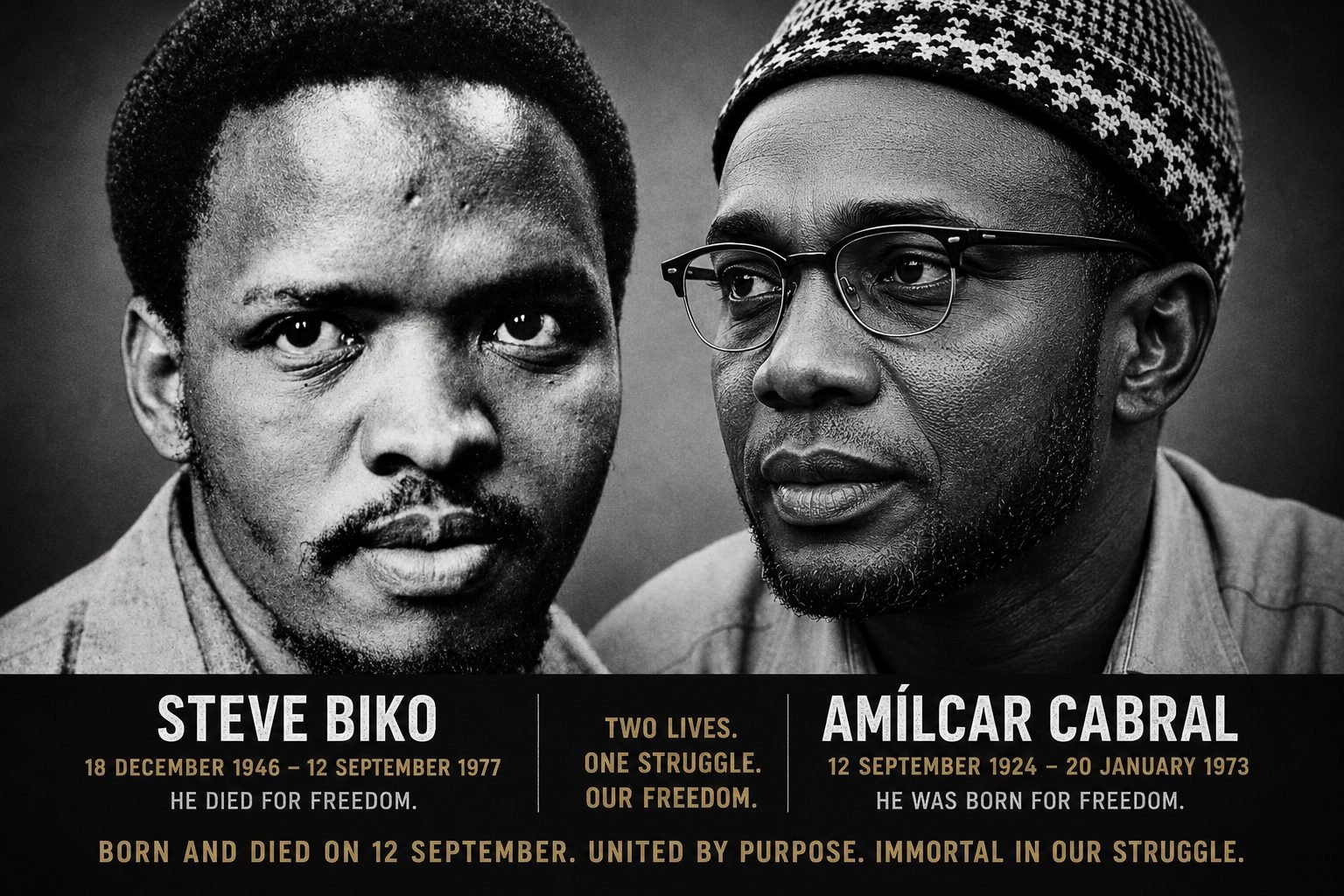
Illustration: Steve Biko (1946–1977) and Amílcar Cabral (1924–1973). Dates as recorded.
Steve Biko died, and Amílcar Cabral was born, on 12 September. Both are remembered for their words. Both built things that had to work – clinics, schools, funds, and in Biko's case a coalition – and both of the states they opposed understood what that meant.
12 September is a date with two men in it. Not every reader will know both of them.
Steve Biko died on that day in 1977, in police custody in Pretoria, at the age of thirty. With fellow students he founded the South African Students' Organisation, became its first president, and grew into the best-known voice of the Black Consciousness Movement. At its heart, he wrote, was the realisation "that the most potent weapon in the hands of the oppressor is the mind of the oppressed".
Readers of this series will know that sentence. It has appeared in five of my articles this year: on Ngũgĩ wa Thiong'o, Wole Soyinka, Gibson Kente, the Southern African Development Community and Mosibudi Mangena. I keep returning to it because it names the ground on which every other struggle is fought. A people can be held down for a long time by force, but it is held longest once it has come to accept the oppressor's account of who it is. That is why Biko began with the mind. It is also why, having begun there, he did not stop there. Last September, in Heritage, Biko, and Ethical Leadership in 2025, I called him a builder as well as a thinker.
Amílcar Cabral was born on that day in 1924, at Bafatá in what was then Portuguese Guinea. He led the PAIGC, the party that led the struggle against Portuguese rule in what are now Guinea-Bissau and Cape Verde, and he thought as hard as he fought. In January 1966 he took his thinking on national liberation to the first Tricontinental Conference in Havana, in an address later published as "The Weapon of Theory". He was assassinated in 1973, at the age of forty-eight.
We remember both of them chiefly by their thoughts and their written sentences. That is a kind of honour. It also leaves out the better half of the record, because each of them spent a short life building things that had to work on an ordinary morning: a clinic that had to open its doors, a school that needed a teacher in front of it. We should know them, too, by the institutions they bequeathed us, on which to elevate the struggle and take it to a new pedestal. This piece is about what they built, and about a question their building answers better than their writing ever could. What does a clinic say that a pamphlet cannot?
What Biko built inside the banning order
Steve Biko was admitted to the medical school of the University of Natal's Non-European section at the beginning of 1966. His studies suffered as his political work grew, and during the course of 1972 he was excluded from the medical school. In March 1973 the state banned him and confined him to the magisterial district of King William's Town, which took in Ginsberg, the township where he had grown up. The banning order was meant to end his usefulness. Instead it drew the boundaries of what he did next.
Inside those boundaries, working through the Black Community Programmes, he helped to establish a clinic. Zanempilo – the name means "the place that brings health" – opened in January 1975 at Zinyoka, a village ten kilometres outside King William's Town, now Qonce. It stood within the area his banning order allowed him to move in.
Its first medical officer, and the driving force behind it, was Dr Mamphela Ramphele. The clinic became, in the words of South African History Online, "the nerve centre of BCM activities": a place where patients were seen, and where the movement met and received its visitors.
The clinic was not the only thing he built in that district. In 1975 he helped establish the Zimele Trust Fund, which paid the start-up costs of small income-generating projects for the families of political prisoners and for people just released from prison. He set up the Ginsberg Educational Fund, which gave bursaries to students, many of them bound for Fort Hare. He helped revive the Ginsberg crèche, so that mothers could leave their children in care and go out to work. A leather workshop at Njwaxa was employing about fifty people by 1974. And Zanempilo worked well enough to be copied: a second clinic, Solempilo, "Eye of Health", was built near Adams Mission, south of Durban.
The movement had a phrase for this kind of work. "Black man, you are on your own" is often put in Biko's mouth, but the South African History Archive traces the first time it appeared in print to his comrade Barney Pityana, in a paper titled "Priorities in Community Development" that the SASO Newsletter carried in September 1971. SASO took it up as its rallying cry. It has come to be read as a statement about who could take part in the struggle. Pityana's paper shows what else it meant. It is an argument for "self-help and self-reliance", and the slogan is its summary: "The message is simple," he wrote, and then set it out in capital letters. If no one else would build the clinic, the fund and the crèche, black communities would build them themselves.
There is a detail here I cannot pass over. He had lost his place at medical school. The state had then confined him to a single district. He answered both by helping to build a place where medicine was practised by others, on ground the state itself had chosen for him.
The hardest thing to build
Clinics and trust funds were not the most ambitious of his projects. For about three years before his death, Biko worked to bring the divided liberation movements into a working unity: the African National Congress, the Pan Africanist Congress and the Unity Movement (Steve Biko Foundation). The initiative came from inside Black Consciousness. The Black People's Convention had begun to see itself as a possible catalyst for uniting the movements, and in Lindy Wilson's words, quoted by South African History Online, Black Consciousness was to develop "from psychological unity to political unity".
In January 1977 the Convention elected Biko its Honorary President, and the office gave him the standing to speak for it. He held talks with the PAC's Robert Sobukwe. He opened a dialogue with the ANC's underground through figures including Griffiths Mxenge. Attempts were made to arrange a meeting with Oliver Tambo, the ANC's leader in exile; the last was set for Botswana in the first week of September 1977.
It is the least spoken-about part of his life. It is also the hardest kind of building. A clinic needs money and a doctor. A coalition needs people who have spent years distrusting one another to decide that what they share is larger than what divides them. Biko believed the struggle would be stronger fought together than apart, and he spent his last years acting on that belief.
In August 1977 he broke his banning order and travelled to Cape Town with his comrade Peter Jones, hoping to meet Neville Alexander, a former Robben Island prisoner from the Unity Movement tradition. The meeting did not take place. On the long road home, police stopped the two men at a roadblock near Grahamstown, now Makhanda, and detained them. The meeting in Botswana was never held. Biko died in detention on 12 September. Forty-nine years on, a reopened inquest into his death began hearing evidence in the Gqeberha High Court last month and has since been postponed, without findings.
The agronomist who counted the farms
Amílcar Cabral trained as an agronomist. From 1953 he carried out an agricultural survey of the colony, travelling through it and talking with peasants about their work and their histories. It is hard to think of a better apprenticeship for a man who meant to free a country than to have counted its farms.
In Havana he gave the reason. On the political level, he said, "our own reality – however fine and attractive the reality of others may be – can only be transformed by detailed knowledge of it, by our own efforts, by our own sacrifices." Detailed knowledge was the survey. The call to rely on our own efforts is one that South Africa's black students would make for themselves a few years later.
The PAIGC – in full, the African Party for the Independence of Guinea and Cape Verde – dates its own founding to September 1956. Once the armed struggle was under way, the party did more than fight in the areas it held. It administered them. It established schools, medical clinics and courts, and people's stores where villagers could trade. In April 1972 a United Nations special mission visited those areas, and Cabral would cite its finding that the party was, in effect, their administration.
Cabral was clear about why this mattered. In a party directive of 1965 he wrote:
"Always bear in mind that the people are not fighting for ideas, for the things in anyone's head. They are fighting to win material benefits, to live better and in peace, to see their lives go forward, to guarantee the future of their children."
The same directive gives an order that reads today like a line from a development plan: "Create schools and spread education in all liberated areas" (Cabral, party directive, 1965).
The weapon of theory
The survey was one half of him. The other half was an argument about what independence would have to mean, and he made it in Havana in January 1966, in the address later published as "The Weapon of Theory".
Cabral belonged to the camp that insisted African countries must break completely with their former colonial powers and chart an independent path based on unity, cooperation, and self-reliance. He drew one distinction inside that: the quarrel was with Portuguese colonialism, not with the Portuguese people. Colonial rule works, he argued, by taking from a people the freedom to develop what they have. Liberation is the undoing of that: "the national liberation of a people is the regaining of the historical personality of that people, its return to history through the destruction of the imperialist domination to which it was subjected". And he set a material test for it, not a ceremonial one. National liberation "exists only when the national productive forces have been completely freed from every kind of foreign domination".
He was blunt about what the liberation movements themselves lacked. "We are not going to eliminate imperialism by shouting insults against it," he told the conference. The deeper failure was that they had neglected the work of thinking: "The ideological deficiency, not to say the total lack of ideology, within the national liberation movements … constitutes one of the greatest weaknesses of our struggle against imperialism, if not the greatest weakness of all." For oppressed intellectuals to reclaim the minds of their people, they must first free themselves from reliance on the intellectual foundations of the oppressors – what Fanon diagnosed in the colonised intellectual who throws himself into "the frantic acquisition of the culture of the occupying power". Biko, at the other end of the continent and with no recorded contact between them, came at the same ground from another direction, and found the oppressor strongest in the mind of the oppressed. The ANC made a related demand in its own Strategy and Tactics, adopted at Morogoro in 1969: liberation "involves a stimulation and a deepening of national confidence, national pride and national assertiveness" – qualities which, the document is careful to add, "properly channelled and properly led", do not "stand in conflict with the principles of internationalism".
He believed in the revolutionary potential of the African people, especially the working classes, and in the Cuban Revolution's capacity to create not only a new life but a "New Man, fully conscious of his national, continental and international rights and duties". This concern with forging a new humanity preoccupied many African revolutionaries, from Fanon and Lembede to Biko. Fanon had closed The Wretched of the Earth asking that we "work out new concepts, and try to set afoot a new man".
Nor did Cabral spare his own side. The one social sector able to see imperial domination for what it is, and to run the state that colonialism leaves behind, is what he called the native petty bourgeoisie – his phrase, not mine, for the educated salaried class of clerks, teachers and officials, who hold position but no capital. He did not say it with satisfaction. He called that inevitability "one of the weaknesses of the national liberation movement", because a class with no economic base of its own faces a choice: "to betray the revolution or to commit suicide as a class" and be reborn as revolutionary workers. Which way it goes, he said, "depends on what Fidel Castro recently correctly called the development of revolutionary consciousness". It is why he could say that a problem that is essentially political carries "certain characteristics which belong to the sphere of morals".
What a clinic says that a pamphlet cannot
Both men were making a claim about legitimacy. The colonial state in Guinea and the apartheid state in South Africa each claimed the right to govern on the strength of law and force. Cabral and Biko contested that claim, and the most persuasive form their contest took, I would argue, was not a speech. It was a service that worked.
A pamphlet asks to be believed. A clinic that is open when a mother arrives with a sick child does not ask for anything. It demonstrates. It shows, in the one place where the argument can be tested, that the people making it can do what they say, as the colonial and apartheid authorities would not. Cabral's directive says as much in its own terms: people judge a movement by what arrives in their lives, not by what is in anyone's head.
None of this sets building against thinking, and Cabral would have refused the choice. He reminded the conference in Havana "that every practice produces a theory". The clinic at Zinyoka and the schools in Guinea were theories of their own: arguments about who was fit to govern, made in brick and in lessons, and tested every morning.
Anyone who has had to keep a public service running learns quickly that opening it is the easy day. The difficult days come afterwards, when the door must be open for someone who arrives and cannot wait. Speeches are made on the first day. Legitimacy is earned on all the others.
What the state did with what they built
It began before the ban. Biko's banning order was tightened so that he could no longer direct the Black Community Programmes, and the work passed to Dr Ramphele. In April 1977 she was banished to Tzaneen in the northern Transvaal, where, under restriction, she set up another community health programme. On 19 October 1977, five weeks after his death, the state shut down the Black Community Programmes along with the other Black Consciousness organisations, and the clinic passed into government hands. Solempilo was closed before it could open.
The ban ended the project. It did not end the clinic. The people who had built it were gone, and the building was kept. I read that as a concession of the whole argument. The clinic was useful and the village needed it; what could not be allowed to stand was that the people who provided it were not the state.
In Guinea the colonial government's response differed in method and matched in logic. Under General António de Spínola, governor from 1968, Portugal answered with a policy that went by the slogan Por uma Guiné Melhor, "For a Better Guinea": presented as an effort to improve the living conditions of the population, and carried out in part by moving people into strategic villages. I read the same concession there. The answer to a working service was to promise one of their own, on their own terms.
In both places the state behaved as though it had learned the lesson the liberation movements were teaching. It could not answer a clinic with a speech either.
Claim no easy victories
It would be dishonest to write about either man as though building settled everything, and Cabral would have been the first to object. The same 1965 directive contains an instruction that has outlived him: "Mask no difficulties, mistakes, failures. Claim no easy victories."
It also contains a sentence that every public servant should keep somewhere visible: "If ten men go to a rice field and do the day's work of eight, there's no reason to be satisfied."
So the account must be kept honestly. Zanempilo was one clinic, serving one rural district, and the unity Biko worked for was not achieved in his lifetime. Cabral was assassinated in Conakry on 20 January 1973, and who directed his killing is still argued over. He did not see what his movement founded. Eight months after his death, on 24 September 1973, the PAIGC, acting through a People's National Assembly elected in the liberated areas, proclaimed the Republic of Guinea-Bissau (Instituto de História Contemporânea, NOVA University Lisbon). Portugal recognised its independence on 10 September 1974.
Cabral's own rule requires the next sentence. The state he died for has been under military rule since November 2025, when the army took power days after a presidential election; the African Union suspended it that week, and elections have been promised for 6 December. I do not write this to diminish him. I write it because he would have.
Biko and Cabral did not live to govern, and I will not pretend to know what either would have made of that burden. What their lives leave us is simpler and harder than a verdict. They set a standard of legitimacy that has nothing to do with eloquence: that the right to be trusted with a people's affairs is earned where the service meets the person who needs it, on the ordinary morning, when no one is making a speech.
Twelve days after the date that holds these two men, South Africa will mark Heritage Day, and on the same day Guinea-Bissau will mark the anniversary of its independence. We will speak, rightly, about what we have inherited. Among the things these two men left us, the most useful is not a sentence. It is a test. When someone arrives who cannot wait, is the door open?
“The future is not an accident.”
Dr Malusi Gigaba is a Scholar-Statesman, an ANC NEC Member, a former Cabinet Minister of the Republic of South Africa, a Member of Parliament, and a member of both the Joint Standing Committee on Defence and the Portfolio Committee on Trade, Industry and Competition.