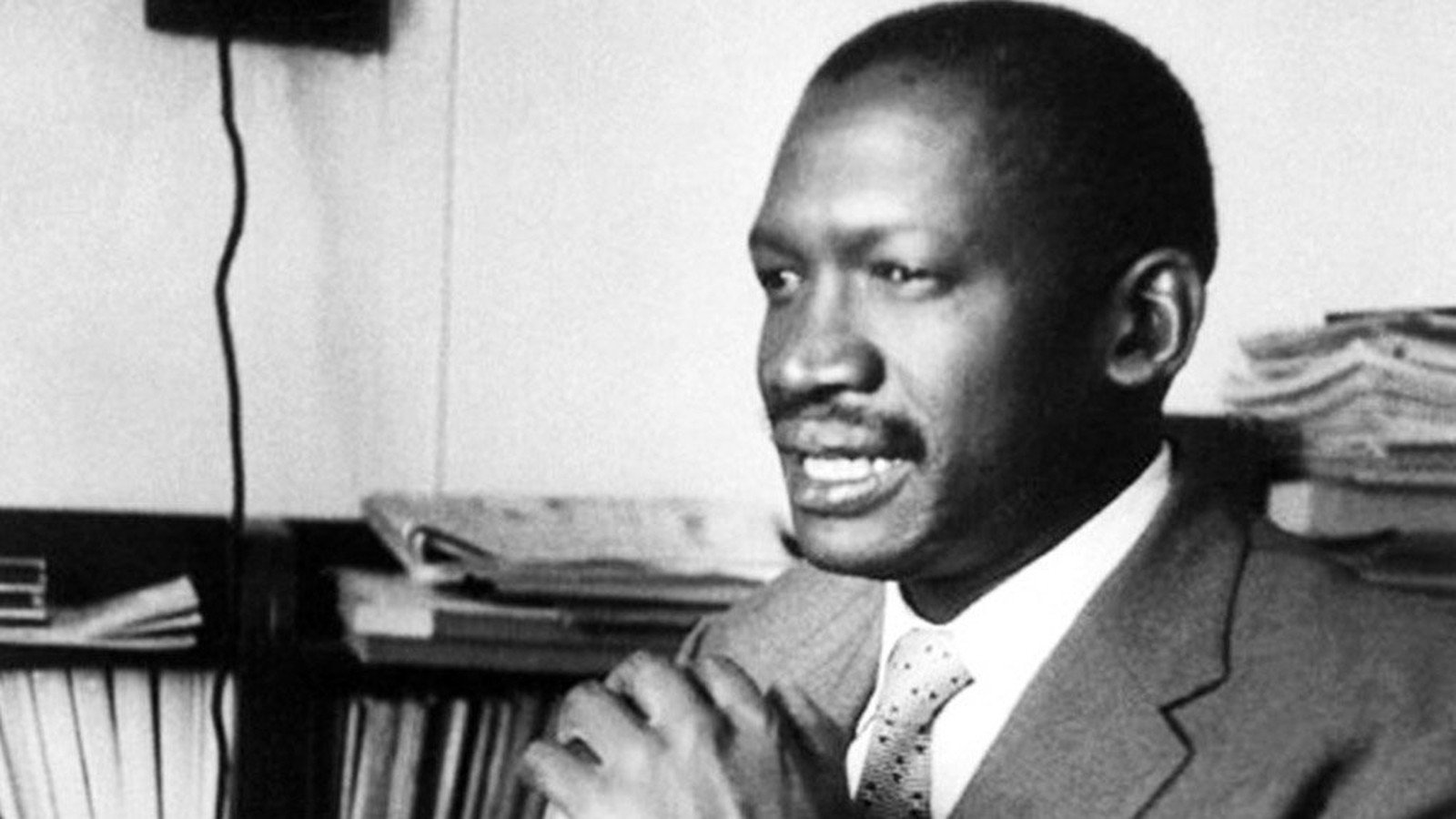
February binds them. It is the Southern Hemisphere's late summer: the afternoon thunderstorms are still gathering, the heat still pressing down on the highveld, when this month holds the birth of Sam Motsuenyane (11 February 1927), the birth of Nthato Motlana (16 February 1925), and the death of Robert Sobukwe (27 February 1978). Three men. Three spheres. One unbreakable purpose.
Forty-eight years ago this past Friday, Robert Mangaliso Sobukwe drew his last breath in Kimberley, banished, surveilled, and still unbowed. He had never stopped thinking. And that, the apartheid state knew, was the most dangerous thing of all.
This February, I find myself returning to all three of them. Not as museum pieces but as living instruction. In the struggle against apartheid, each occupied a different trench. Motsuenyane built institutions where the system said none could exist. Apartheid had placed a glass ceiling on black economic aspirations, except as the beast of burdens, providers of cheap labour. Motlana healed bodies and organised communities where the system said neither could be trusted to Black hands. Apartheid had curtailed black skills and determined that black people, regardless of capacity, would only possess such skills as would serve to oil and turn the wheels of the apartheid economy. And Sobukwe challenged the very architecture of the mind that sustained the system in the first place. Apartheid had sought not only to cut down every credible leader the black majority had, it also brutally tried to dim their ideas and prevent these from being distributed among their own people.
Different battlefields. The same war. The same demand on us now.
1. The Builder – Sam Motsuenyane
Sam Motsuenyane grew up on the Eignaarsfontein farm in Potchefstroom, the son of sharecroppers, in a society designed to keep Black men behind ploughs, not behind desks. The system assumed his ambitions would stop at the field's edge.
He had other plans.
At twenty-two, after being arrested, detained for two weeks without cause, acquitted in court, and then slapped across the face by his employer when he returned to collect his wages, Motsuenyane made a vow: he would never again work for a white man. That slap did not break him. It built him.
In 1964, he co-founded the National African Federated Chamber of Commerce (NAFCOC), the institution that would become the organisational backbone of Black business in South Africa. And then he did something that many thought impossible. He took NAFCOC's very first modest collection, a mere seventy rand from assembled delegates, and turned it into a decade-long campaign to establish Africa's first Black-owned bank.
African Bank opened its first branch in Ga-Rankuwa in 1975. Every homeland government in the country had tried to block it. The apartheid state had hedged it with conditions designed to ensure failure. And still, the branch opened.
"Where the front hoof of a cow has trodden, so must the hindleg tread." – Setswana proverb that shaped Motsuenyane's life
Motsuenyane understood something that is still radical today: economic power and political power are not separate conversations. They are the same conversation, conducted on different floors of the same building. While others debated liberation in theory, he was building the financial infrastructure that liberation would need to be real.
He later chaired the Motsuenyane Commission into the treatment of ANC detainees in exile camps. It was another act of moral courage, turning his lens inward on the very movement whose ideals he had always served. He became a parliamentarian and diplomat. He wrote his autobiography, A Testament of Hope, at the age of eighty-four. He passed away on 29 April 2024, at ninety-seven, still to the end the doyen of Black business.
From The Builder we learn: self-reliance is not a philosophy. It is a practice. Institutions do not fall from the sky. Someone had to collect the seventy rand. Someone had to make the calls, endure the rejections, wait ten years, and open the branch anyway.
The next generation of South African leaders must do the same. Demanding a seat at the economic table is not enough. Build new tables when the old ones remain guarded.
2. The Doctor – Nthato Motlana
Nthato Harrison Motlana was born in Marapyane, near Pretoria, the son of farm labourers, in 1925. He would go on to become one of the few Black students admitted to study medicine at the University of the Witwatersrand. Even then, he had to petition the apartheid government for permission to attend his own graduation ceremony in 1954.
He opened the first Black private medical practice in Soweto that year. For the next four decades, his surgery was more than a clinic. It was a sanctuary.
When the June 16 uprising erupted in 1976, students who had been shot by police were dragged to Dr Motlana's rooms. He bandaged them, hid them, and did not betray them to the security forces. The state, which had already tried him alongside Nelson Mandela during the 1952 Defiance Campaign, knew exactly who he was. And still, bleeding children came to his door, because the township knew he would not turn them away.
We would drag bleeding children, gunned down with live bullets, to Dr Motlana. We could trust him. – Sibongile Mkhabela, CEO of the Nelson Mandela Children's Fund
Motlana chaired the Soweto Committee of Ten after the collapse of the Urban Bantu Council. It was a civic leadership role that the apartheid state eventually banned, because a Black community governing itself was, to them, an act of sedition. He was also a member of the Soweto Education Crisis Committee, a predecessor to the National Education Crisis Committee (NECC). He went on to found Lesedi Clinic, the first privately owned Black hospital in the country, and the Sizwe Medical Aid Scheme, the first Black-owned medical aid fund.
After 1994, he co-founded New Africa Investments Limited (NAIL), which listed on the Johannesburg Stock Exchange as one of the country's first and most significant black economic empowerment vehicles, and owned The Sowetan newspaper. He served as personal physician to Nelson Mandela after his release from prison. He passed away on 1 December 2008, at eighty-three.
From The Doctor we learn: community leadership is not a title. It is a daily choice to put yourself between the vulnerable and the machinery that threatens them. Motlana's practice was a political act. His business ventures were a continuation of his medicine. In everything he did, the question was the same: how do we make Black life more liveable, more dignified, more free?
Ultimately, Dr Motlana's was a precursor to Amartya Sen's idea of "development as freedom". In this view, which predated Sen's, true development was not primarily about economic growth (like rising GDP), industrial expansion, or technological progress. Instead, it was about the process of expanding the real freedoms that people enjoy. It was about removing the barriers that trap people – lack of money, no voice in government, no education or access to good, quality, primary health care – so that every individual has the genuine opportunity to shape their own destiny. A developed society is not just a rich one, but a free one in the broadest sense.
The leaders we need today are not those who retreat when the system becomes hostile. They are those who open their surgery doors wider when the wounded begin to knock.
3. The Prof – Robert Mangaliso Sobukwe
Robert Sobukwe was born in Graaff-Reinet on 5 December 1924. He taught. He read. He thought with a ferocity that frightened the state more than any weapon. They called him "The Prof", and not mockingly. It was the kind of title people bestow on those who seem to carry something beyond ordinary intellect.
Sobukwe taught African Studies at the University of the Witwatersrand. He edited The Africanist newspaper. And on 6 April 1959, he stood before a gathering in Orlando, Soweto, and launched the Pan Africanist Congress. It was a movement built on the conviction that African self-determination could not be borrowed from others, that liberation had to be conceived, claimed, and led by Africans for Africa. From the founders of the ANC Youth League in 1944, he had learned and imbibed the notion that "the leaders of the African people must come out of their own loins".
The Pan Africanist Congress and the African National Congress were, despite their parting, born of the same furnace. The 1959 split was real and the ideological differences between them were genuine. But both movements drew from the same refusal: that Black people in South Africa would not accept permanent subjugation. History has always been richer than any single organisation can contain. What Sobukwe built was not a rival to that determination. It was another face of it.
On 21 March 1960, the same day as the Sharpeville Massacre, he led a peaceful march against the pass laws and was arrested outside the Orlando police station. He served three years. Then, when his sentence expired, the state passed a law specifically to hold him longer. The "Sobukwe Clause" was a parliamentary amendment designed for one man alone. It allowed his detention to be renewed year after year. He spent six years in solitary confinement on Robben Island, then was banished to Kimberley for the rest of his life.
"There is only one race to which we all belong, and that is the human race." – Robert Sobukwe, PAC Inaugural Speech, 1959
He was denied a passport. His travel was monitored. Doctors requested that he be given freedom of movement as his lung cancer progressed. The state refused. He died on 27 February 1978 in the suffocating heat of Kimberley's Northern Cape summer, having spent the final chapter of his life under conditions designed to ensure that his voice reached no one.
And yet, here we are.
Sobukwe's intellectual framework seeded movements and thinkers across the continent and continues to shape political thought today. His insistence on African agency, his rejection of dependency, his demand for a society defined not by race hierarchy but by loyalty to the African majority: these ideas did not die with him. Biko visited Sobukwe in Kimberley in September 1972 and maintained communication with him. South African History Online records that Biko was inspired by some of Sobukwe's ideas, and the Black Consciousness Movement drew on the well that Sobukwe had dug.
From The Prof we learn: ideas are the longest-lasting instruments of liberation. The body can be imprisoned. The mind, if it has been sufficiently disciplined and committed, cannot be. Sobukwe never stopped thinking. He wrote from Robben Island. He taught wherever he was allowed to stand. The state could ban the man. It could not ban the thought.
Leaders like Sobukwe teach us that the hallmark of true leaders is the ideas they embody, which they "sell" to the nation, and which the masses in turn embrace as their very own. These ideas do not emerge innately within the leaders, they are not born with them, but they develop and forge them in the course of their interaction with their material circumstances, with the suffering of the people and their pursuit for genuine freedom. In that sense, among others, Thami ka Plaatjie opines that "Sobukwe's leadership excellence was strongly influenced by his love for knowledge which extended to his love for the African people and his deep resentment for any form of oppression".
Many leaders want to lead, but where to is the question they also cannot answer. Leaders like Sobukwe teach us about the primacy of the African people thinking for themselves about solutions to the problems of their own people. But, his life also teaches us that white political and economic establishment punishes severely those African leaders who refuse to imbibe white ideas about how we should free ourselves and what freedom should mean to us.
In an era of information wars and narrative manipulation, this is the lesson we need most: principled clarity of thought, held consistently and expressed with courage, anchored in the welfare of the people, outlasts the machinery of suppression.
What February Asks of Us
These three men did not share the same ideology. Motsuenyane worked within the economic structures of his time to bend them toward Black advancement. Motlana organised civic power in the township with a doctor's precision and a politician's nerve. Sobukwe challenged the ideological foundations of an unjust society from a platform of pure principle.
They would not have agreed on everything. That is not the point.
The point is that the liberation of South Africa required all three battlefields to be fought simultaneously. Political thinkers without economic infrastructure would have had nothing to defend. Business builders without civic organisation would have had no community to serve. And community medicine without ideological clarity would have spent itself on symptoms rather than the disease.
South Africa in 2026 faces a different kind of liberation struggle. One that does not announce itself with pass laws and detention orders, but with youth unemployment among those aged 15 to 24 running above sixty percent in 2025, with an economy that has failed to grow fast enough to absorb the children of the democracy these three men helped to birth, and with institutions that are fragile precisely because leadership has sometimes confused authority with service.
The three spheres these men occupied, business, civic life, and political thought, are exactly the three spheres in which South Africa's renewal must now be built. We cannot afford to fight on only one front.
From Motsuenyane, the lesson is blunt: self-reliance is a practice, not a philosophy. Do not wait for someone else's permission. Start with seventy rand if that is all you have, and build from there.
From Motlana, it is this: put your skills in the service of the community. Leadership is not a designation conferred by power. It is confirmed daily by those you serve.
And from Sobukwe, perhaps the most urgent lesson for this moment: never surrender the clarity of your thinking to the pressure of the moment. The most dangerous thing you can do to an unjust system is to think about it clearly, speak about it accurately, and refuse to be silenced.
February has always been this country's most demanding month.
It holds our births and our deaths, our beginnings and our endings, our debts of memory and our obligations to the future. Today, on the forty-eighth anniversary of Sobukwe's passing, I honour all three of them: The Builder, The Doctor, and The Prof. The only tribute that endures is a commitment to the work they left unfinished.
The battlefields have changed. The struggle has not ended. It has only moved to new terrain: boardrooms, classrooms, data centres, community halls, and the contested space of public narrative. On every one of those terrains, South Africa needs builders, doctors, and thinkers.
It is time we became them. The future is not an accident.
“The future is not an accident.”
Dr Malusi Gigaba is a Scholar-Statesman, an ANC NEC Member, a former Cabinet Minister of the Republic of South Africa, a Member of Parliament, and a member of both the Joint Standing Committee on Defence and the Portfolio Committee on Trade, Industry and Competition.