There is a dangerous myth at the heart of our national conversation. It is the myth that Black Economic Empowerment (BEE) is to blame for South Africa's economic stagnation. That it enriched a few and impoverished the many. That it must now be discarded in favour of a supposedly neutral, race-blind alternative — as proposed by the DA's "Economic Inclusion Bill."
This myth is politically convenient, and analytically false.
Let us confront it, not with slogans, but with facts. Not with sentiment, but with substance.
The Roots of Economic Crisis Run Deeper Than BEE
South Africa's long economic malaise predates BEE, and extends far beyond it. Ultimately, South Africa's economic challenges are structural, and require a concerted, consistent, sustained and purposeful structural transformation programme. The notion that to solve our economic programmes we need more privatisation and the retreat of the state from the economy is a fallacy that the failure of the neoliberal and Washington Consensus agenda have already put paid to. In actual fact, we need more state involvement in driving the structural transformation agenda, and guiding the private sector in areas of the most strategic intervention in order to industrialise our economy and create a sustainable manufacturing sector. In addition, the state must ensure alignment of the macro-and micro-economic policies, and ensure that monetary policy supports fiscal policy if we are to achieve higher levels of growth that will make redistribution and job creation more feasible.
Between 2012 and 2022, GDP growth averaged just over 1%, youth unemployment climbed above 50%, and inequality remained among the worst globally, with a Gini coefficient consistently above 0.63.
But is BEE to blame for this?
The answer is no. Structural drivers (load-shedding, de-industrialisation, skills mismatches, spatial apartheid and policy drift) have played far larger roles. Treasury data and global research confirm this.
As economist Duma Gqubule notes:
"You cannot rely on private investors alone to kick-start growth in an economy stuck at 1%. The state's macroeconomic choices are decisive."
The real problem is not that BEE exists. It is that BEE was never designed to fix macroeconomic stagnation on its own. And it has been poorly enforced, unevenly implemented, and too often gamed.
What BEE Actually Is — and Is Not
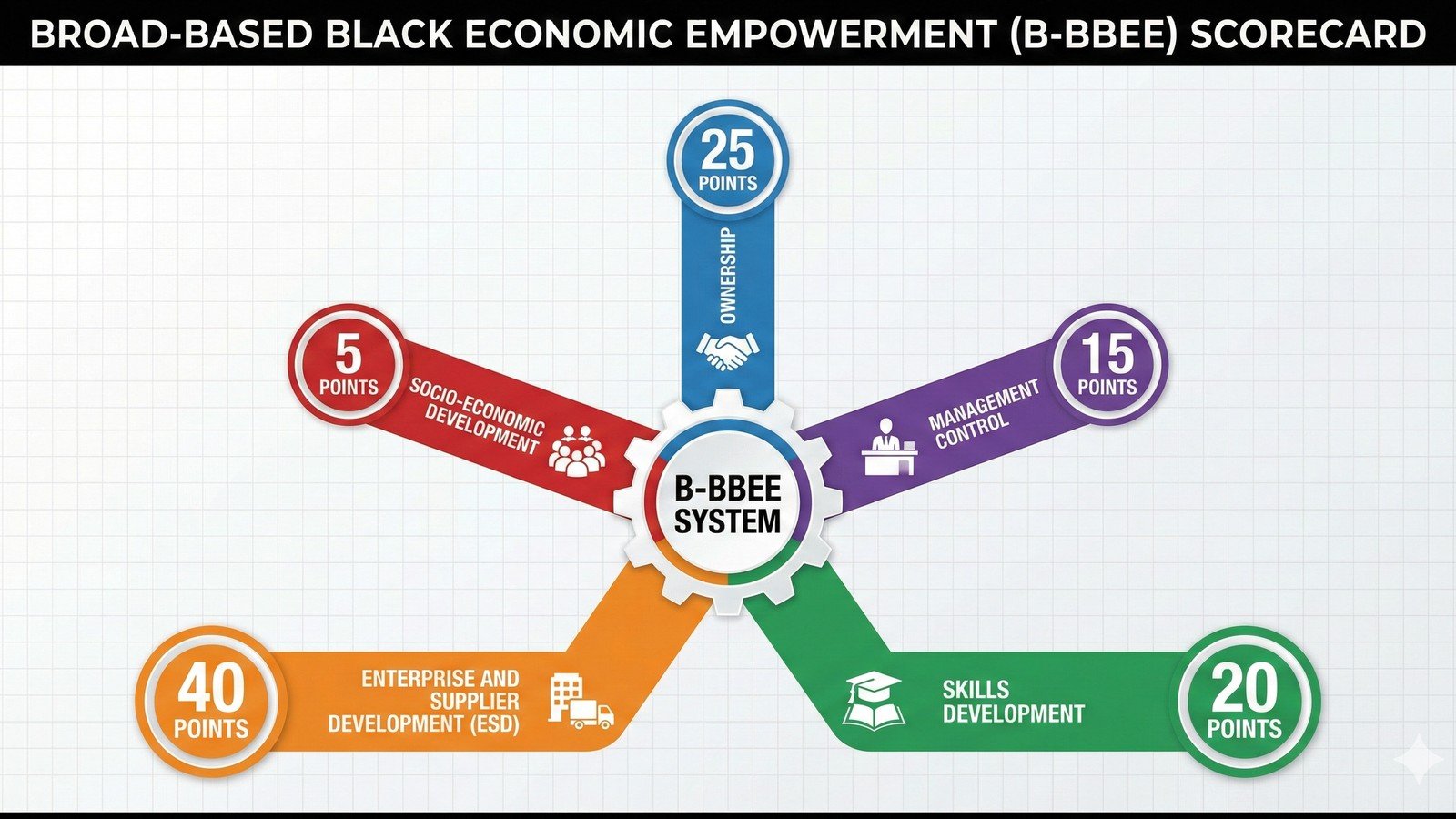
The Broad-Based Black Economic Empowerment (B-BBEE) framework is not a tender scheme. Nor is it a cash giveaway. It is a scorecard-based system that evaluates companies on five criteria:
- Ownership – 25 points
- Management control – 15 points
- Skills development – 20 points
- Enterprise and supplier development (ESD) – 40 points
- Socio-economic development – 5 points
Together, ESD, skills development and socio-economic development account for more than 75% of the total scorecard. Yet most criticisms of BEE focus narrowly on elite ownership deals: a mere 24% of the score.
These elements are linked to procurement, licensing and investment incentives. Compliance is voluntary in law, but practically mandatory if one wishes to do business with the state or major corporates.
Commissioner Tshediso Matona puts it clearly:
"The policy is voluntary in law, but you must comply if you want to do business with the state."
This is not unusual. Many countries use similar tools: Malaysia, India, Brazil, Canada, and the United States all have active equity and inclusion policies aimed at redressing group-based historical injustice. BEE is part of a broader global practice, not a South African anomaly.
Afrikaner Empowerment Was Real — and State-Engineered
Those who argue that BEE is 'reverse racism' often forget how the Afrikaner community was itself uplifted: through the full machinery of the state.
From 1910 to 1994 (for more than 80 years), white governments deployed a systematic, state-led strategy to elevate poor Afrikaners. The 1932 Carnegie Commission diagnosed the "poor white problem" and recommended targeted job reservation, state employment preference, Afrikaner financial institutions and education reform.
What followed was nothing short of a national mobilisation:
- Sanlam, Volkskas, Avbob and Assupol were created or expanded to pool Afrikaner capital.
- Job reservation laws (e.g. Industrial Conciliation Act, Apprenticeship Act) excluded black South Africans from skilled work.
- Public Service Acts enabled Afrikaner dominance in state employment.
- The University Extension Act (1959) locked black students out of Afrikaner universities.
By 1994, Afrikaners dominated key sectors of finance, infrastructure and state enterprise, not by free markets, but by design.
To quote the report:
"The Afrikaner experience shows that comprehensive, institutional, and exclusionary state planning — however unjust — delivered durable economic outcomes."
If this was legitimate state-driven upliftment, how can we now claim that BEE (a less aggressive, constitutionally-aligned policy) is somehow illegitimate?
What the Data Really Shows
Black ownership of JSE-listed assets remains below population share. While official figures suggest around 30% black ownership (including pension funds), stricter readings show only 5.8% of South African-based listed assets are directly owned by black South Africans.
On management:
- African women remain vastly underrepresented in top roles.
- White men, about 3–4% of the population, still hold a disproportionately high share of senior positions.
On enterprise development:
- Over R26 billion is spent annually on supplier development, yet the quality varies.
- Genuine black-owned SMEs benefit in some cases; in others, it is box-ticking.
On skills development:
- Over R41 billion has been invested annually by measured entities.
- Yet the link between training and job placement remains poorly tracked.
These are not signs of a failed policy. They are signs of incomplete transformation.
Why the Youth Must Not Be Misled
Youth unemployment in South Africa remains among the highest in the world: 45% by official estimates. This statistic is weaponised by BEE critics who argue that race-based policies have failed the next generation.
But such claims collapse correlation into causation. As the evidence shows:
"South Africa's joblessness and inequality flow from de-industrialisation, low growth, skills deficits, energy and logistics failures, and entrenched spatial apartheid."
BEE was never designed to fix unemployment on its own. But it has channelled billions into skills development, with R41.6 billion spent in one year alone: much of it targeted at youth.
Yet, young black South Africans remain underrepresented in leadership pipelines and formal work.
This is the reform challenge, not the policy's failure, but its incomplete follow-through.
As the B-BBEE Commissioner said:
"We must move from input-based compliance to outcome-based transformation."
The youth must not be misled into blaming the only policy tool that names them, invests in them, and opens doors once closed to their parents.
Reform, Not Retreat
It is easy to scapegoat BEE. It is harder to fix what is broken.
The DA billboard claimed: "BEE made elites rich and left SA poor." The party's proposed "Economic Inclusion Bill" seeks to remove race entirely from redress, replacing BEE with a poverty-based inclusion mechanism.
But here's the flaw:
- Poverty in South Africa remains structurally racialised. The average white household earns more than five times what the average black household earns.
- Removing race from redress would flatten history, erasing the very structures we seek to undo.
- As critics of the DA proposal point out, a race-neutral approach may sound fair, but it is blind to the enduring economic footprint of apartheid.
The policy choice is not "race or poverty." It is whether we can design redress tools that account for both.
What we need is not repeal, but reform:
- Tighten enforcement: Focus on outcomes, not tick-boxes.
- Fix measurement: Use annual reports and rand-value disclosures.
- Support genuine SMEs: Shift ESD from PR to productivity.
- Centre African women: Hard targets, real accountability.
As the report states:
"The choice is not between BEE and no BEE. It is between a refined, evidence-driven transformation framework… or a noisy, symbolic system that keeps generating paperwork while inequality remains unchanged."
A Just Economy is a Designed Economy
We must end the double standard. If Afrikaner upliftment through state design was valid, so too is black economic redress.
BEE is not the enemy of growth: stagnation is. Corruption is. Elite capture is. We must fight those evils without abandoning the moral arc of economic justice.
Because empowerment is not charity. It is equity.
And equity is not a handout. It is a correction.
It is time to reimagine BEE, not bury it.
However, we cannot discount the views that seem to suggest that it is time to go beyond BEE in order to advance the economic agenda of the black majority, to increase the participation of black people in production and ownership of productive assets. Above all else, we must implement a meaningful structural transformation programme.
“The future is not an accident.”
Dr Malusi Gigaba is a Scholar-Statesman, an ANC NEC Member, a former Cabinet Minister of the Republic of South Africa, a Member of Parliament, and a member of both the Joint Standing Committee on Defence and the Portfolio Committee on Trade, Industry and Competition.