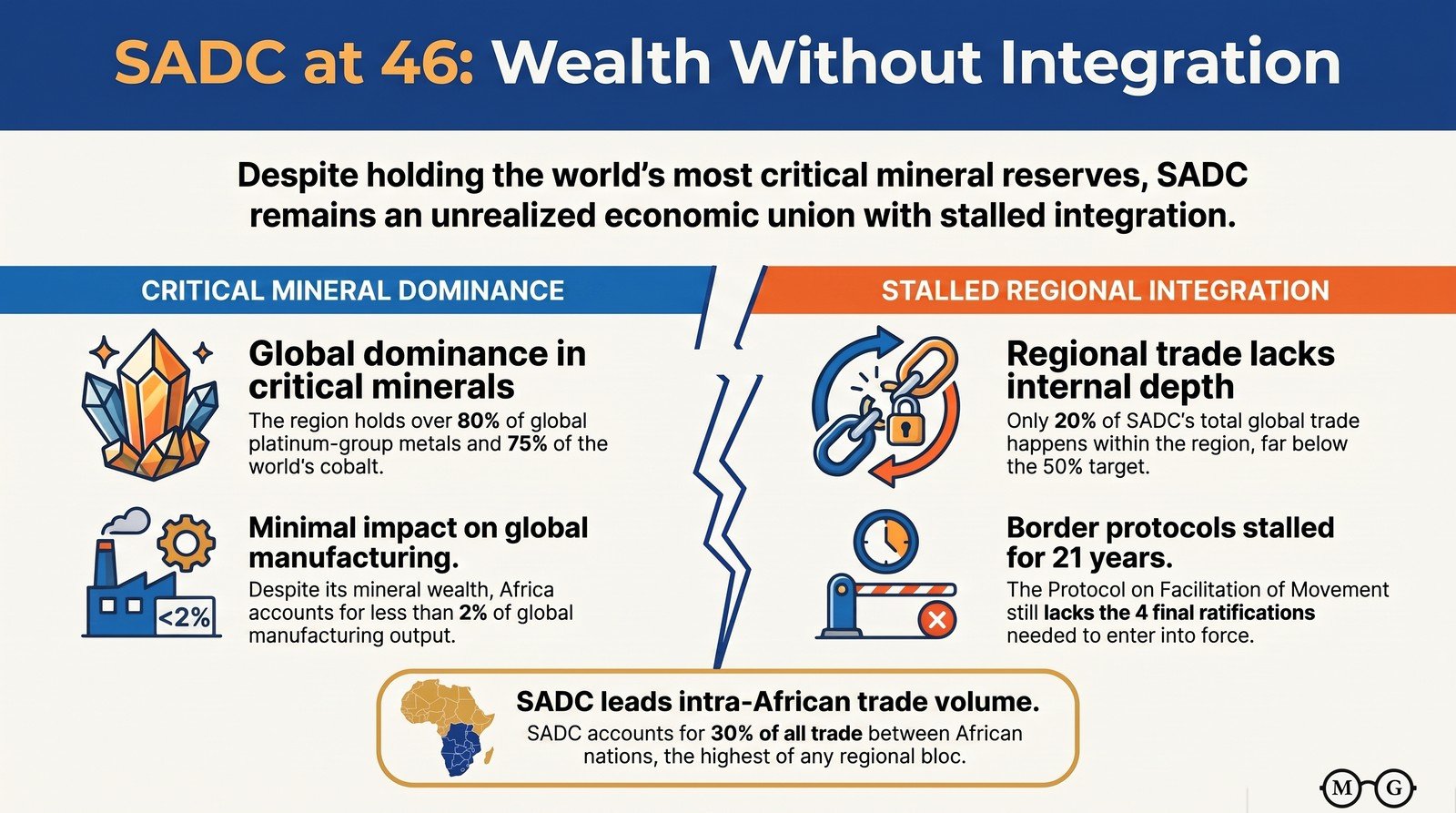
SADC at 46: the region holds more than eighty per cent of the world’s platinum-group metals and three-quarters of its cobalt, and conducts about a fifth of its trade inside itself — against a target of half.Compiled 16 August 2026. Sources: USGS Mineral Commodity Summaries 2026; African Development Bank; tralac; SADC.
On 1 April 1980, in Lusaka, the leaders and representatives of nine southern African states adopted a declaration titled Southern Africa: Toward Economic Liberation. Five of them were the Frontline States: Angola, Botswana, Mozambique, Tanzania and Zambia, the informal caucus of heads of state chaired by Julius Nyerere. They were joined by Lesotho, Malawi, Swaziland, and a Zimbabwe then seventeen days short of its independence. The declaration founded the Southern African Development Coordination Conference. Reducing the region's economic dependence on South Africa was the first of its four stated aims.
Not cooperation. Not integration. Escape.
That was forty-six years ago.
Twelve years later, on 17 August 1992, in Windhoek, a different signing took place. The Coordination Conference became a Community. A loose arrangement of shared sectoral responsibilities acquired legal personality, a Summit, a Council of Ministers, a Secretariat, and a Tribunal. The objective changed with it: no longer liberation from South Africa, but integration of Southern Africa. That anniversary falls tomorrow. It will be thirty-four years.
Two foundings. Two purposes. And tomorrow morning, in Durban, the forty-sixth Ordinary Summit of Heads of State and Government opens under the chairship of the Republic of South Africa: the country the first founding was designed to escape. The Organ Troika sits today. The heads of state arrive in the morning.
There is no irony in that. Irony is what we reach for when we would rather not draw a conclusion. The proper response is a question: has it worked? Not whether we like the answer. Whether it worked.
What was actually built
Begin with the achievement, because the failures only matter if the thing was real.
It was real. In August 2008 the SADC Free Trade Area came into effect, with eighty-five per cent of intra-regional trade moving at zero duty; by January 2012 liberalisation reached its maximum. Of all eight of Africa's Regional Economic Communities, SADC trades more with itself than any other. That is not a small thing on a continent whose economies were built to trade with Europe and with each other only by accident.
But I should give the qualifier rather than wait for someone to supply it. "More than any other" is a statement about size, not about depth. Just over thirty per cent of all the trade that happens between African countries happens inside SADC, the largest share of the eight and by a distance. Measure it the harder way, though, as a share of the region's own trade with the world, and the figure is about a fifth. That is not my number. It is the one our own Minister of International Relations gave in Durban four days ago, in the speech accepting the chair, immediately before committing us to a target of fifty.
Both of those are true at once. We are the continent's largest internal market and we conduct a fifth of our business inside it. The distance between twenty and fifty is the honest measure of what forty-six years has and has not achieved.
In August 1995 the Southern African Power Pool was founded: twenty-one utilities across twelve countries, with functioning day-ahead, intra-day and forward physical electricity markets. Power crosses these borders in a way people still cannot.
And there is a record in peace and politics that deserves to be stated plainly. SADC has been drawn into Lesotho repeatedly: militarily in 1998 and again in 2017, and through mediation in 2014. The mediation in Zimbabwe that produced the Global Political Agreement of September 2008. Last October, when Tanzania held an election, the SADC Electoral Observation Mission publicly declared it flawed: against the incumbent, in a bloc that decides by consensus. Anyone who believes our regional institutions are merely clubs of the governing should sit with that fact for a moment.
Sit, too, with this one. Since October 2024, four SADC member states have changed their governments at the ballot box: Botswana, where the ruling party was defeated after fifty-eight years; Mauritius; Malawi, where a sitting president conceded to his predecessor; and Seychelles. In the same period, on the assessment of the V-Dem Institute, five of the seven countries in sub-Saharan Africa moving towards democracy rather than away from it were SADC members.
That is what was built. Now the rest.
The border that never opened
I held the Home Affairs portfolio, so I write this chapter from inside the administrative record rather than about it.
On 18 August 2005, at Gaborone, SADC adopted a Protocol on the Facilitation of Movement of Persons. Article 36 provides that it enters into force thirty days after two-thirds of member states deposit their instruments of ratification: eleven of the sixteen, as the Community now stands.
It is not in force. It has never been in force. The protocol turns twenty-one the day after the summit.
Malawi signed it in July, taking the number of signatures to ten. But signing is not ratifying, and the ratifications have not come. How many have come I cannot tell you with confidence, and neither, I think, can anyone else working from the public record. The UN Economic Commission for Africa names four ratifying states. A 2015 count records six, and names two the Commission leaves out. The number circulating in the press this week is seven, unnamed. The sources do not merely differ on how many have ratified; they differ on which countries have. A regional instrument whose ratification count cannot be established from the Community's own documents is telling you something before you have read a word of its contents.
Four days ago in Durban, taking the chair of the Council of Ministers, South Africa urged member states to adopt it.
Compare. The Economic Community of West African States has operated a free movement regime phased in from 1979, a protocol older than our organisation itself, and on the African Development Bank's most recent Visa Openness Index it has reached one hundred per cent reciprocal visa-free access among its members. The East African Community's Common Market has been in force for sixteen years. And SADC? SADC's visa reciprocity fell last year, from sixty per cent to fifty-two. Not stalled. Reversed.
Yesterday the Sunday Times, citing people it did not name, reported that Zimbabwe and Mozambique had resisted having the protocol tabled as a stand-alone item. Our own department disputes the framing: its spokesman told the same paper the matter had been placed on the agenda, to be taken within the discussion of migration protocols. I record both, because I cannot settle it. What is not in dispute is that the published summit agenda carries no stand-alone item on the free movement of persons.
So let me ask the question the whole matter turns on. If the border did not open, did the people stop crossing?
They did not. On the 2022 Census, 83.7 per cent of South Africa's immigrant population comes from SADC countries, of just over two-point-four million international migrants the census counted in all.
How many of them hold papers, nobody can tell you, and it is worth understanding why before anyone reaches for a percentage. Writing in the Sunday Times this morning, the Statistician-General, Risenga Maluleke, set out the problem. Home Affairs keeps permit and deportation records. The Border Management Authority holds port-of-entry data. Stats SA produces both the mid-year population estimates and the monthly tourism figures. "None is designed to match automatically."
“Better-connected systems would not make migration easy to count in real time — nowhere is it easy — but they could provide one reliable figure, clearly linked to its source, instead of leaving the public to choose between four different numbers.”
— Risenga Maluleke, Statistician-General and head of Stats SA, Sunday Times, 16 August 2026
Consider what that describes. We are asked to hold a firm view about a movement we have not legislated, cannot count, and report in four numbers that were never built to agree. Then we are surprised that the argument generates more heat than light. The protocol's failure did not prevent the movement. It only prevented the movement from being managed.
That is the whole lesson, and it is not a lesson about migrants. It is a lesson about states. A state that cannot manage mobility cannot, in the end, govern; and a region that will not legislate the movement it already has is not protecting itself, it is merely refusing to look. We built a border regime that produces neither security nor order: only vulnerability for those who cross and pretext for those who resent them.
Failure to manage human movement negates the vision of the founding fathers of both the OAU and SADC. Dr Kwame Nkrumah made the argument plainly: he advocated for a more united Africa as a mechanism to create economies of scale, maximise Africa's power in global economic and political relations and ensure we defeat colonial legacy of division and vulnerable micro-states. His view was that if Africa stays divided, wealthy countries of the Global North would keep controlling the prices of commodities. To meet the demands of independence and improve living standards, Africa must use all its creativity and skills, and mobilise the whole continent's resources through unity.
Migration management is therefore not an option for any of us to get out of, but it is a gateway towards a much bigger vision of a vastly improved status for Africa in the world.
Steve Biko put it to a Cape Town conference in January 1971.
“The most potent weapon in the hands of the oppressor is the mind of the oppressed.”
— Steve Biko, White Racism and Black Consciousness, 1971
Forty-six years ago this region organised itself to reduce its dependence on a state that had made those borders instruments of control. We inherited that architecture. We have kept it. Nobody makes us keep it.
What is not in force
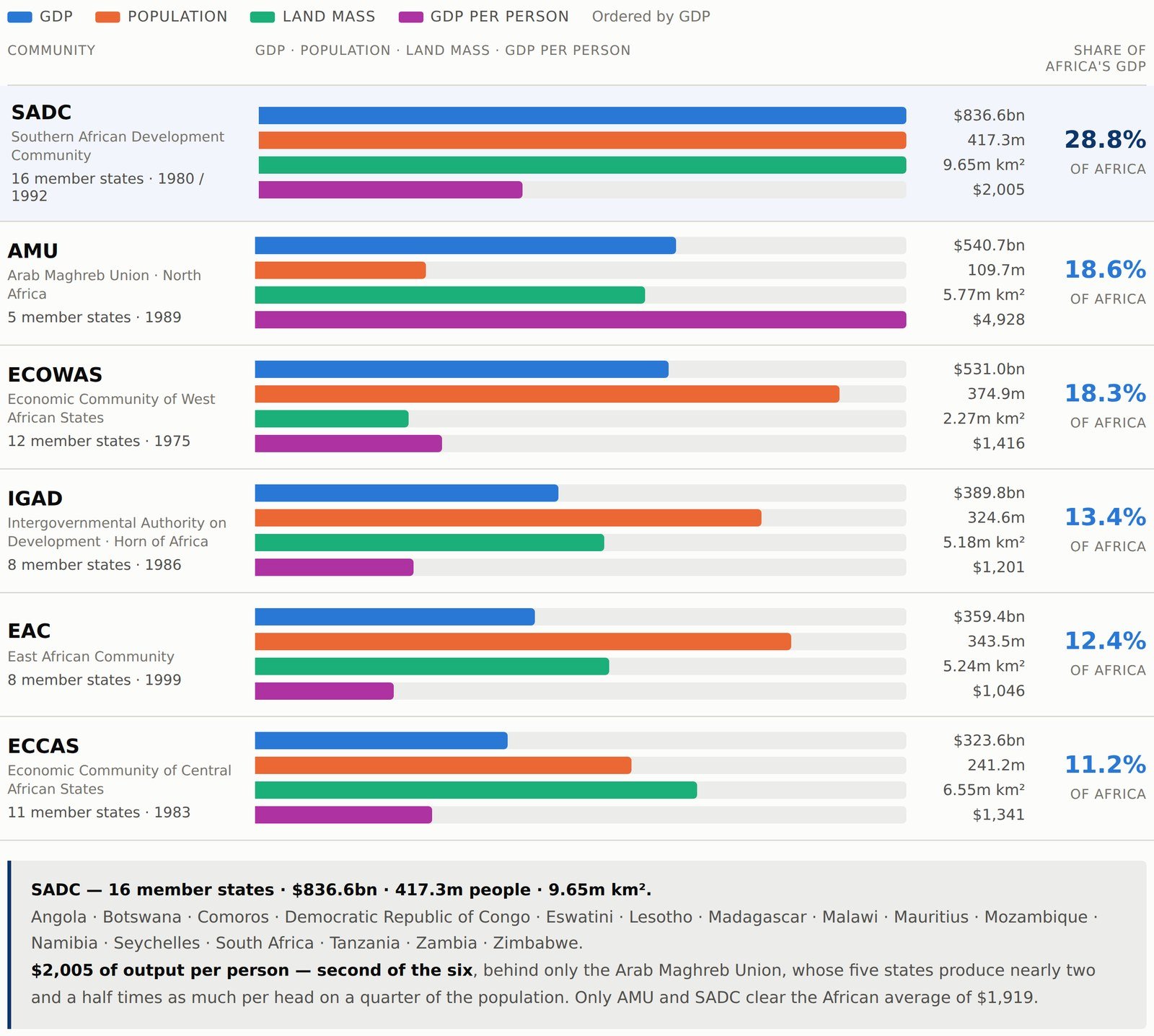
Figure 1 — Africa’s six region-anchored Regional Economic Communities, ordered by economic output. Bars are scaled independently within each measure; the fourth is a ratio and must be read down the column, not across. Sixty seats sit across fifty states, because eight countries hold membership of more than one community.Sources: African Union; UN Population Division; World Bank; IMF. Compiled 16 August 2026.
The 2003 Regional Indicative Strategic Development Plan set out a sequence. Free Trade Area by 2008. Customs Union by 2010. Common Market by 2015. Monetary Union by 2016. Economic Union by 2018.
The first was achieved. The other four were not.
The revised Plan, running to 2030, restates those objectives without target dates at all. Confronted with four missed deadlines, the institutional response was not to explain them, not to resequence them, not to concede that the sequence had been wrong. It was to delete the deadlines.
Nor does the Community have a court. The SADC Tribunal began work in November 2005. It was suspended in 2011 and disbanded in 2012. A replacement Protocol signed in 2014 by nine member states, eight of them after South Africa withdrew its signature in 2019, confining the court to disputes between states and removing the right of individuals to approach it at all, has never entered into force. No SADC tribunal has sat since 2012. A citizen of West Africa may bring a human rights complaint to the ECOWAS Court of Justice without even exhausting domestic remedies first. A citizen of Southern Africa has nowhere to go.
I want to be fair about the structural obstacle, because part of this is not a failure of will. Between them, the eight communities and the two regional mechanisms have a hundred and six members. The African Union has fifty-five. The Democratic Republic of Congo belongs to four: ECCAS since 1983, COMESA, SADC since the Blantyre summit of September 1997, and the East African Community since 2022. It trades freely under none of them. It sits outside the SADC free trade area, as Angola does. It sits outside COMESA's. Four memberships, no liberalisation.
And the African Union invited this. The Abuja Treaty of 1991, which set out how the continent's economies were to be joined, made an objective of "the establishment of other communities where they do not exist." When the Union finally moved to contain the proliferation, at Banjul in July 2006, it suspended the recognition of new communities. It capped how many bodies could exist. It said nothing about how many a state might join. Sixteen years later the DRC joined a fourth, and broke no rule.
One country has ever resolved its own overlap by choosing. Tanzania gave notice on COMESA in 1999 and left the following year, because it could not reconcile a zero-tariff commitment there with what it had undertaken elsewhere. It remains the exception.
That is a reason. It is not an excuse, and the difference matters. The inherited architecture explains why a customs union is hard. It does not explain the deleted deadlines, and it certainly does not explain a dissolved court.
And there is a genuine dilemma here that I do not think is honestly served by pretending otherwise. When Mali, Burkina Faso and Niger fell to coups, ECOWAS suspended them and imposed sanctions. On 29 January 2025, all three left the organisation altogether. When Madagascar fell to a coup in October 2025, SADC declined to suspend it, engaged the transitional authorities, dispatched a Panel of Elders, and kept sixteen members. One bloc enforced and lost a third of West Africa. The other accommodated and held together.
I do not put that forward as a defence of accommodation. A coup is a coup, and a regional body that cannot say so plainly has mislaid something. But anyone who demands that SADC be as hard-edged as ECOWAS should be made to say what they would have done on the morning after those three departures, and to accept that a regional community holding together is not, on its own, a moral achievement. It is only ever an opportunity.
What this region is sitting on
The theme of the summit that opens tomorrow is critical minerals. Let us take it at its word.
The countries of SADC hold, on the United States Geological Survey's figures, more than eighty per cent of the world's reserves of platinum-group metals and produce about eighty-one per cent of its platinum. They produce roughly three-quarters of the world's cobalt and around sixty per cent of its rough diamonds by value. Add close to half the world's chromite ore, better than a third of its manganese, and in Zimbabwe the largest lithium producer on the continent.
On no other measure does this region lead Africa by anything approaching those margins: not population, not output, not integration, not institutional strength. The energy transition the whole world says it intends to make cannot be made without what is under this ground.
And here is the paradox that I think is the true subject of this anniversary. A bloc holding the largest concentration of the minerals the century requires cannot open its own borders, cannot seat its own court, and cannot agree a common tariff.
What does that cost? It is not a rhetorical question, and it has a documented answer.
In December 2025 the Democratic Republic of Congo, a SADC member state, signed a Strategic Partnership Agreement with the United States. On the published analysis of its terms, it grants American companies a right of first offer on mineral sites, ahead of Congolese investors. It establishes a joint steering committee, five American members and five Congolese, sitting inside the governance of Congolese minerals. It requires preferential fiscal treatment for American persons, with a decade of tax stabilisation. It requires the DRC to amend its mining law, its tax policy and potentially its own Constitution within twelve months. And in the drafting, the Congolese obligations are expressed as shall, while the American commitments are expressed as intends to.
It is before the Congolese Constitutional Court. Over fifty members of the United States Congress have raised objections to it. It may not survive in its present form. But the lesson does not depend on its survival, and it is this: when terms are not set here, they are set elsewhere. A region that cannot agree the rules among sixteen of its own will find that somebody has drafted rules for one of them, in a language of shall and intends to.
Nor is it only the terms of extraction that are drafted elsewhere. It is the roads out. The Lobito Corridor, which carries Congolese and Zambian copper to the Angolan coast, is being rebuilt with European and American money: a Global Gateway package from Brussels, and financing from the G7's infrastructure partnership. Last September a Chinese state-owned contractor answered with one-point-four billion dollars under a thirty-year concession to modernise TAZARA, the Tanzania–Zambia railway China built in the first place, in the years when Zambia was still trying to escape a different dependence, and the work was launched in Lusaka in November. Two corridors, two sponsors, one purpose. The route by which Southern Africa's minerals reach the sea is now a question other people are answering, with their own money, for their own reasons.
And there is a harder number still, one that no summit theme survives contact with. For all that is under this ground, Africa accounts for less than two per cent of global manufacturing output and just 1.4 per cent of its manufacturing exports. We hold four-fifths of the world's platinum and capture a fraction of what is made from it. We hold three-quarters of the world's cobalt and do not make the cells. The energy transition will be built out of Southern African rock and assembled somewhere else, and that is not a prediction. It is a description of what is happening now.
I want to be careful not to make this a complaint about the world. In May the African Development Bank published its Industrialisation Index and recorded that Morocco had passed South Africa as the most industrialised economy on the continent, the first time since the index began measuring in 2010. I should be straight about the margin: nineteen ten-thousandths of a point. But the margin is not the part that should trouble us. The Bank publishes the whole series, and the whole series is the story. In 2010 our score was 0.8819 and Morocco's was 0.7807. By 2024 ours had fallen to 0.8396 and Morocco's had climbed to 0.8415. The Bank credits Morocco's sustained industrial upgrading and export diversification; of us it says only that South Africa "continues to experience a long-term gradual decline in industrial competitiveness". Four SADC countries are in the continental top ten. But the country that holds the platinum was overtaken by a country that does not, and nobody imposed that on us.
So when the theme says industrialisation, the question to put to it is not whether the ambition is correct. It obviously is. The question is what will be in force by the time the chair changes hands.
What forty-six years asks of those who held office
So: has it worked?
Partly. The dependence the founders of 1980 set out to reduce has indeed reduced. South Africa's share of the region's economic output has fallen from about sixty per cent at the turn of the century to roughly half today. Copper from the Copperbelt now reaches the sea through Lobito and through Dar es Salaam, by routes that do not touch a South African port at all.
But look closely at how that happened. The dependence loosened not because the region built alternatives to us out of strength, but substantially because we declined: our rail failing, our ports congested, our power interruptible, our growth the slowest of any region on the continent. The founders of 1980 wanted a region that needed South Africa less because it had more. What we have produced is a region that needs South Africa less because South Africa has less.
And there is a fact about that relationship which South Africans rarely say aloud. Our merchandise trade surplus with SADC is larger than our entire national trade surplus. Take the region out of the accounts and the balance inverts. In 2024 we sold some thirty-one billion United States dollars in goods to the rest of the continent, more than ninety per cent of it into SADC. And what we sell there is not what we sell elsewhere. To China we sell ores. To the United States we sold, until recently, minerals and motor cars. To the region we sell things we have made. The Department of Trade, Industry and Competition told Parliament as much in June. This region is not a charity attached to our economy. It is the reason we still have a manufacturing export base at all.
That is not the same achievement. It is barely an achievement at all.
There is a clock on this that nobody mentions. When the continent set out how its economies would be joined, in the Abuja Treaty of 1991, it gave itself a transition "not exceeding thirty-four (34) years", with an outer cumulative limit of forty. The thirty-four years run out in May 2028. Even the outer limit expires in 2034. A customs union at regional level was to have been completed inside the first of those, and has not been.
Which brings me to the only demand I want to make of a summit, and I want it to be small enough that nobody can hide behind its grandeur. Not another masterplan. Not another strategy running to 2063. Not another theme.
Ratify the protocol. Four more member states, and the free movement of
persons in Southern Africa enters into force. Four signatures. It has been four
signatures for two decades, through six chairships and more communiqués than
any of us have read, while millions crossed those borders anyway because life
required it of them and the law had nothing useful to say.
An organisation is not what it announces. It is what it has in force.
South Africa takes the chair of a Community founded to be less dependent on South Africa. I can think of no more exacting test of whether this country has understood what the region is for. The test will not be met by what is said in Durban tomorrow. It will be met, or it will not be met, by what is in force when we hand the chair on.
“The future is not an accident.”
Dr Malusi Gigaba is a Scholar-Statesman, an ANC NEC Member, a former Cabinet Minister of the Republic of South Africa, a Member of Parliament, and a member of both the Joint Standing Committee on Defence and the Portfolio Committee on Trade, Industry and Competition.