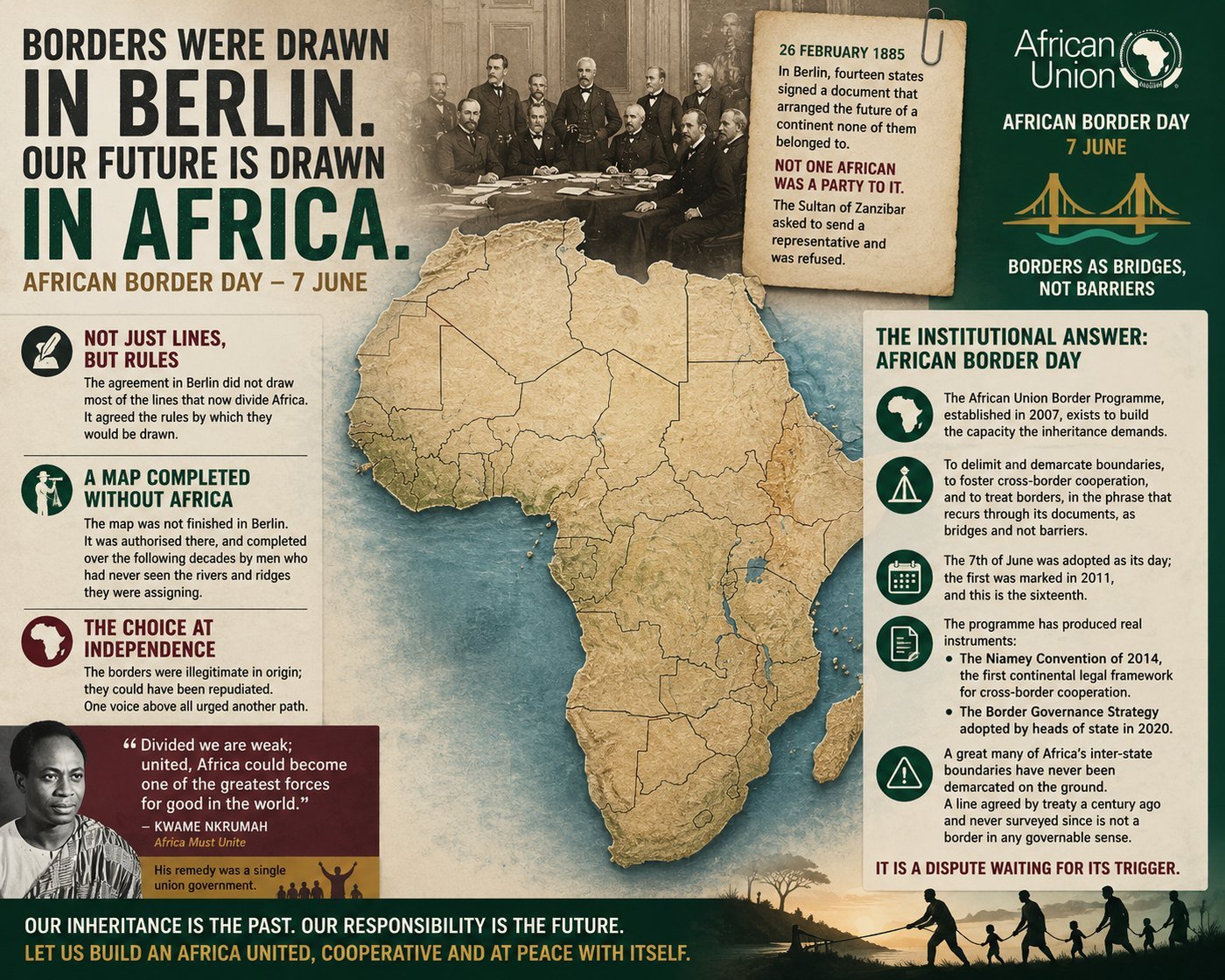
On 26 February 1885, in a chancellery in Berlin, fourteen states signed a document that arranged the future of a continent none of them belonged to. Not one African was a party to it; the Sultan of Zanzibar asked to send a representative and was refused. And yet the agreement those powers signed did not, in fact, draw most of the lines that now divide Africa. It did something more lasting. It agreed the rules by which they would be drawn.
That distinction is not a historian's quibble. It is the whole inheritance, and Africa has spent more than a century living inside it. The map was not finished in Berlin. It was authorised there, and completed over the following decades by men who in most cases had never seen the rivers and ridges they were assigning.
I come to this as more than a reader of that history. I have administered one of these borders. For that reason I take African Border Day, marked each 7 June, not as a commemoration but as an audit. The lines are an inheritance; refusing to let them go on dividing us is now our work, and no one else's. The audit has to begin with how they came to be.
The rules were written in a room with no Africans in it
What was Berlin for? Not, in the first instance, for Africa at all. The conference Otto von Bismarck convened in November 1884, at the prompting of King Leopold II of Belgium, sat for some three and a half months and produced the General Act, a treaty of thirty-eight articles concerned with free navigation on the Congo and Niger and with the procedure by which one European power could claim African territory and have the others recognise the claim. Its purpose was to keep the European powers from going to war with one another over the continent. In that, it succeeded. The entire cost of that success was charged to people who were not in the room.
What passed for method
It is worth asking what science governed the division of a continent, because the answer explains the burden Africa carries now. Almost none. No principle of nation, language, watershed or people decided where the lines fell. Where the map shows a straight edge, a meridian or a parallel, it records the absence of any African fact in the decision. The nearest thing to a rule was the doctrine of "effective occupation," under which a claim counted only where a power actually administered the ground, and its effect was not justice but a race inland to seize what had so far only been sketched.
And sketched is the word. By the 1880s the outline of the continent was known to European cartographers, but its interior was among the last blank spaces on the world map, alongside the poles, with the Congo basin and the Great Lakes still being filled in. Borders were therefore agreed in European capitals across country no European had surveyed and, in places, none had seen. Lord Salisbury, the British Prime Minister of those years, described the exercise with a candour that still indicts it: "We have been engaged in drawing lines upon maps where no white man's foot ever trod; we have been giving away mountains and rivers and lakes to each other, only hindered by the small impediment that we never knew exactly where the mountains and rivers and lakes were." The men dividing Africa did not know what they were dividing, and said so.
What Berlin actually fixed was only the Congo, and for a reason worth naming: the Congo was the quarrel the conference had been called to settle, between Leopold's International Association, the French claims pressed by the explorer Pierre de Brazza, and Portugal's older claim to the river's mouth. The compromise neutralised the basin, guaranteed free navigation, professed to abolish the slave trade, and handed Leopold personal title to what became the Congo Free State, a territory the size of Western Europe governed as one man's private property, with consequences now counted among the gravest crimes of the colonial age. France would in time assemble the largest African empire by area and Britain the most strategically placed, but the conference's immediate beneficiary was a single private individual. The rest of the map was completed over the next twenty years, treaty by treaty, which is why independence reached most of the continent only in the 1950s and 1960s, against boundaries that had taken half a century to draw and not a day to consult an African.
Before the line, Africa held space differently
To see what the colonial border did, it helps to see what it displaced. The notion of a border as a hard line, fixing the exact point where one sovereign's writ ends and another's begins, was largely foreign to African statecraft. As Jeffrey Herbst's work on African states argues, power here was organised to govern people rather than to fence land: it gathered at the centre and thinned with distance, fading into frontier zones rather than stopping at a surveyed edge, with sovereignty often shared in the hinterland and movement across it an ordinary fact of life. This was not disorder. Mali and Songhai, the Asante kingdom, the Sokoto Caliphate, Great Zimbabwe, the kingdom of Benin were complex and durable states. What they did not hold was the European conviction that a state is an unbroken line drawn around a people.
The colonial line was the opposite proposition: fixed, total, indifferent to whatever lay beneath it. It is the deepest of the inheritances, because it changed not only where the borders ran but what a border was taken to be. The independent African state inherited more than the wrong lines. It inherited a European theory of the line itself, and has governed by that theory ever since.
As well as breaking up the natural economies and social systems of the indigenous people, what followed the Berlin Conference broke up the natural process of nation-state formation in Africa and created, through partition, the vulnerable states Ali Mazrui described.1
“The partition of Africa … resulted in some of the most vulnerable societies in modern history… At the centre of this calamity is the role of the West in creating an international system that has reduced proud Africans to the lowest caste of the twentieth century. How will post-colonial Africans overcome this condition in the twenty-first century?”2
— Ali A. Mazrui, preface to The Curse of Berlin: Africa After the Cold War
Only our creative imagination today could picture what African statehood would have been had it evolved naturally, with borders drawn by states as they grew. We must deal with the colonial disruption as we confront it in reality, not in imagination, and forge the Africa we must, not the one that ought to have formed centuries ago. That train has long left the station.
A related grievance is often folded into this one, and a scholar's discipline is to keep them apart. The familiar world map does shrink Africa: the Mercator projection of 1569 renders a continent some fourteen times the size of Greenland as though the two were near equals, which is why the African Union endorsed the "Correct the Map" campaign in 2025. But that is a distortion of cartographic mathematics, not of the partition. The two only rhyme, in that each is a case of Africa drawn by others to their own proportions.
“… a great people has nothing to do with petty history, nor with ethnographic reflections sorely in need of renovation. It matters little that some brilliant Black individuals may have existed elsewhere. The essential factor is to retrace the history of the entire nation. The contrary is tantamount to thinking that to be or not to be depends on whether or not one is known in Europe.”
— Cheikh Anta Diop (1973)
Diop’s warning holds for the cartographer as much as for the historian. Correcting the map and governing the borders are different tasks, and the continent is owed both.
What the lines did to the ground beneath them
The lines were not drawn on a blank page. They fell across living societies, and what they did to them is the substance of the inheritance.
They split single peoples. German Kamerun, seized in 1884, was divided between Britain and France after the First World War; in a United Nations plebiscite in February 1961 its Southern Cameroons joined the French-speaking republic while its Northern Cameroons joined Nigeria. One people, two colonial languages, two legal traditions, and, decades later, a war. The Anglophone crisis that began in 2016 with a strike by lawyers and teachers and hardened into armed conflict the following year is, at root, a quarrel over which colonial language governs a courtroom and a classroom. It has killed thousands and uprooted many more. That is what an ungoverned line does when it is left to fester inside a state instead of being governed across one.
Closer to home, the same logic split the BaTswana, the EmaSwati and the BaSotho down the middle. There are today more BaTswana, EmaSwati and BaSotho living in South Africa than in Botswana, Eswatini and Lesotho; families sit on both sides of the fence, crossing borders, passport in hand where they bother with one at all, to visit kin or to conduct family rituals, and communities on either side of the line answer to the same traditional authority. The travesty cannot be explained in any rational way.
They lumped strangers together as readily as they split kin. On 1 January 1914 the British amalgamated their Northern and Southern protectorates into a single Nigeria, largely so that the southern surplus would cover the northern deficit: a Muslim north of emirs and a religiously plural south bound into one state because it balanced a colonial ledger. And they dissolved sovereign kingdoms into administrative units. When the Gold Coast became Ghana in 1957, the territory it inherited included the Asante kingdom, broken as a power, its king Prempeh I deported to the Seychelles and its sovereignty ended by annexation after the rising of 1900 led by the Queen Mother Yaa Asantewaa. A state that had governed for centuries became a province on another power's map.
The same logic still speaks in the continent's tongues, sorted into Francophone, Anglophone and Lusophone blocs that answer to no African geography, only to which European power held the pen. The language an African child is schooled in was, for most of the continent, chosen in a European capital. That is the inheritance entire: peoples split, strangers conjoined, kingdoms dissolved, and a map, even a set of languages, imposed from outside. The temptation is to dwell there. That is not our work. The injury is settled and acknowledged; the question we are obliged to ask is the next one.
The choice to keep them, and the warning that came with it
When independence came, the new states faced a decision rarely treated as the decision it was. The borders were illegitimate in origin; they could have been repudiated, the map redrawn by language or kinship or precolonial polity. One voice above all urged them not to accept the inheritance as it stood. Kwame Nkrumah warned that an Africa left balkanised would be picked off and re-colonised piece by piece, and pressed instead for continental union. "Divided we are weak," he wrote in Africa Must Unite; "united, Africa could become one of the greatest forces for good in the world." His remedy was a single union government.
The assembled states chose a narrower path. At the first ordinary session of the Organisation of African Unity, in Cairo in July 1964, they adopted Resolution AHG/Res.16(I), recording that border disputes were "a grave and permanent factor of dissension" and pledging "to respect the borders existing on their achievement of national independence." This was not nostalgia for the colonial arrangement. It was a judgement that a continent relitigating every inherited line by force would be worse than the injustice of the lines themselves, that the building of states needed a settled foundation more than a perfect one. The principle the lawyers call uti possidetis has held for sixty-two years, and now stands in law as Article 4(b) of the Constitutive Act of the African Union. It is among the most consequential acts of collective self-restraint in modern political history, and Africa is owed the recognition of it.
But Nkrumah's warning did not expire because the vote went the other way, and to respect a line is emphatically not to accept it. Keeping the borders was never a concession that they were just; it was a refusal to add the catastrophe of redrawing fifty of them by force to the injury of their drawing. The real project, the one this continent has set itself, and the one I pursued, imperfectly, from the Home Affairs lectern, is neither to honour the lines nor to redraw them, but to drain them of their power to divide, to make the border matter less and less until it can no longer wound. That is not capitulation. It is Nkrumah's unity sought by other means: not yet the single union government he envisaged, but the patient dissolution of the border's dividing force through integration. Cairo closed one question and opened another we are still answering.
A day on the calendar, and what it was meant to do
African Border Day is the institutional answer to that second question. The African Union Border Programme, established in 2007, exists to build the capacity the inheritance demands: to delimit and demarcate boundaries, to foster cross-border cooperation, and to treat borders, in the phrase that recurs through its documents, as bridges and not barriers. The 7th of June was adopted as its day; the first was marked in 2011, and this is the sixteenth. The programme has produced real instruments, the Niamey Convention of 2014, the first continental legal framework for cross-border cooperation, and the Border Governance Strategy adopted by heads of state in 2020, against an uncomfortable fact it exists to confront: a great many of Africa's inter-state boundaries have never been demarcated on the ground. A line agreed by treaty a century ago and never surveyed since is not a border in any governable sense. It is a dispute waiting for its trigger.
Borders are an integration question before they are a security one
Say "border" and the mind reaches for security: smuggling, trafficking, the movement of weapons, the illegal crossing. I understand the reflex; I governed under it. But to treat the border as a security problem first is to mistake the symptom for the structure. The border is, before anything else, where the continental project either works or fails, and what fails there is not abstract.
The partition built an economy designed to face outward. It cut Africa into more than fifty mostly small markets, laid each colony's railways to carry raw materials to a coastal port and on to a European capital rather than to a neighbour, and left a litter of separate customs, currencies and legal systems, so that an African trader still meets more friction reaching the next country than reaching Europe. It precluded whole regions from trading with one another and from forging a common economic diplomacy, a legacy that persists today.
The result has outlived the empires that built it: on the eve of the African Continental Free Trade Area, intra-African trade stood at roughly sixteen percent of the total, against some sixty percent in Asia and nearly seventy in Europe, by the measure of the United Nations Economic Commission for Africa. Africa traded with everyone but itself, because it had been built to.
Read against that inheritance, the African Union's Agenda 2063, the continent's fifty-year blueprint, "The Africa We Want," adopted in 2015, is best understood as a programme of repair, and its flagship projects as an inventory of fragmentations to be reversed: the free-trade area to reunite the severed markets, the Single African Air Transport Market to connect the cities the map left facing outward, the African Passport and free movement to lower the borders the partition raised. None is a foreign idea imposed on Africa. Each is the undoing of a specific thing done to it.
But the inheritance also obstructs the cure, and that is the harder truth this day requires. A treaty a truck cannot cross is a document, not an economy, and the free-trade area, though now in operation, is slowed at every crossing by the very apparatus the colonial line bequeathed: clashing customs regimes, a thicket of non-tariff barriers, transport that still runs to the coast. The African Passport, launched with ceremony in Kigali in 2016, remains in practice a document for officials. The Protocol on Free Movement of Persons, adopted in 2018, needs fifteen ratifications to take force; eight years on, it has four. It would be too easy, and not quite honest, to lay all of this at Berlin's door: the slowness is also present political choice, the instinct to guard a revenue base, to shield a labour market, to hold the inherited border as a possession. But that instinct is itself inherited. The colonial state taught the African state to read the border as a thing to be defended; integration asks us to treat it as a thing to be shared. That remains the unfinished business between the map drawn after Berlin and the Africa that Agenda 2063 describes.
And it is not, in the end, a matter of ledgers. The lines fell through living communities, assigning a market town to one flag and the farms that fed it to another. For the people of the borderland, whether a boundary is well or badly governed is the daily question of whether a child reaches the school on the far bank, whether a trader may sell across a line her grandmother crossed freely, whether a clinic treats the sick on both sides. To govern the border well is to govern for them first. They did not draw the line, and they have lived longest with its neglect.
The mobility test, and a record I am implicated in
If trade is one face of the border, the movement of people is the other, and the harder one. The Southern African Development Community adopted a Protocol on the Facilitation of Movement of Persons in 2005; two decades on, it has still not entered into force, for want of ratification by the required two-thirds of its members. The continent that pledged at Cairo to respect its borders has been markedly slower to agree how its citizens may cross them.
The 2017 White Paper on International Migration was produced under my tenure, and it was not a weak document. Its vision, a more open, Afrocentric movement regime for Africans, in line with Agenda 2063 and away from the colonial migration legacy, was ahead of the national consensus of its day, and the continent has been moving toward it ever since. That intent was, I still hold, the right one. What fell short was not the paper but the capacity of the state to deliver it: the resourcing that did not arrive, the systems that were not built. When I have graded my generation's record as incomplete and poor, that is the part I mean. The ambition was right, and time is bearing it out.
I have set out elsewhere some of my own experience of the complexity of migration on the continent. South Africa is the largest receiving country for migrants, regular ones, above all tourists, and irregular ones, mostly economic migrants and asylum-seekers; most asylum-seekers here are in truth economic migrants. To deal with that honestly, South Africa must shift its paradigm away from combating migration toward managing it, so that ordinary citizens can realise its economic and security benefits rather than only fear its costs.
Migration management is a real paradigm shift. It redirects resources toward ensuring that those who enter do so as documented migrants, who can themselves be protected from arbitrary action by the state or by their neighbours. It demands an all-of-state effort, across national government and between its tiers, and a whole-of-society one, involving labour, business and civil society. And it demands that South Africa engage its near and distant neighbours, as we actively tried to do, in a shared responsibility, because no single country, least of all a high-receiving one, can manage migration alone.
There is, however, a significant gap between the good intentions of policy and the resources government has provided to manage a phenomenon that grows more complex by the day. The Border Management Authority needs a substantial funding upscale, and so does the South African National Defence Force in its border-patrol role. Without that, our borders remain porous and we are condemned to react rather than anticipate, which breeds among South Africans a corrosive sense of being overrun.
What we should be building toward is "soft borders": a management approach that allows relatively free movement of people, goods and services with minimal friction while still maintaining oversight, emphasising cooperation, economic integration and flexibility, and managing security risks through less intrusive means, shared databases, intelligence cooperation, the mutual recognition of travel documents. That is the opposite of the fortified, wall-and-checkpoint border, which remains necessary only in the absence of the trust that soft borders require.
Realising that future has preconditions, and naming them is not erecting barriers to free movement but making it possible. Countries must document their nationals and hold reliable, automated population databases; be able to share those databases where there is genuine concern; issue their people identity and travel documents; encourage regular, documented movement through recognised ports of entry; collaborate in managing migration; and, above all, develop their own economies so that fewer of their citizens are forced to move under duress. The African Union began precisely where it was safest, issuing the AU Passport first to Commissioners as a test; SADC adopted its Free Movement Protocol; the Peace and Security Organ has reaffirmed the goal in meeting after meeting. The dream remains; the work of the preconditions is how it is reached.
These same conditions would reduce irregular migration and protect the most vulnerable, women and children above all. Africa loses too many of its ablest young people to violent seas, drowned in unsafe boats bound for Europe. That has to be stopped, not by arresting them and not by leaving them to be swallowed by the water as an earlier age left them to the slave ships, but by regularising their movement across countries and regions. In a meeting of African and European interior and migration ministers in Tripoli, the late President Muammar Gaddafi challenged Europe directly: many of those crossing the Mediterranean, he argued, were merely following resources taken from Africa during the colonial period, and Europe could not disown its share of the cause. Europe took no responsibility. One need not adopt the messenger to register the point: a continent cannot reasonably be asked to police a migration crisis whose origins it did not create while responsibility for those origins goes unacknowledged.
The most practical answer is the unglamorous one. In 2015 we launched a pilot community border-crossing point at Tshidilamolomo, on the South Africa–Botswana border, a community split between the two countries along the Molopo River by a boundary that runs some 1,840 kilometres. Residents must cross daily or weekly for work, school, shopping and family, yet the nearest official ports of entry lie hours away. The pilot enrolled residents on both sides through their governments, with machine-readable documents, proof of residence and biometric verification on each entry and exit, and a special border pass, reuniting in practice a community that a colonial line had divided in principle. Solutions of that kind, rolled out at points jointly identified with our neighbours, ease the pressure at the major ports of entry and build, crossing by crossing, the documented population databases on which any humane mobility system depends.
The principle is the one the Border Programme states and the one I hold to: a state that cannot govern mobility cannot, in the end, govern. The refugee, the cross-border trader, the migrant worker, the student are not exceptions to the order of the continent. They are that order, in motion. A border policy that meets them as threats first has misunderstood both the people and the border.
What this day actually asks
Founding documents are not nostalgia. The General Act of Berlin was a founding document, and its legacy is a map. Resolution AHG/Res.16(I) was a founding document, and its legacy is the discipline that has kept that map from becoming a battlefield. Africa Must Unite was a founding document of another kind, and its warning against balkanisation is still unspent. The instruments of the African Union Border Programme are founding documents too, and their legacy is unwritten, because their legacy is the work that remains.
That work is unglamorous. It is the survey team in the borderland, the harmonised customs form, the demarcation commission whose findings make the news in no country at all. It is exactly the patient institutional labour that political short-termism is built to neglect, its rewards a decade away and its costs in this year's budget. But it is the labour on which the continental project now rests. The lines were drawn for us, and against us, by men who are long dead. Refusing to let them divide us any longer is ours to do, and there is no one else to whom it can fall.
"The future is not an accident."
Dr Malusi Gigaba is a Scholar-Statesman, an ANC NEC Member, a former Cabinet Minister of the Republic of South Africa, a Member of Parliament, and a member of both the Joint Standing Committee on Defence and the Portfolio Committee on Trade, Industry and Competition.
1 Atul Kohli (State-Directed Development, 2004) characterises most African states as either fragmented-multiclass or neo-patrimonial. Other writers — Walter Rodney, Amílcar Cabral, Thandika Mkandawire, Frantz Fanon, Ben Turok among them — have offered their own readings of the African state; Hamza Alavi and Régis Debray theorised post-colonial states in Asia and Latin America in ways that travel to the African case, focusing on the structural constraints on genuine independence.
2 When Mazrui asked how post-colonial Africans would overcome being the "lowest caste" of the twentieth century in the twenty-first, he ascribed social agency to today's Africans. If colonialism was above all a socio-economic system, and not merely foreign administration, then the question of whether any part of the continent is yet "post-colonial" remains open. Mazrui's challenge is to exercise that agency: to become a post-colonial people, and a people equal to others in the global division of labour and the global order.