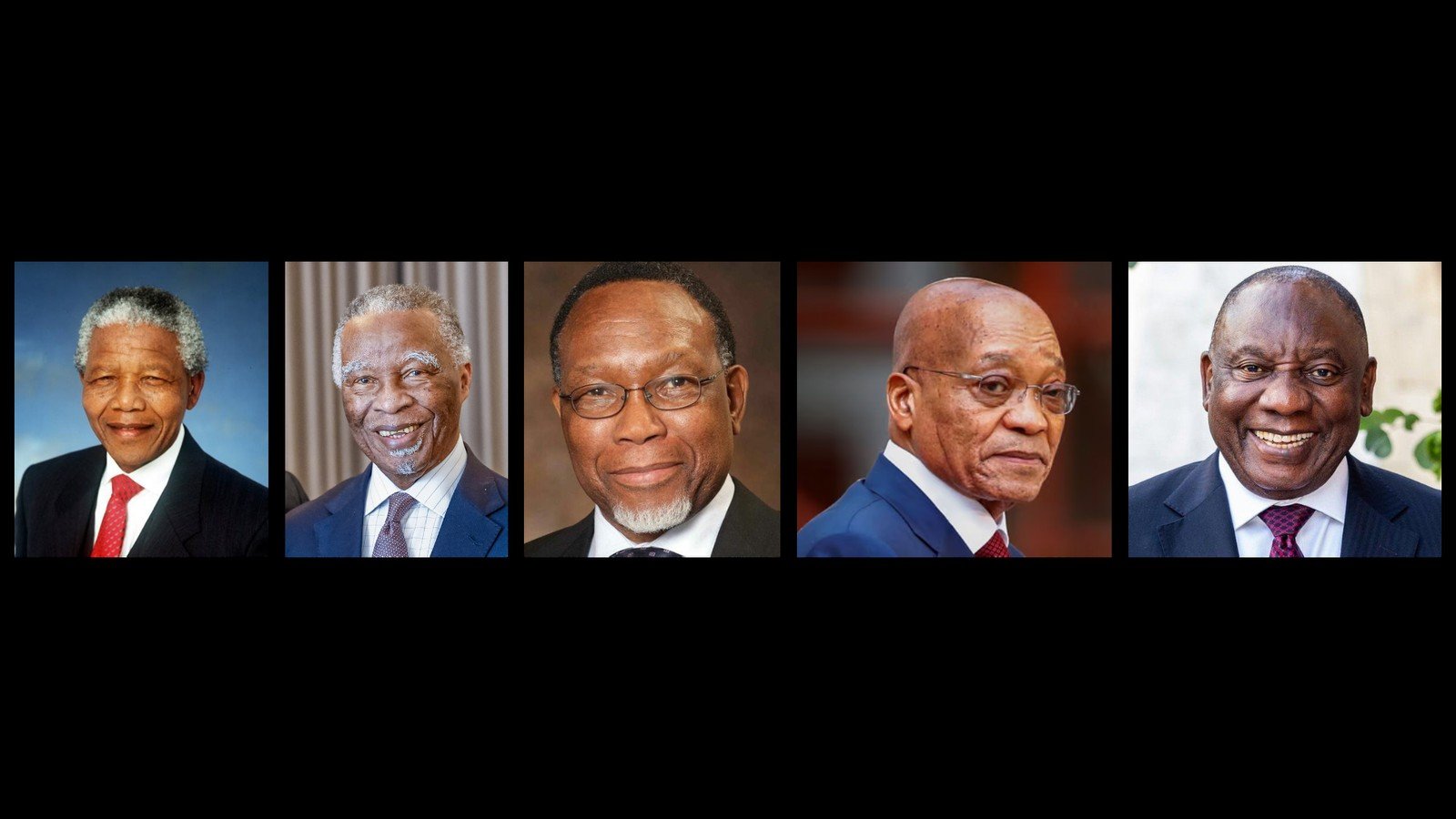
February is a month that asks South Africans to pause.
On 2 February 1990, the apartheid state announced the unbanning of liberation movements that had been criminalised for decades. Nine days later, on 11 February, Nelson Mandela walked out of Victor Verster Prison. Those two moments did not end history. They reopened it.
What followed was not a single story, but a sequence of presidencies, each shaped by the pressures of its time. Each president inherited a different country from the one before. Each faced a distinct mix of threat and possibility. Each left behind a legacy that tells us something not only about leadership, but about the evolving demands of South Africa's democracy.
If we are honest – and honesty matters here – these legacies are uneven. They contain achievement and constraint, ambition and limitation. Taken together, however, they form a record worth studying, especially as the country looks ahead to a new and uncertain chapter.
1. Nelson Mandela – Holding the Centre
Nelson Mandela's presidency was not primarily, and/or only, about policy innovation. It was about survival – national survival and rebirth.
South Africa in 1994 was a country suspended between hope and catastrophe. The risk was not abstract. It was immediate: civil conflict, institutional collapse, and the possibility that political freedom would be consumed by vengeance.
Mandela's defining contribution was stabilisation through reconciliation, unity and reconstruction. Yet this choice was neither easy nor universally celebrated. From the moment he signalled a commitment to reconciliation rather than retribution, Mandela faced sustained criticism from multiple quarters – including sections of the liberation movement, victims of apartheid violence, and those who believed that compromise amounted to moral surrender.
Yet these were not merely his personal preferences, but those of the ANC and the broader democratic movement. They were informed by the experiences of the African continent, and by the strategic priorities developed to ensure a successful transition to democracy.
However, these criticisms were not marginal. Some sectors argued that justice required punishment, that reconciliation without prosecutions would entrench impunity, and that forgiveness would come at the expense of accountability. The establishment of the Truth and Reconciliation Commission was, in part, a negotiated response to these tensions – a compromise reflecting both the demand for truth and the limits of a fragile transition.
Mandela did not deny the pain behind these objections. But he stood his ground.
He understood that the politics of retribution, however emotionally satisfying in the short term, carried long-term risks for a deeply divided society with fragile institutions and armed constituencies on all sides. His choice was not naïveté. It was foresight.
By choosing constitutionalism over triumphalism, Mandela anchored South Africa's transition in restraint. He set a precedent that power would be exercised within rules, not above them – even when those rules frustrated legitimate anger.
History has affirmed the wisdom in, and absolved, that choice.
Mandela secured South Africa's right to exist as a constitutional democracy. The task that followed was different: to decide what that democracy would do with its survival.
2. Thabo Mbeki – Beyond Survival, Towards Agency
If Mandela's task was to hold the country together, Thabo Mbeki's was to move it beyond the psychology of transition.
Mbeki believed South Africa could not define itself narrowly as a post-apartheid state seeking acceptance, but had to act as an African country with a responsibility to shape its environment.
During his presidency, South Africa played a central role in advancing NEPAD and championed the transformation of the Organisation of African Unity into the African Union. He also supported the establishment of the African Peer Review Mechanism as a voluntary governance framework among African states.
Mbeki championed economic reforms that, while controversial – including GEAR – contributed to a sustained period of macroeconomic stability, rising growth rates, declining debt levels and, for a time, a budget surplus prior to the 2008 global financial crisis.
He had his drawbacks – including a divisive HIV and AIDS debate and tensions within the tripartite alliance – but his tenure expanded South Africa's strategic imagination and embedded African agency in institutional form.
3. Kgalema Motlanthe – Custodian of Constitutional Continuity
Kgalema Motlanthe's presidency was brief, but not insignificant.
Assuming office during a period of political transition and global financial uncertainty, his contribution was custodial. He ensured that the machinery of government functioned without rupture and that leadership transition occurred within constitutional bounds.
In doing so, he reinforced a critical democratic norm: that political turbulence would not translate into institutional instability.
4. Jacob Zuma – Embedding South Africa in a Shifting Global Order
Jacob Zuma's presidency remains the most contested in South Africa's democratic history.
It would, however, be analytically incomplete to treat his period as devoid of lasting strategic consequence.
One enduring development was South Africa's formal entry into BRICS in 2011. South Africa was not a founding member and did not initiate its creation. Its inclusion followed an invitation from existing members, reflecting recognition of its diplomatic reach and continental standing.
Measured by GDP, South Africa remains the smallest member of the bloc. Yet its contribution lay in its institutional credibility and its role as the only African member at the time. This broadened BRICS' legitimacy and reinforced it as a Global South formation.
In hindsight, BRICS membership did not confer power, but it conferred options. As global politics has grown more fragmented, this positioning has expanded South Africa's diplomatic room to manoeuvre.
Among the more durable policy initiatives of this period were the adoption of the National Development Plan 2030, significant infrastructure investment commitments, the establishment of new universities, and expanded health and social policy frameworks. These reflected an expansive developmental outlook, even as governance failures came to dominate the national conversation.
However, allegations of "state capture" became the defining controversy of this period, eclipsing other policy initiatives and shaping public memory of the presidency.
5. Cyril Ramaphosa – Containment in an Age of Volatility
Cyril Ramaphosa inherited a state under strain.
Rather than reactive politics, calibrated manoeuvre has defined much of this presidency.
During COVID-19, the emphasis was on institutional mobilisation and constitutional procedure. With coalition politics and the Government of National Unity, the priority was stability over dominance. In global affairs, South Africa has avoided binary alignments between competing powers.
This approach has frustrated those seeking rapid and meaningful transformation. He has often been accused of being cautious on certain matters. In key areas of economic reform – including energy stabilisation, freight logistics improvement and the restructuring of Transnet and Eskom – the administration has demonstrated measurable intent.
Ramaphosa's legacy, still unfolding, is likely to be judged less on bold breakthroughs than on whether the state remained intact during sustained volatility.
What the Pattern Tells Us
Leadership is shaped by context.
Karl Marx observed in The Eighteenth Brumaire of Louis Bonaparte that people make their own history, but not under circumstances of their own choosing. Each president operated within constraints inherited from the past.
As Dan O'Meara reminds us, organisation and ideology remain central in shaping how social struggles unfold. Our leaders do not exist outside these dynamics.
The next chapter will be shaped by three pressures.
The first is economic growth that is fast and sustainable enough to absorb a large youth cohort. Youth unemployment remains extraordinarily high.
The second is state capability in the systems that make sustainable growth possible. Electricity reliability and freight logistics remain binding constraints.
The third is the development of human capabilities through sustained investment in education, health and social development.
For the next president, the lesson is not imitation, but synthesis – continuity and change. The challenge is to aggregate the strengths of prior leadership while embracing the reforms required for meaningful, sustainable growth and redistribution.
The next presidency will not begin on a blank page. It will inherit a democracy that has survived transition, asserted agency, navigated global realignment, and endured volatility.
The task ahead will be less about redefining South Africa than about making it work.
“The future is not an accident.”
Dr Malusi Gigaba is a Scholar-Statesman, an ANC NEC Member, a former Cabinet Minister of the Republic of South Africa, a Member of Parliament, and a member of both the Joint Standing Committee on Defence and the Portfolio Committee on Trade, Industry and Competition.