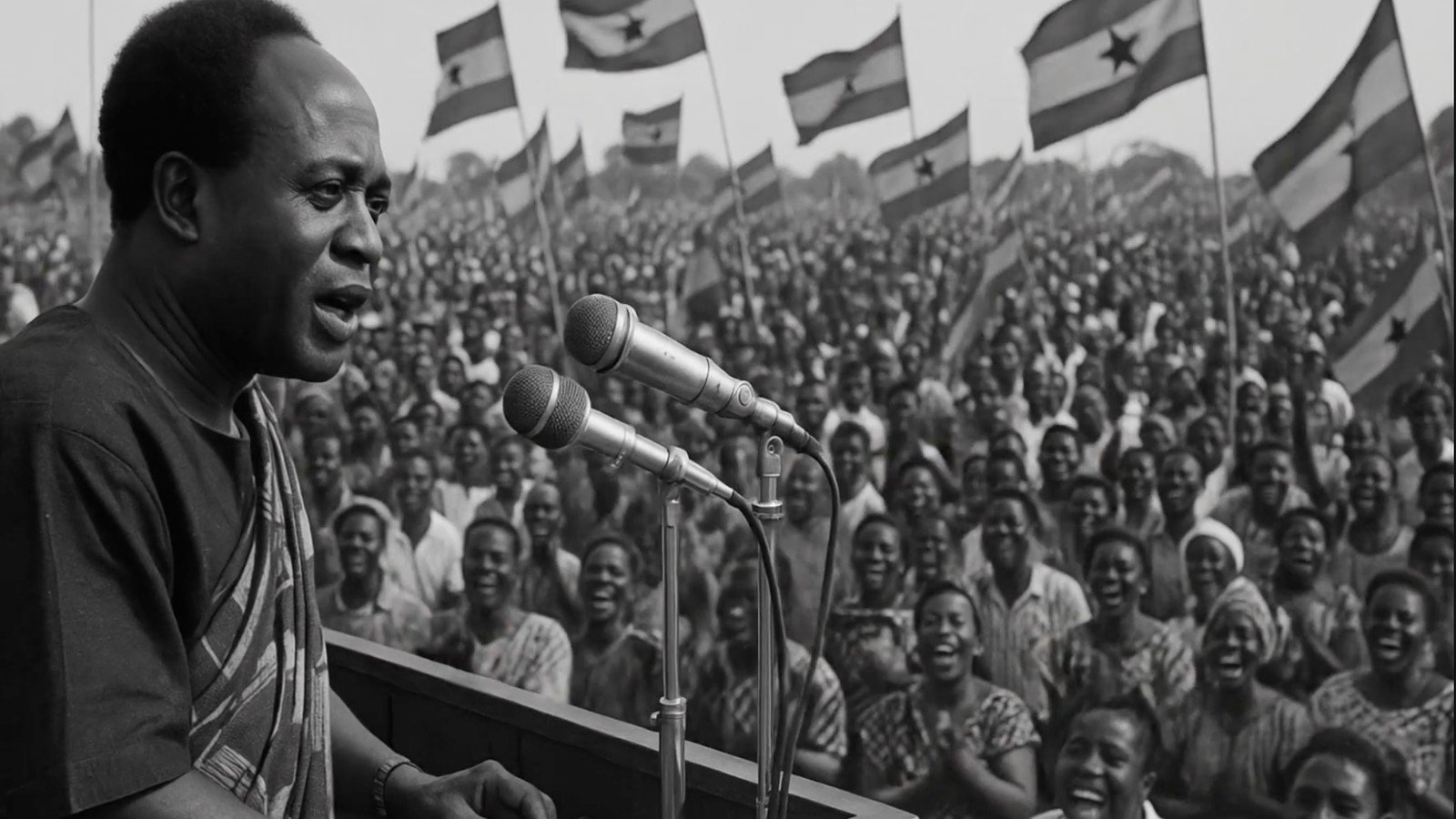
Today, Ghana pauses to honour Dr Kwame Nkrumah, the country's first President and one of the towering figures of Africa's independence generation. Dr Nkrumah was born on 21 September, 116 years ago. For us across the continent, his legacy is not confined to Ghana's borders. It speaks to the entire Pan-African project – to the struggle for African unity, dignity, and sovereignty that defined the 20th century and continues to shape our destiny today. Leaders like Dr Kwame Nkrumah believed in African unity and independence as a sine qua non for human progress. I write this reflection as part of our Heritage Series, mindful that history is not simply about what happened, but about what it teaches us for the future.
The Road to Independence
Kwame Nkrumah's place in history was secured even before he became President. Ghana, then the Gold Coast, became the first sub-Saharan African country to gain independence from a European colonial power on 6 March 1957. This achievement was not an accident of history; it was the result of Nkrumah's unrelenting campaign.
In 1949, he broke away from the cautious United Gold Coast Convention (UGCC) to form the Convention People's Party (CPP), rallying the masses under the demand of for "Self-Government Now." He mobilised workers, farmers, and students through "Positive Action" – strikes, boycotts, and civil disobedience. Though imprisoned by the colonial authorities, his popularity only soared. He won elections from his cell in 1951, emerging as Leader of Government Business and later Prime Minister (1952–1960).
On 10 July 1953, moving the Independence Motion, after the publication of the Constitutional Reform White Paper, Nkrumah proclaimed that,
"At this time, history is being made; a colonial people in Africa has put forward the first definite claim for independence. An African colonial people proclaim that they are ready to assume the stature of free men and to prove to the world that they are worthy of the trust… For we are ripe for freedom, and our people will not be denied. They are conscious that the right is theirs and they know that freedom is not something that one people can bestow on another as a gift. They claim it as their own and none can keep it from them."
When independence was declared in 1957, Nkrumah stood before the jubilant crowd in Accra and declared: "At long last, the battle has ended… Ghana… is free forever." Three years later, after a referendum transformed Ghana into a republic, he became its first President (1960–1966).
Nkrumah's Dream
Nkrumah believed deeply that Ghana's freedom could not stand alone. He proclaimed:
"Our independence is meaningless unless it is linked up with the total liberation of Africa," he insisted.
This conviction drove him to champion the creation of the Organisation of African Unity (OAU) in 1963, and to push tirelessly for continental institutions that could pool sovereignty – a united Africa with one army, one market, and one destiny.
Many of his contemporaries thought him too radical, too impatient. Yet the ideas he articulated remain with us: the African Union, the African Continental Free Trade Area, the African Passport promoting free movement across borders, and even current debates about continental security architecture all trace their lineage to Nkrumah's vision. The AU's Agenda 2063, the continent's strategic framework for achieving inclusive and sustainable development, remains an enduring legacy of the Pan-Africanist visionaries of which Nkrumah was a crucial part. Without a shadow of doubt, he was among the frontrank midwives and architects for a free, independent and peaceful Africa fully in charge of her own forces of production, and was an advocate of the deployment of these productive forces for the development and empowerment of the peoples of Africa. As a result of his enduring vision, many of his successor Pan-Africanist leaders and scholars have continued to champion his ideas over the years, not allowing his vision to die.
The African Union e-Passport, launched symbolically in Kigali in July 2016 and initially issued only to heads of state and AU officials, carried the spirit of Nkrumah's dream of a borderless Africa. Yet, nearly a decade later, its rollout remains limited. Ordinary Africans still face visa barriers, bureaucracy, and the contradictions of states reluctant to open their borders. This unfinished implementation is a reminder that while Nkrumah's ideas endure, their realisation demands political courage and institutional will.
Instead, Africa has been suffering from a devastating neocolonial legacy which has impaired her progress towards full independence. While independent in word, Africa's economic and political system have remained directed from outside, exercised through economic leverage (debt and structural adjustment, corporate power and unfair trade relations), political and diplomatic influence (including cultural dominance) and military power (involving military bases, direct interventions and other). In his book, Neo-colonialism: The Last Stage of Imperialism, he pointed out that rather than relinquish control entirely, former colonial powers and new superpowers (like the US) developed more sophisticated, indirect methods to maintain their influence and access to resources and markets.
When one looks at the Democratic Republic of the Congo (DRC), in particular, this very strong neocolonial intervention can be observed at play alongside subjective weaknesses of the country's leadership. Even where there has not been military intervention as a physical form of neocolonial capture, many African countries have been subjected to economic strangulation and political capture by neocolonial forces and their imperialist allies, and this includes South Africa.
Nkrumah would remain seized of the struggle for independence in Africa, in both its theoretical and practical form, until his death. This is because he was a revolutionary intellectual, keen to study and understand the scientific patterns of the development of the struggle for independence both from a practical as well as theoretical, a local and aggregate point of view. As a practitioner of the struggle, he made mistakes, but as a theoretician of the struggle, he was willing to learn from those mistakes and to use those experiences, his own concrete experiences, to draw general lessons and teach other revolutionary practitioners.
Nkrumah and South Africa's Struggle
Nkrumah's Pan-Africanism was not abstract for South Africans under apartheid. Ghana's independence in 1957 sent shockwaves of hope across the continent. Nelson Mandela, who visited Accra in April 1962 during his clandestine African tour, later reflected that seeing a free Black African state made the dream of South African freedom tangible.
Oliver Tambo, leading the ANC's external mission, developed direct links with Accra. Ghana provided diplomatic solidarity and recognition, helping the ANC secure a place within the OAU's Liberation Committee in 1963. This gave the movement and our struggle both legitimacy and access to international support.
Walter Sisulu and Govan Mbeki drew inspiration from Nkrumah's insistence that liberation must go beyond national borders. The ANC's policy of situating the South African struggle within the wider anti-imperialist front owed much to this Pan-African climate. Even the Freedom Charter's ethos – that South Africa belongs to all who live in it, Black and white – and its advocacy for a free and democratic South Africa at peace with her neighbours resonated with Nkrumah's insistence on unity beyond tribal or regional divides.
Thabo Mbeki's generation, raised in exile, absorbed this Pan-African outlook. When he later declared, "I am an African," it carried an echo of Nkrumah's project – that national identity must always be tied to continental destiny. In this way, Nkrumah's influence reached into the heart of ANC thinking. He gave the movement a continental horizon, sharpening its conviction that apartheid could not be defeated in isolation but only through African solidarity and global alliances.
The Coup and Exile
Nkrumah's story, however, is also one of betrayal and exile, which underlines the vicissitudes of the independence movement and struggle in Africa. On 24 February 1966, while on a peace mission to Hanoi, Vietnam via China, his government was toppled in a coup led by the Ghanaian military and police. Western powers, wary of his socialist leanings and his support for liberation movements across Southern Africa, were widely reported to have played a role. After finding asylum in Guinea, where President Ahmed Sékou Touré honoured him with the (honorary) title of co-President, Nkrumah never returned home. He died in Bucharest, Romania, on 27 April 1972, a giant of the independence era who ended his days far from Ghana.
Was he the last to experience a coup? Certainly not. As a result, Africa has not known periods of sustained peace leading to sustained development since the commencement of the decolonisation process.
Was Nkrumah an 'Authoritarian'?
Opponents cast Nkrumah as an authoritarian – a charge the 1966 coup leaders and their backers advanced as the principal public justification for removing him, often paired with claims of economic mismanagement. It is true that by 1964 Ghana had become a one-party state, with the Preventive Detention Act (1958) and press restrictions limiting dissent. But to single him out is to miss the historical context: across the continent in the 1960s and 1970s, one-party rule and tight executive control were the prevailing nation-building model, not a singular descent into tyranny. But, put differently, the frenzy by Western countries to impose in Africa their political system on countries whose historical development was not suited to it was a deliberate ploy to ensure that we cannot advance with the independence project to its fullest. We therefore need to carefully study the China political system and how it has contributed to developing China to where it is today!
Julius Nyerere in Tanzania, Jomo Kenyatta in Kenya, Kenneth Kaunda in Zambia, even Léopold Senghor in Senegal – all concentrated power in single parties, arguing that multiparty competition would fracture fragile new nations along ethnic or regional lines. In this sense, Nkrumah was a man of his time, no more autocratic than his peers. What set him apart was not his domestic style of governance, but his continental ambition. His Pan-African radicalism, his refusal to be boxed by Cold War alignments, and his insistence that Africa must chart its own economic and political course made him a threat to external interests and a target for destabilisation. In that climate, the charge of 'authoritarianism' functioned less as diagnosis and more as a politically useful rationale – preparing the ground for what followed.
A Continental Pattern of Silencing
Nkrumah's downfall was not an isolated event. The 1960s through to the 1980s were years of assassinations, coups, and exiles across Africa – a systematic undermining of leaders who sought genuine independence.
Patrice Lumumba, Congo's first Prime Minister, was assassinated in January 1961, with Belgian complicity. Four years later, Joseph Mobutu consolidated power in a coup (1965), ruling for over three decades.
Eduardo Mondlane, leader of Mozambique's liberation movement, was killed by a parcel bomb in Dar es Salaam, February 1969.
Samora Machel, Mozambique's first President, died in a plane crash near Mbuzini, South Africa, in October 1986, under contested circumstances that remain unresolved.
Thomas Sankara in Burkina Faso was assassinated in October 1987, when Blaise Compaoré seized power. Even those who survived, like Uganda's Milton Obote, spent long years in exile after military coups.
The pattern is stark: leaders who pushed for radical sovereignty and Pan-Africanism were cut down, while their successors often entrenched narrower, more authoritarian systems that served external interests or personal rule.
The historical record is consistent: where Pan-African leaders were removed, what followed was not a flowering of democracy, but prolonged periods of authoritarianism, instability, or external manipulation.
There are even more recent examples of political assassination in order to silence the genuine anti-colonial voices, such as that of Chris Hani in South Africa in 1993. Imperialist and neocolonial forces have found new ways to silence their mortal opponents, by accusing them of many things, including of course, being anti-peace, anti-democratic and so on, utilising even the legal platforms, in order to frame an agenda that results still in their political assassination, even as that may not be physical.
The Cold War Context
We must also recall that Africa's independence coincided with the height of the Cold War. The continent became a chessboard for global powers. Support for coups, assassinations, and destabilisation was not accidental – it was deliberate policy. The CIA's role in Congo, French interventions in West Africa, Soviet involvement in Ethiopia and elsewhere: all ensured that African states were never left to chart their course free from outside pressure. In this environment, visionary leaders like Nkrumah, and Lumumba and others, faced double jeopardy: resistance from domestic elites and active hostility from global powers.
Lessons for Today and Tomorrow
Why revisit these painful histories? Because they teach us that the struggle for Pan-African unity and independence is not over. For today's leaders, the lesson is sobering: personal charisma and lofty ideals are not enough. Institutions must be built that protect sovereignty, guard against external manipulation, and carry forward visions of unity even when leaders fall. It is also a reminder that the rhetoric of 'authoritarianism' can be selectively applied. When visionary leaders centralised power to pursue liberation, they were cast as dictators; when their successors entrenched personal rule with foreign backing, the world often looked away. Above all else, it is a stark reminder that the struggle, and dream, for Africa's total emancipation remains unaccomplished!
For the younger generation, the task is to ensure that Nkrumah's dream of an Africa united and free from external domination is not relegated to history books. Pan-African cooperation must be more than commemorative speeches; it must be embedded in trade, technology, infrastructure, and security frameworks that bind us together.
Closing Reflection
Kwame Nkrumah once said,
"We face neither East nor West: we face forward."
His life, his fall, and his exile remind us how costly that stance has always been. Yet his words remain a compass.
To face forward today is to finish what he began. It is to turn the African Continental Free Trade Area from agreement to lived reality. It is to transform the African Union Passport from a symbolic document carried by heads of state into a tool of everyday life for traders, students, professionals, and workers across the continent. It is to ensure that mobility, opportunity, and cooperation are not the privilege of a few but the right of all Africans. And above all, it is to remember his enduring warning: "Divided we are weak; united, Africa could become one of the greatest forces for good in the world."
As we mark his legacy this September, we do so not only to honour a man, but to recommit ourselves to the unfinished work of Pan-Africanism. The question before us is whether the next generation of leaders will summon the political will to remove the barriers that continue to divide us and finally deliver the unity that Nkrumah envisioned.
That is the true heritage we must claim – an Africa that faces forward, together.
Africa's future is not an accident.
“The future is not an accident.”
Dr Malusi Gigaba is a Scholar-Statesman, an ANC NEC Member, a former Cabinet Minister of the Republic of South Africa, a Member of Parliament, and a member of both the Joint Standing Committee on Defence and the Portfolio Committee on Trade, Industry and Competition.