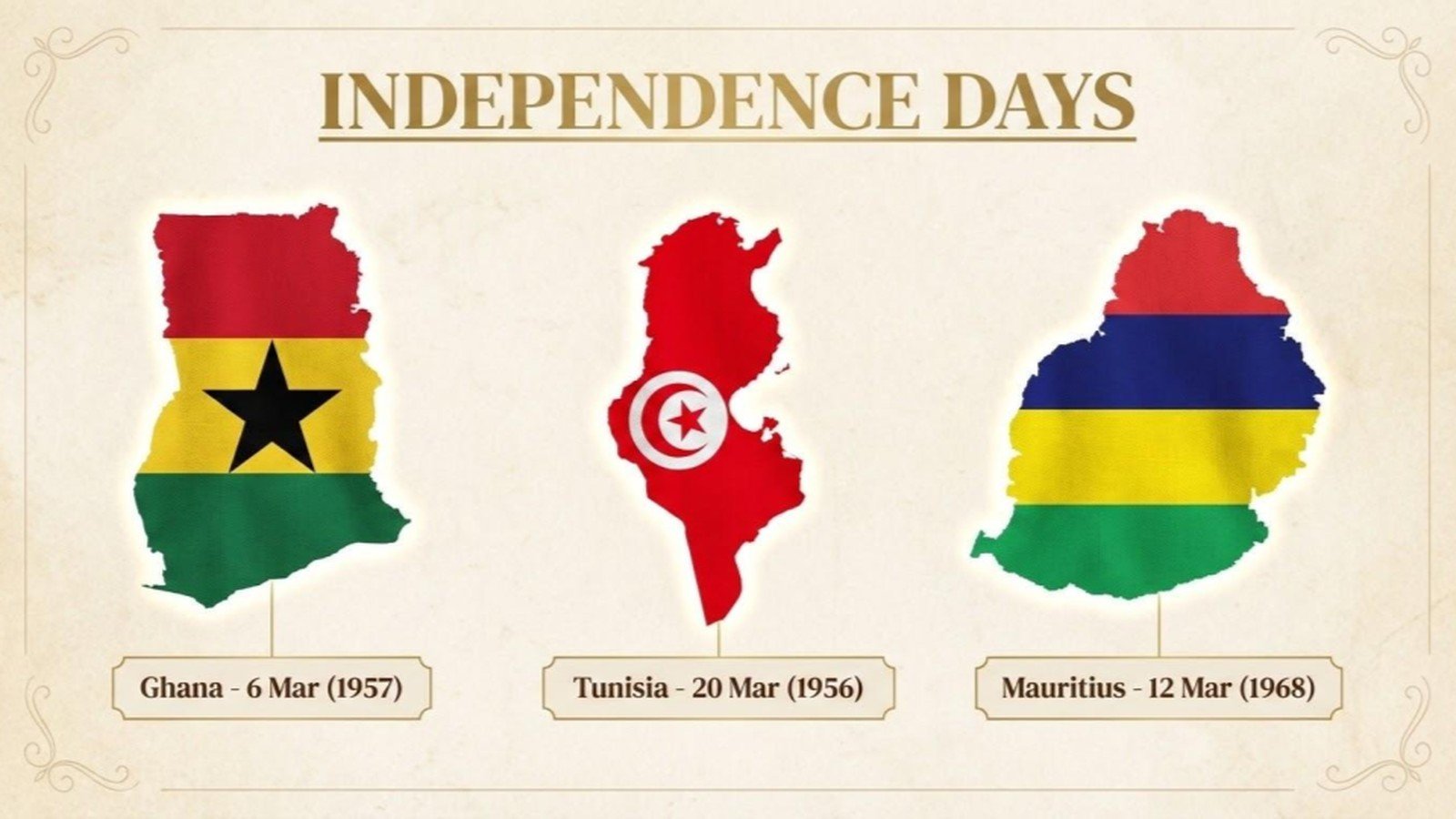
March carries a particular weight on the African calendar. This month, three countries mark their independence: Ghana on 6 March, Mauritius on 12 March, and Tunisia on 20 March. Three different trajectories, three different relationships with the idea of independence – and, taken together, three different angles on a question that has not yet been fully answered.
This is the third post in this series. The first, published on 1 March, was titled "Three Battlefields, One Struggle" – an examination of how the liberation struggle was contested simultaneously on political, cultural, and economic terrain. The second, published on 8 March, was titled "The Stage Was Also a Battlefield" – an account of how performance, art, and cultural expression became instruments of both resistance and the construction of identity, as well as an act of affirming the humanity of the oppressed.
Each post has tried to move the conversation away from ceremony and toward the harder questions that independence raises. This one does the same, but through a specific lens: what happens in the years and decades after independence is won.
Ghana anchors this argument. Not simply because 6 March falls first on the calendar, but because what Ghana did in 1957 changed the terms of possibility for the entire continent. It was the first country in sub-Saharan Africa to break free from colonial rule. In doing so, it demonstrated to every colonised people still under European authority that decolonisation was achievable – through mass organisation, disciplined politics, and the refusal to accept a colonial timetable. The proof of concept mattered. What followed, for Ghana and for the continent, is the substance of what this post examines.
On the morning of 6 March 1957, Kwame Nkrumah stood before a crowd in Accra and did two things simultaneously. He ended the Gold Coast. And he began Ghana.
But, Nkrumah did more than that: he proclaimed that Ghana's freedom was intricately linked with that of Africa as a whole. Until the latter was achieved, the former was unsafe and could not be fully and permanently guaranteed. He cast his eyes across the continent-wide struggle for independence and could foresee, and foretell, that Africa's genuine independence depended on that of all her nations and peoples, not just a single country.
Towards this effect, he believed that while Ghana was now an independent zone of humanity, it was also the launching pad from which to support all other struggles of other nations for their independence.
His prophetic words that, "Our independence is meaningless unless it is linked up with the total liberation of Africa", would echo across the continent and serve as a clarion call for all independent States to support the struggles for independence, whatever the sacrifices required.
This distinction between the Gold Coast and Ghana matters more than the ceremony. The Gold Coast was not a country. It was a colonial, exploited, commercial label. Portuguese sailors arrived on that Atlantic shoreline in 1471 and named what they found after what they intended to take. They did not see, or recognise, the people, the kingdoms, the languages or the political structures that had organised life there for centuries – only the commodity. For nearly five centuries, through Portuguese, Dutch, and finally British colonial rule, that extraction-invoice served as the territory's identity in the world.
These settlers sought to destroy the people, the kingdoms, the languages, the culture and the political structures they found in order to advance the colonial-imperialist agenda. Colonialism, and its offspring, neocolonialism, do not see us as a people with a culture, heritage and identity, but only as commodities to be exploited and cast aside once their exploitative value is complete.
The name that replaced it was proposed by J.B. Danquah – scholar, lawyer, and one of the independence movement's founding architects – and adopted by Nkrumah. It invoked the medieval Ghana Empire, which had flourished between roughly the ninth and thirteenth centuries as one of the great powers of West Africa, controlling trans-Saharan trade and exercising political authority across vast territories. Here is the fact that deserves to be stated plainly, because it is what makes the naming significant rather than merely symbolic: the medieval Ghana Empire was not located in present-day Ghana. It flourished in what is now southern Mauritania and western Mali – several hundred kilometres northwest of the modern state's borders. The word Ghana itself was not a place-name but a royal title – meaning something close to warrior king or war chief – given to the rulers of an empire whose own people called it Wagadu.
Nkrumah and Danquah knew this. The geographical distance was the point, not a problem. Ghana – the name – was the refusal of the Gold Coast's premise. It located this new country not in a European inventory of extractable commodities but in the older, deeper story of African civilisation, statecraft, and political thought. Ghana was not a backward focus, but drawing on the people's rich heritage in order to forge ahead into a brave future. The colonial name said: this territory is a coastline with a commodity. The new name said: this is a country with a rich past.
In the decade that followed, the argument spread. The former French Soudan became Mali in 1960, invoking the medieval Mali Empire that had succeeded the Ghana Empire in the same region. The former Rhodesia became Zimbabwe in 1980, its name drawn from the great stone architecture of the pre-colonial Zimbabwean plateau. Each renaming was a version of the same assertion: the colonial name was not the country's real name, and independence meant recovering the authority to name oneself.
The Coastline Before the Ceremony
To understand what Nkrumah was actually speaking about in Accra that morning, it helps to stand first on the coastline that made the speech necessary. Along Ghana's Atlantic shore, more than forty castles and forts were built – not by Ghanaians – beginning with Elmina Castle, constructed by the Portuguese in 1482 as São Jorge da Mina: the oldest surviving European building in sub-Saharan Africa. Cape Coast Castle was built by Swedish traders in 1653, passing through Danish and Dutch hands before the British took control in 1664. In the eighteenth century it became one of the most significant slave trading posts in West Africa. Dungeons capable of holding hundreds of captives at a time were built beneath the European quarters. The Door of No Return – the passage from the dungeon directly to the waiting ships – is still there.
For well over a century, the Gold Coast coastline served as a primary centre of British slave trading. Estimates from the Trans-Atlantic Slave Trade Database place the total number embarked at approximately 12.5 million people – of whom approximately 10.7 million survived the passage to the New World. The human traffic moved through dungeons built into the geography of what would one day be Ghana. When Britain abolished the trade in 1807 – not slavery itself, but the trade – Cape Coast Castle was repurposed as an administrative and educational centre. The infrastructure of extraction simply shifted its object. The stone walls were the same. The relationship of power they encoded was the same. Only the commodity had changed. The Dutch abolished their participation in 1814 and 1815. By 1872, Britain had consolidated control of the entire Gold Coast. And there the territory remained – a colony – for the next eighty-five years.
The Struggle: From the Accra Riots to the First Independent State in Sub-Saharan Africa
The independence movement that Nkrumah came to lead emerged from a structural rupture: tens of thousands of Gold Coast men had fought for Britain during the Second World War – in East Africa, in Burma – in a conflict fought, among other things, in the name of freedom. They returned to a colony. They returned to restricted movement, economic marginalisation, and an administration that had intensified extraction in the post-war period. The promised political reforms were minimal. The cost of living had risen. Employment was scarce.
On 28 February 1948, a group of ex-servicemen organised a march in Accra to present a petition to the Governor. Police opened fire. Three men were killed. The march had been orderly. What followed was not: riots spread across the territory. The British arrested six nationalist leaders – the Big Six – including Danquah and Nkrumah, who had returned from twelve years of study in the United States and Britain the previous year. The unintended consequence was to make them, and the cause they represented, more credible than before.
Nkrumah had arrived as secretary of the United Gold Coast Convention (UGCC) – an organisation of professionals seeking self-governance "in the shortest possible time," a phrase that concealed a gradualist accommodation with the colonial timetable. In June 1949, after his release, he founded the Convention People's Party, having been disillusioned with the slow progress made by the UGCC. This party's slogan admitted no ambiguity: Self-Government Now. Where earlier organisations had drawn from an educated elite, the CPP built from ordinary working people – market traders, artisans, junior civil servants, teachers. His Positive Action campaign of 1950, modelled on Gandhian non-cooperation, brought the colonial economy to a halt. He was imprisoned again in January 1950. In February 1951, elections were held under a new constitution. The CPP won thirty-four of thirty-eight contested seats. Nkrumah won his own constituency from his prison cell. The British released him and asked him to form a government.
Six more years of constitutional negotiation followed. On 18 September 1956, Britain confirmed that independence would be granted on 6 March 1957 – a date chosen to coincide with the 113th anniversary of the Bond of 1844, the agreement by which the Fante chiefs had first entered into a relationship with the British Crown. The irony of the date was noticed. When Ghana became independent that morning, it was the first country in sub-Saharan Africa to break free from colonial rule.
The Continental Moment
Nkrumah understood immediately what this meant beyond Ghana's borders. "Our independence is meaningless," he told the crowd that night, "unless it is linked up with the total liberation of Africa." This was not rhetorical flourish. It was a strategic statement of intent. Ghana was to be a proof of concept – and a base of operations. Among those in Accra for the ceremony was Martin Luther King, twenty-eight years old and fifteen months out of Montgomery, invited by Nkrumah. He watched the British flag come down and the Ghanaian flag – red, gold, green, and the Black Star – go up, and said on his return that it reminded him a people can break from oppression without violence. The proof worked. In 1960 – the Year of Africa – seventeen countries became independent in a single calendar year. Harold Macmillan gave his Wind of Change speech to the South African Parliament in February of that year. The continent that had been almost entirely colonised in 1957 had over forty independent nations by the end of the decade.
What followed within Ghana was more complicated, culminating in the toppling of Nkrumah on 24 February 1966 through a coup, while he was abroad. He went into exile in Guinea and died in Bucharest in April 1972.
What Ghana's arc demonstrates, across the longer view, is that none of this was the end of the story. By the 1990s, Ghana had re-established itself as one of the more stable democracies on the continent.
Tunisia: What Citizens Can Construct – and What Must Be Defended
A Roman senator, Cato the Elder, is renowned for having ended every speech in the Senate with the phrase "Carthago delenda est" ("Carthage must be destroyed"). This relentless call for annihilation culminated in the Third Punic War (149–146 BCE), which ended with the complete destruction of Carthage, a city founded around 814 BCE on the coast of what is now Tunisia, by the Roman general Scipio Aemilianus.
Carthage was a major maritime and commercial empire, dominating trade in the western Mediterranean, with colonies in Sicily, Sardinia, Corsica, Iberia, and North Africa. However, from 264 BCE it got into relentless conflicts and wars with Rome, culminating in the First Punic War (264–241 BCE), then Second Punic War (218–201 BCE) and Third Punic War (149–146 BCE).
During the Second Punic War, the famous Carthaginian general Hannibal Barca famously crossed the Alps with elephants and nearly brought Rome to its knees, winning major victories like Cannae. He laid siege to Rome for over a decade, shattering the myth of Roman invincibility. Yet, Carthage refused to send reinforcements and he was ultimately recalled back to Carthage when Rome, led by Scipio Africanus, eventually counterattacked, in what would be Hannibal's final showdown with Rome. He would suffer defeat at Zama in 202 BCE, after years of war, supported by a weakened cavalry. After three years of brutal fighting, Carthage was captured in 146 BCE.
After the Second Punic War, Carthage lost its overseas territories, its navy, and became a Roman client state. Carthage had recovered economically but remained militarily weak.
However, following the Third Punic War, the Romans systematically destroyed Carthage, burning the city down and sending its survivors into slavery. Carthaginian territory became the Roman province of Africa. The obliteration of Carthage remains one of antiquity's most stark examples of genocide and the brutal finality of Roman imperial policy.
Tunisia gained independence from France on 20 March 1956 – almost one year before Ghana's. Tunisia's independence marked an end to almost a millennium-long struggle for total independence going back to the prehistoric siege of Carthage.
What makes Tunisia instructive for this argument is not 1956 but what happened more than half a century later, when its citizens demonstrated something independence alone cannot provide: the capacity to construct democratic institutions from below, under pressure, through genuine deliberation.
On 17 December 2010 at 11:30am, a single act of public protest against economic humiliation in a provincial town of Sidi Bouzid where a street vendor deliberately set himself on fire and died - aptly called the Arab Spring - became the catalyst for a political shift that spread across North Africa and the Middle East. At its Tunisian origin, the uprising was a civic refusal – an assertion that the existing terms of the arrangement were unacceptable. People said no. What Tunisia did with that opening was, for a time, genuinely remarkable. A broad coalition – political parties, trade unions, human rights organisations, and religious groups that agreed on very little else – negotiated a new constitutional settlement together. The 2014 constitution was not delivered from above. It was constructed through the kind of painstaking civic labour that rarely earns international headlines but constitutes the actual substance of democratic self-governance. The Nobel Peace Prize in 2015 went to the Tunisian National Dialogue Quartet – the civil society formation that held the process together when it threatened to fracture. For a period, Tunisia was held as the exception: the one Arab Spring transition that had held.
Then, by 2021, executive power had been concentrated, parliament suspended, and the constitutional architecture the country had so carefully constructed was being revised on terms that bore little resemblance to the original settlement. Democratic achievement, it turns out, is not self-sustaining. It requires the same quality of organised civic attention that built it: persistent, vigilant, and capable of resisting not only obvious threats but incremental ones. Tunisia is not a story of failure. It is a story about what is genuinely at stake, and about who carries the burden of keeping what has been built. That lesson travels beyond North Africa.
Mauritius: The Argument No Structural Condition Predicted
Mauritius marked its independence on 12 March – three days before this piece is published. The proximity is appropriate. Mauritius carries the argument in this series that is hardest to dismiss.
When the island gained independence in 1968, almost nothing in its circumstances predicted what would follow. No oil. No strategic minerals. A small population whose very presence was rooted in the labour histories of colonialism. Geographic isolation in the Indian Ocean that was more liability than asset. The structural criteria development economists use to forecast institutional outcomes gave Mauritius no obvious advantage.
What it built over more than five decades and multiple changes of government – through deliberate, repeated political choices rather than structural inheritance – was a functioning multi-party democracy with consistent peaceful transitions of power, an independent judiciary, and a human development trajectory that has placed it consistently among the strongest governance performers on the continent. The restraint this required – choosing to protect the institution rather than exploit the political moment, election after election, government after government – is what makes Mauritius the argument that larger and better-resourced states cannot easily explain away. If a small island with none of the conventional structural advantages could build and sustain this, the limiting factor elsewhere has not been history or resources or starting conditions. It was will. It was choice.
The Harder Question
Nkrumah posed it in Accra before independence could answer it: free from colonial rule – toward what?
Nkrumah has argued that Africa faces the spectre of neocolonialism after independence. Neocolonialism, his opinion, is more harmful than classic colonialism because it catches the hitherto oppressed with their guard down, whilst still celebrating the independence from direct colonial rule. It faces less resistance because its domination is masked by the façade of independence, making it harder to combat. For true liberation, African states must achieve not just political but economic self-determination, break from the capitalist world system, and unite continentally (through Pan-Africanism) to resist this external control.
Three anniversaries this month offer three partial answers at different stages of completion. Ghana opened the question, set the continental ambition, and demonstrated that decolonisation was achievable through mass organisation and disciplined politics – and showed, across the longer arc, that the building continues even after coups and reversals and the fall of the founding leader. Tunisia demonstrated that citizens can construct democratic institutions from below, under genuine pressure – and that those structures require sustained, organised defence, not merely the initial act of construction. Mauritius demonstrated that deliberate institutional choice, maintained consistently across generations and political cycles, can produce outcomes that starting conditions did not predict.
None of these is a completed story. Ghana's trajectory has included coups, reversals, and recoveries. Tunisia's constitutional project remains contested. Mauritius faces its own pressures. The point is not arrival. The point is the direction of travel, the choices that drove it forward, and the choices that allowed it to reverse.
For African states – South Africa among them – the question Nkrumah could not answer in Accra in 1957 remains open. It is answered, or left unanswered, not in declarations or ceremonies, but in the daily conduct of institutions, governments, and citizens about what they are willing to protect, and what they are prepared to let slide.
Three independences. The destination they were all pointing toward is still under construction. That is not a failure of the original vision. It is the work that continues.
“The future is not an accident.”
Dr Malusi Gigaba is a Scholar-Statesman, an ANC NEC Member, a former Cabinet Minister of the Republic of South Africa, a Member of Parliament, and a member of both the Joint Standing Committee on Defence and the Portfolio Committee on Trade, Industry and Competition.