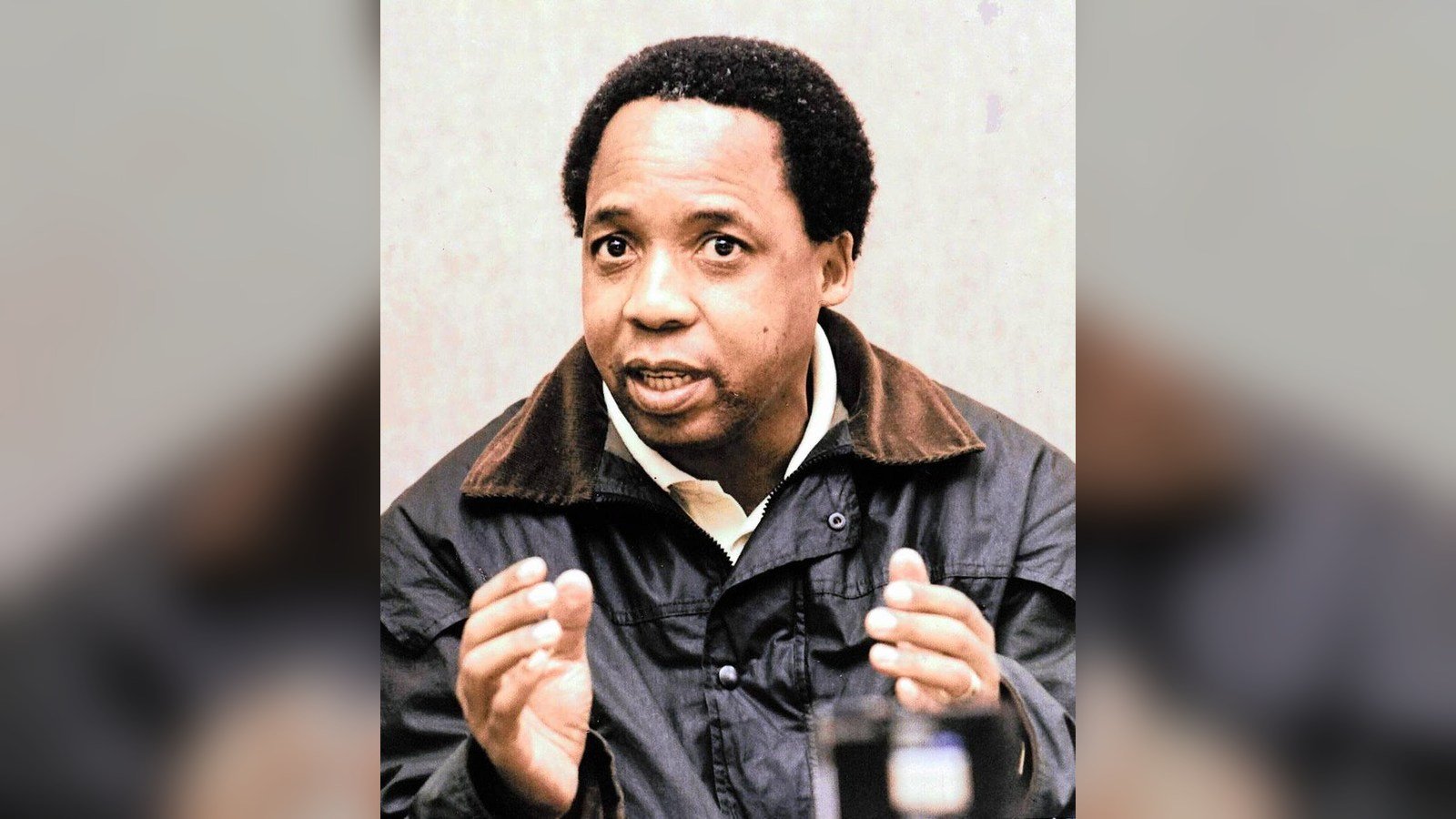
At approximately 10:15 on the morning of Saturday, 10 April 1993, Chris Hani was shot dead in the driveway of his home at 2 Hakea Crescent, Dawn Park, Boksburg. He had gone out in a tracksuit to buy a newspaper. The man who killed him was arrested within hours; the full circuitry of the conspiracy that put him there has, in the thirty-three years since, never been traced.
THE MAN WHO WAS KILLED
Martin Thembisile Hani was born on 28 June 1942 in Sabalele, Cofimvaba, in the Transkei. Sabalele, as President Mandela stated at his funeral on 19 April, was a place well-known, "Not for its beauty, but for its harshness. No running water. No electricity. No decent housing. Inadequate health care. Little formal education. Yet this small, virtually unknown village produced a Chris Hani, whose life shook the whole country and impacted on the world's stage."
He studied Latin and English literature at the University of Fort Hare, and left South Africa in the early 1960s after being charged for political offences and fleeing while on bail.
By the mid-1970s he was running an MK command base in Lesotho, from which cadres were reinfiltrated into the country in small, coordinated cells. He later succeeded Joe Slovo as Chief of Staff. On 8 December 1991, following Slovo's diagnosis with bone marrow cancer, he was elected General Secretary of the South African Communist Party.
None of these titles capture what he actually was by April 1993. He was the political figure whose credibility spanned two constituencies that were in genuine danger of parting ways: the negotiators at the World Trade Centre in Kempton Park and the township youth whose patience with the pace of transition was already exhausted. He was the bridge. The assassins understood this precisely. It is why they chose him.
THE MORNING OF 10 APRIL 1993
Janusz Waluś, a Polish-born immigrant and member of the Afrikaner Weerstandsbeweging, drove to 2 Hakea Crescent on the morning of 10 April 1993 and waited. When Hani returned from the shops, Waluś shot him four times with a .22 calibre pistol and drove away.
A neighbour, Retha Harmse, a white Afrikaner woman, saw Waluś's car leaving the scene and noted the licence plate number. She telephoned the police. Waluś was arrested within hours.
The investigation established that the killing had been planned in collaboration with Clive Derby-Lewis, a Conservative Party Member of Parliament, and his wife Gaye. At the Derby-Lewis home, police found a document, later recorded in the Truth and Reconciliation Commission archive as a "hit-list", containing the names of Nelson Mandela, Joe Slovo, Chris Hani, Mac Maharaj, Pik Botha, Justice Richard Goldstone, and the journalists Ken Owen and Tim du Plessis. The list was not aimed only at the ANC and the SACP. It was aimed at the architecture of the transition itself: politicians, jurists, and journalists whose removal was calculated to collapse the process.
Waluś and Derby-Lewis were convicted of murder and sentenced to death. The sentences were commuted to life imprisonment following the Constitutional Court's judgment in S v Makwanyane of 6 June 1995, which abolished the death penalty under the 1993 Interim Constitution. Derby-Lewis died in prison in November 2016. Waluś was granted parole by the Constitutional Court in November 2022, after four prior refusals by successive Ministers of Justice, released on 7 December 2022, and deported to Poland the following year.
THE ADDRESS THAT KEPT THE COUNTRY FROM BURNING
Within hours of the assassination, South Africa's townships were preparing to explode. The political situation was, by every account of those who were managing it, in genuine danger of collapsing into violence on a scale that would have ended any possibility of a negotiated transition.
Nelson Mandela addressed the nation on SABC. The speech he gave is one of the most consequential pieces of political communication in South African history. He said:
Tonight I am reaching out to every single South African, black and white, from the very depths of my being. A white man, full of prejudice and hate, came to our country and committed a deed so foul that our whole nation now teeters on the brink of disaster. A white woman, of Afrikaner origin, risked her life so that we may know, and bring to justice, this assassin.
The structure of that address is a masterclass in political communication under conditions of crisis. Mandela did not reassure the country that nothing was wrong. He insisted that what was wrong had a specific address, and that the address was not "white South Africa." By naming Retha Harmse in the same breath as Janusz Waluś, he refused the false consolations of collective blame. The townships did not burn. The negotiations continued.
That act — reconciliation offered from the position of the wronged, at the moment of maximum provocation, by the leader of a movement that had every historical reason to withhold it, is the act that held the country together. It is also the act against which the decades since should be measured.
WHAT THE ASSASSINATION DID TO THE TIMELINE
Chris Hani's killing had an effect opposite to the one its planners intended. But the political atmosphere in the hours and days that followed was not best described as grief. The closer word was fury.
The mass outpouring of grief was the visible half of what needed to be named. The harder half was the rage that ran beneath it. Across every township in South Africa (from Soweto to Langa, from Mamelodi to KwaMashu, from Duncan Village to Kagiso) Black South Africans understood immediately what had happened and what it meant. Chris Hani was not simply a leader of the liberation movement. He was one of them in a way that few other figures in the ANC or the SACP had managed to be: the man from Cofimvaba who had come up through the same conditions they had come up through, who had spent three decades in the bush and in the underground so that the negotiations they were now watching on television would have somewhere to go. The assassins had not killed an abstraction. They had killed a brother.
What was gathering in the hours after 10 April 1993 would have been retribution at a scale South Africa had not seen since Sharpeville in 1960 or Soweto in 1976, and this time it would have been directed, organised, and unapologetic. For a generation of young Black South Africans, the moral question of whether restraint was warranted had been settled long before 10 April. What remained was the tactical question of whether restraint was still possible. By the afternoon, in many centres, the answer had already tipped toward "no."
In July 1993, the Multi-Party Negotiating Forum announced that South Africa's first democratic election would be held on 27 April 1994, a date set, in part, to demonstrate that the transition was real, that it had a timetable, and that the threat of violent disruption would not be allowed to derail it. On 17 November 1993, the Forum's plenary endorsed the interim constitution; on 22 December 1993, Parliament approved it; on 27 April 1994, it came into force, and millions of South Africans voted for the first time in their lives. The architecture that Constitution carried, a justiciable Bill of Rights, an independent Constitutional Court, sunset clauses for civil servants and the security forces, and a Government of National Unity structure: reflected the political pressures of the moment. These were compromises. They were made, in part, by the need to hold the centre together after 10 April 1993.
RECONCILIATION OFFERED. RECONCILIATION NOT RETURNED.
The architecture that emerged from April 1993 was built on an asymmetry. On one side: the SABC address, the funeral at FNB Stadium, the leadership choice to hold the line rather than avenge the loss, and the patience that let the negotiations continue. On the other side: a Commission finding that could not complete itself, a plea of remorse the family rejected, and a case closed before its questions had been answered.
The Truth and Reconciliation Commission stated that it "was unable to find evidence that the two murderers convicted of the killing of Chris Hani took orders from international groups, security forces or from higher up in the right-wing echelons." That is the formal finding. It is also an acknowledgement of what the Commission could not establish.
In 2024, a retired Judge of the High Court, Chris Nicholson, published a book titled Who Really Killed Chris Hani?, in which he argued, with reference to documentary material, that the real plotters behind the murder were never caught. Nicholson draws specific attention to the registered owner of the vehicle Waluś drove on the morning of the murder, a businessman named Peter Jackson, and to an instruction found in the security police case file stating that Jackson should not be followed up. A retired Judge of the High Court, writing with access to the record and in his professional capacity as a former adjudicator, has concluded in print that the circuit of the conspiracy was never closed. That is not a marginal claim, and it ought not to be treated as one.
The parole proceedings sit inside the same asymmetry. The Constitutional Court, in November 2022, found that the Minister of Justice's repeated refusal to grant Waluś parole was legally irrational, and ordered his release. Waluś had, by that point, formally expressed remorse, and that expression had been accepted by the Minister as sufficient for the purposes of the parole test. The Hani family has consistently and publicly maintained that the expression was not sincere. The Court's judgment turned on the legal question of rationality, not on the human question of sincerity. These are different tests. Waluś was released, deported, and is now a free man in Poland. Chris Hani remains where he was left on the morning of 10 April 1993.
This is not an argument against the Constitution. It is an argument about what was asked of one side, and what was not asked of the other. A generation of Black South Africans have been making this observation with increasing clarity, and they have been correct to make it. Reconciliation, to be real, cannot be the sole burden of the wronged. The record must be closed. The truth must be told in full. The remorse, if offered, must bear the weight of what was done.
THE ARCHITECTURE OF FORGETTING
The Hani family's concern goes beyond the parole decision. The family's objection to the commemoration of Chris Hani's 33rd assassination anniversary days ago can be seen as a symptom of a larger national habit, accumulated over three decades, the reduction of liberation thinkers to liberation symbols, the preservation of the name, the photograph, and the street, and the quiet discarding of the content. Chris Hani has been remembered primarily in that reduced form: as a photograph, a date, a piece of street nomenclature, a municipality. He was not primarily that.
The question South Africa has not yet answered is how it intends to immortalise the memory of its freedom fighters – its heroes and heroines – in ways that elevate their memories and legacy beyond mere symbols, into substantive arguments about the country's desired future. The narration and interpretation of the memory of liberation figures has, over three decades, drifted steadily toward a register that converts anti-apartheid, anti-colonial, anti-imperialist radicals into softer versions compatible with liberal reforms. That drift is not accidental, and it is not neutral. It serves a reading of South African history that the record does not support.
THE COUNTERFACTUAL: BREAD AND FREEDOM
Hani's analysis of the relationship between national liberation and economic transformation was among the most sophisticated available in the South African political tradition. It is worth setting one passage of it on the page. In a speech widely attributed to 1991, he said:
We do not want freedom without bread, nor do we want bread without freedom. We must provide for the material and spiritual needs of our people. We want to be a free people, but we want to be a people with food and clothing, with decent homes, with a good education and a health service available to all.
The second sentence of that passage is the one that has been most consistently set aside. Measure it against the present record. South Africa today carries a Gini coefficient of 0.67: the highest recorded inequality of any country in the world for which the World Bank holds comparable data. Official unemployment at the end of the second quarter of 2025 stood at 33.2 percent. Youth unemployment, the 15-to-24 age cohort whose parents watched Chris Hani buried, stood at 62.2 percent. These are not figures that measure the absence of political freedom. They measure the presence of political freedom alongside the absence of the material conditions that Hani insisted were inseparable from it.
This was no accident. Following the famous 1969 Morogoro Conference, the ANC adopted the Strategy and Tactics document in which the relationship between national liberation and economic emancipation was most clearly laid bare. In that document, the ANC made clear that national emancipation without economic emancipation would be hollow and would not amount to even a shadow of liberation.
To ask what kind of South Africa might exist today if Chris Hani were alive is not to indulge the speculative luxury of counterfactual history. It is to ask a narrower question: what political function was lost when he was killed? The answer is specific. What was lost was the voice that would not have permitted the conversation about freedom to separate from the conversation about bread. It has not been replaced.
Hani's assassination was premeditated in every respect, and not only by Waluś or his immediate accomplices. Those were the hands that held the weapon, but the question of who commissioned the assassination has never been answered, and the passage of time does not close it.
The question of who benefited from the removal of the most credible voice linking liberation to economic transformation deserves to be asked. As scholars from Sampie Terreblanche to Hein Marais have documented, the structural economic architecture of apartheid was not dismantled by the political transition. The forces that sought to protect existing economic power in the transition, forces that have elsewhere been described as "white monopoly capital" (WMC), had the clearest strategic interest in a future without Chris Hani. That is not an accusation. It is an observation that has not been adequately examined.
The economic continuity between the apartheid and post-apartheid periods is not a matter of opinion; it is a matter of record. The multi-class nature of the liberation movement made it vulnerable to co-option by interests whose stake in the new order was the preservation of the old one's economic arrangements. The result, as the literature on South Africa's political economy has documented extensively, is a system in which a new elite has been absorbed into existing structures of accumulation: at the expense of genuine economic transformation.
The political function that was lost when Chris Hani was killed, the voice that insisted freedom and bread were inseparable, has not been replaced. Those who have attempted to occupy that space since 1994 have found it a dangerous place to stand. The question of why that should be so has not been answered.
THE CONTESTED GROUND OF COMMEMORATION
On 8 April 2026, two days before the 33rd anniversary of Hani's assassination, the annual wreath-laying ceremony at his gravesite in Elspark, Ekurhuleni, was abandoned. The Hani family left the site before the proceedings concluded, citing concerns, which the family has raised publicly since 2025, about the form the ceremony had taken under the stewardship of local party and municipal structures. The family's stated position is that the character of the commemoration had drifted from what they consider dignified and consistent with the legacy of the man being remembered.
This post is not the place to adjudicate that dispute. But the fact that the ritual itself has become contested — that the widow of Chris Hani has found it necessary, in public, to ask that her husband's grave be protected from choreography the family did not sanction, is a painful measure of a larger problem. The inheritance has become contested because the inheritors have not agreed on what was inherited.
The murder of Chris Hani was intended to break something. What it actually broke was the timeline. The right wing's calculation — that the removal of the bridge between the negotiators and the township youth would produce chaos sufficient to derail the transition: underestimated both the discipline of the liberation movement's leadership and the political intelligence of Nelson Mandela in particular. That calculation has been noted. It has not been fully reckoned with. The record of who ordered the killing is still not closed. The reconciliation that was asked of the wronged majority has not been fully returned by those from whom it was owed. And the analytical voice Hani brought to the question of what freedom required (freedom and bread, together, without separation) has not yet found its successor.
South Africa's democracy was built, in part, on the site of Chris Hani's death. To take the Constitution that emerged in 1996 seriously is to take seriously what was invested in it. What was invested was not abstract. It was a specific man's life, ended in a driveway in Boksburg, on a Saturday morning, with a newspaper.
“The future is not an accident.”
Dr Malusi Gigaba is a Scholar-Statesman, an ANC NEC Member, a former Cabinet Minister of the Republic of South Africa, a Member of Parliament, and a member of both the Joint Standing Committee on Defence and the Portfolio Committee on Trade, Industry and Competition.