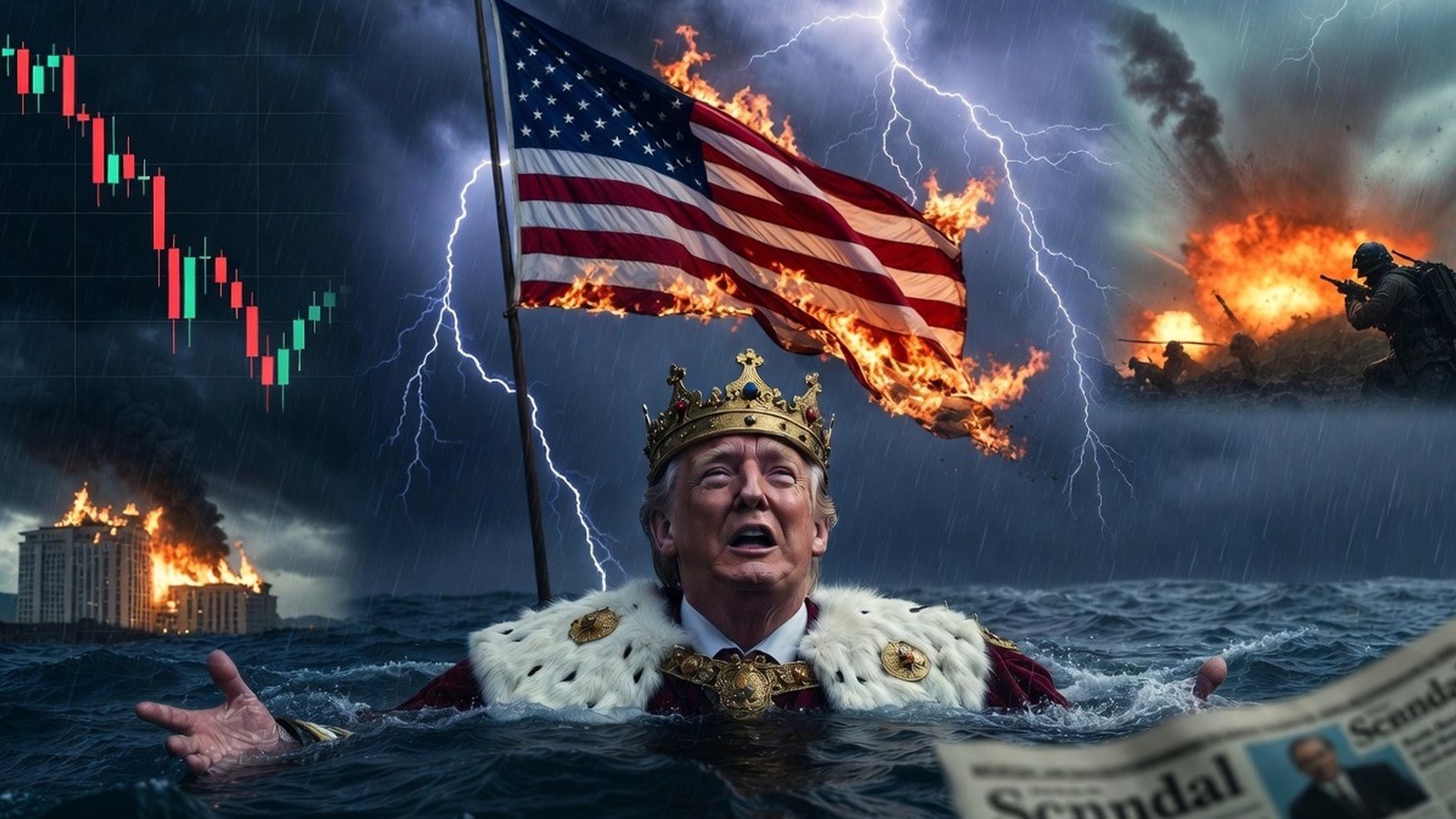
The criminal attack on Iran, coinciding as it did with the sacred dawn of the holy month of Ramadan, has cast a stark and revealing light. It illuminates not merely another spike in the persistent fever chart of global geopolitical risk, but something far more profound and perilous: the unchecked dangers of imperialist arrogance and impunity in its final, most volatile phase. This act, shrouded in the familiar fog of war, is not the bold stroke of a confident hegemon, but the desperate flailing of a waning power, one whose internal moral and political decay now directly fuels global instability.
At the helm of this decline sits the current administration in the United States, arguably the crassest in modern memory in its open embrace of racism, sexism, religious fanaticism, and all forms of bigotry. This is not an incidental detail but a core driver of its foreign policy.
As it declines, the biggest concern among the global capitalist class must be stark spectre of the decline of both the Western economic power and hegemony, and the probability of its replacement by the confluence of southern (embodied in BRICS) hegemony. The US administration represents the desperate organisational and ideological mechanism through which the imperialist bloc is engaging with this fast-advancing eventuality.
They have clearly opted for an aggressive form resistance, since they currently do not enjoy the strategic initiative. As deplorable as it might be among the more sane and sensible members of this bloc, the US administration in the long-run, even in the short-to-medium term, is a bulwark of their interests, an epitome of their will to fight to the death for survival, regardless of the havoc, even to human life, that they might in the process cause.
Like how the advocates of Afrikaner nationalism used culture, identity and religious fervour as a tool to unify a poor, divided Afrikaner people into a powerful political and economic force in favour of the capitalist class and, through privileges, the white working class, the rabid right in the US is using religious fanaticism, white culture and identity both to defend Western economic, political and cultural dominance, as well as to benefit, in particular, the super-rich.
Imperialist powers are renowned for their long-term strategies to ensconce their political and economic, as well as military, power and influence over large parts of the world, and over a long period. In that effort, they utilise all these instruments with equal measure, in different regions, towards the same end.
Reagan's diplomacy with Gorbachev helped create the conditions for the Cold War's end before he left office in January 1989, and the continuity of his successor, George H.W. Bush, saw the Wall's fall in November 1989. It was during Bush's era when Gorbachev was given the assurance that NATO would not expand "not one inch eastward." This guaranteed Russia's uneasy acceptance of the changes that would take place in the knowledge that NATO would not infringe their sovereignty. That assurance was never codified in a binding treaty, which is precisely what enabled its subsequent violation.
Whilst extending NATO membership to Ukraine was not extended during Trump's term but during Joe Biden's, the difference between Reagan's and Trump's approach in seeking to extend US dominance and influence is glaring. Reagan, and all US Presidents, have always sought to enlist the support of their EU allies in their ambitions, even during the infamous Iraqi invasion on the basis of falsehoods. This unilateralism of the current regime in Washington has taken even the EU by complete surprise, threatening even to usurp their own territory - Greenland.
The current Washington strategies are short-termist, and will inexorably result in exactly what they are hoping to avert - reshaping of the global economy in favour of China, the US' biggest rival. It can be expected that China will win this phase without lifting a finger, or pulling any trigger. While the US continues to expend its already heavily strained resources on funding wars, nose-led by the Israeli far-right war-mongers, China continues on the other hand to invest in more infrastructure, industrialisation and modernisation, which expands even further its already vast capital.
While all previous global empires emerged from wars, China is a global power emerging from peaceful pursuits, exploiting wars fought by others in other countries, whilst denying its pursuit of empire. Where the US throws its weight around the world, bullying countries into subordination, China pursues economic cooperation and strategic partnerships with other countries.
Even G7 countries have recently been leading high-powered delegations to Beijing, and India, to seek economic cooperation and strategic partnership opportunities, to the great annoyance of the bully across the Atlantic.
A government that traffics in division and demonisation at home cannot craft a foreign policy of nuance or peace abroad. Its worldview is reductionist, built on "us versus them," a framework that perfectly serves the oldest of imperial tricks: shrouding scandal in war and conflict. When domestic failures mount - Epstein files, when political fortunes wane - impending mid-term electoral losses, the drums of foreign confrontation beat louder. This is an old US trick when faced with domestic scandals and rising domestic political pressures; it wages wars abroad.
Of course, this has, in this instance, been worsened by a fellow crass and equally baneful administration in Israel, hellbent on defying all international pressure and conducting, with impunity, a war of hatred against the Palestinian people and decimation of Iran so that they achieve their infamous vision of "a greater Israel".
The timing of the attack on Iran, an affront to the religious sensitivities of over a billion Muslims, is no accident but a feature of this crass calculus, signalling a disregard that fuels the very grievances it claims to manage.
This is the strategy of a waning imperialist power still desperately pursuing relevance and dominance. Unable to compete on the strength of its example or the integrity of its alliances, it reverts to the blunt instrument of military force and covert action. It is a power that increasingly takes advantage of existing and heightening global tensions, not to resolve them, but to navigate and exploit them, ensuring it remains the indispensable – if resented – arbiter.
In this dangerous game, every regional rivalry and sectarian tension becomes a potential lever to pull, a distraction to deploy, a market for its arms, and a justification for its enduring presence.
What should be even more disconcerting is the fact that whilst attacking Iran and undermining the established international rules and norms, such as those espoused by the United Nations, World Trade Organisation, to mention but a few, this administration embarks on these destabilisation charades with no endgame in mind.
After attacking Venezuela and abducting its President and his wife, killing some of their nationals and undermining its sovereignty, the Trump administration had no idea what should happen afterwards, as those it had hoped would join the Board of Looting of Venezuelan oil refused to partake in the act. They have captured President Maduro, but the political administration in Venezuela remains intact, and still loyal to President Maduro.
In actual fact, the so-called Global Board of Peace was Trump's pathetic attempt to galvanise, post-facto, a multilateral consensus for his violation of Venezuela's sovereignty from like-minded would-be looters. In both Venezuela and Iran the US has acted unilaterally to destabilise oil-producing countries for its own interests. Both violations were meant to effect "regime changes", but in both instances these attempts have failed dismally.
After launching a surprise and criminal attack on Iran, and killing the Supreme Leader, many among his family and over 150 innocent school girls, destroying Iranian infrastructure, the Iranian leadership remains intact and will instal a new Supreme Leader to carry forward the vision of his predecessor. Iran remains steadfast in its refusal to bow down to the US.
Iran now even refuses to negotiate any further with the US, given that the US has attacked them twice during the past year while they were in the midst of negotiations, in both instances at the behest of apartheid Israel which dictates US foreign policy.
Instead, attacking Iran has led to destabilisation of other Gulf Countries, which is inexorably going to increase antipathy towards the US in the region and insecurity in the US. Furthermore, this is going to destabilise and disunite the Middle-East as many ruling elites in the region are made to account for their tacit support for the US.
Imperialism employs force, deception and looting in order to pursue its global accumulation process. For, at the very heart of global destabilisation through war are the selfish interests of the military-industrial complex (MIC), which refers to the close, often opaque relationship between a nation's military, its defence industry, and the political system that supports them. The concept highlights how these interconnected entities can mutually benefit from sustained military spending and conflict, potentially influencing public policy toward perpetual war preparedness.
Money and banking are at the very heart of the military-industrial complex. They provide the loans and investments it needs to run, and push it to focus on profits. In exchange, the military sector gives bankers a safe, government-backed place to make high returns, which helps stabilise their investments. This partnership between war, government, and finance is a very powerful part of modern capitalism.
As U.S. President Dwight D. Eisenhower warned in 1961, the MIC could exert "unwarranted influence" in the US, threatening democratic processes and peaceful priorities and, dare we add, global stability prospects.
The consequences of this arrogance are straining the very foundations of the post-war order. Old alliances are strained, but they will not break just yet. Partners in Europe and elsewhere watch with deepening unease, caught between a habitual loyalty and a growing recognition of the reckless path being charted. They offer tepid, qualified support, their statements laced with calls for "de-escalation" that serve as silent rebukes to the provocations. The transatlantic bond, once monolithic, is now a network of fraying cables, groaning under the weight of divergent interests and moral discomfort.
We can anticipate that the current US administration will remain a destabilising and polarising force in the world. Its unilateralism and its being viewed as a henchman or proxy for the Netanyahu regime will not win it allies. It will become even more isolated.
Ultimately, this path leads not to renewed dominance, but to profound isolation. With each act of impunity, each violation of sovereignty wrapped in hypocritical rhetoric, the United States is isolating itself globally. It alienates the Global South, which sees a blatant disregard for international law and religious respect.
It frustrates its allies who seek stability, not perpetual crisis. It emboldens its adversaries who are presented with a perfect portrait of a hypocritical opponent. The world is not rallying to the flag of this new crusade; it is stepping back, calculating the costs, and beginning to imagine a system no longer centred on Washington's whims.
The attack on Iran during Ramadan is therefore a symbol and a symptom. It symbolises the impunity of a power that believes the rules — of war, of diplomacy, of basic respect — are for others. And it is a symptom of that power's decline, a thrashing attempt to prove vitality through violence. The world is left to navigate the fallout, to manage the heightened risks ignited by this arrogance, and to contemplate the urgent need for a more just and stable international order, one that must inevitably be built as this era of unaccountable imperialism writhes in its destructive twilight.
However, US's global dominance is neither permanent nor stable. Whilst its hegemony perpetuates unequal development, deepening the divide between core capitalist nations and the exploited peripheries of the Global South and perpetuating global conflicts, the possibility and prospects for a more equitable multipolar world order exist. We must look beyond the current chaos caused by greed. The Future Is Not An Accident.
“The future is not an accident.”
Dr Malusi Gigaba is a Scholar-Statesman, an ANC NEC Member, a former Cabinet Minister of the Republic of South Africa, a Member of Parliament, and a member of both the Joint Standing Committee on Defence and the Portfolio Committee on Trade, Industry and Competition.